
A pip in trading is the standard unit used to measure price movements in forex markets. Pip stands for “percentage in point” or “price interest point” and, for most currency pairs, represents the fourth decimal place of a price movement. For example, if GBP/USD moves from 1.2500 to 1.2501, it has moved one pip.
In spread betting, pips are important because they determine your profit or loss based on your stake size per point. Understanding what a pip is can help you calculate risk, position size and potential returns more accurately when spread betting on forex markets.
Forex traders and spread bettors use pips every day to measure market movements. Whether you’re trading GBP/USD, EUR/USD or USD/JPY, understanding pips is one of the first steps towards becoming a more confident trader.
If you’re new to forex spread betting, visit our comprehensive forex spread betting guide.
What Is a Pip?
A pip is the smallest standard price movement in most forex pairs. For the majority of currency pairs, one pip = 0.0001, ten pips = 0.0010, one hundred pips = 0.0100 and so on.
The following table illustrates an example of each:
| Currency Pair | Price Move | Pip Movement |
|---|---|---|
| GBP/USD | 1.2500 to 1.2501 | 1 pip |
| GBP/USD | 1.2500 to 1.2510 | 10 pips |
| EUR/USD | 1.1000 to 1.1100 | 100 pips |
| EUR/USD | 1.1000 to 1.2000 | 1000 pips |
This standardised measurement allows traders to compare movements across different forex pairs regardless of their exchange rate.

Why Are Pips Important in Spread Betting?
When spread betting forex, your profit and loss is typically calculated based on your stake size per point.
Every pip movement translates into a gain or loss depending on:
- Your stake size
- The direction of your trade
- The number of pips the market moves
Because forex markets often move by tens or hundreds of pips during a trading session, understanding pip values is essential for managing risk.
In my experience testing spread betting platforms, one of the biggest mistakes beginners make is focusing on the amount they want to make rather than the number of pips they’re risking. Professional traders typically think in pips first and pounds (or dollars) second.
How Does a Pip Work?
Let’s take a simple, real world example.
Assume GBP/USD is trading at 1.2500 and the market rises to 1.2515. The difference here is 15 pips. If you had placed a long spread bet, you would profit from those 15 pips. If you had placed a short spread bet, you would lose 15 pips.
The pip movement itself remains the same regardless of trade direction.
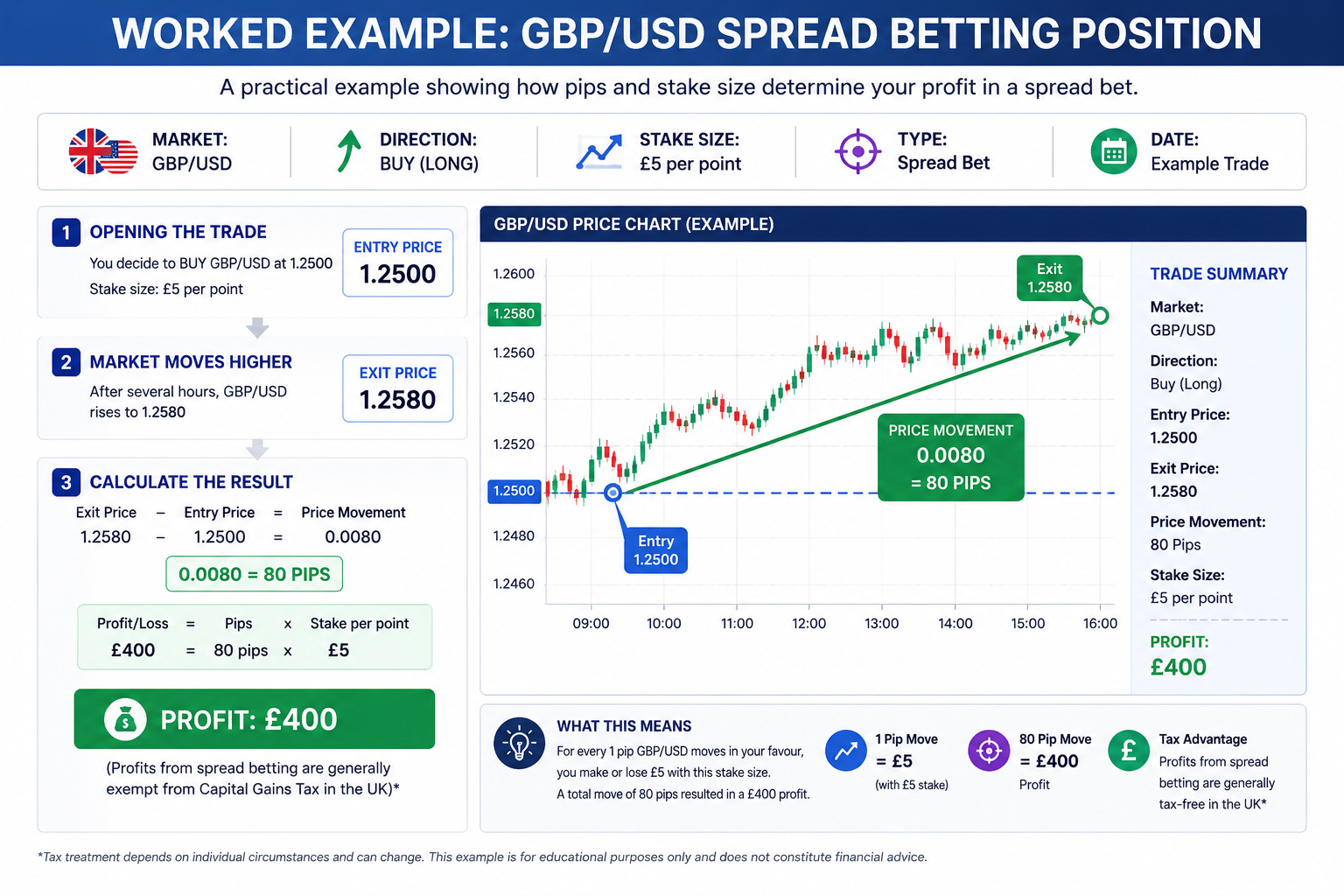
Worked Example: GBP/USD Spread Betting Position
Let’s walk through a realistic spread betting example.
Trade Setup
| Detail | Value |
|---|---|
| Market | GBP/USD |
| Direction | Buy |
| Entry Price | 1.2500 |
| Exit Price | 1.2580 |
| Movement | 80 pips |
| Stake Size | £5 per point |
Step 1: Opening the Trade
I decide to buy GBP/USD because I believe the pound will strengthen against the US dollar. My entry price is 1.2500 and I decide on a stake size of £5 per point.
Step 2: Market Moves Higher
Several hours later, I correctly predict a move higher by the GBP/USD, which trades up to 1.2580. The price movement has been 80 pips.
Step 3: Calculate Profit
To calculate my profit, I simply multiply the price movement in pips by my stake size.
Therefore, my profit is 80 pips × £5 = £400
Because spread betting profits are exempt from Capital Gains Tax (CGT) for the majority of UK residents, I would retain the entire £400, depending on my individual circumstances and tax status.
This is one reason forex spread betting remains popular among UK traders.
What Is a Pipette?
It is not uncommon for modern trading platforms to quote prices with an additional decimal place.
For example, the GBP/USD could be quoted as 1.25005 instead of 1.2500. The fifth decimal place is known as a pipette which is one-tenth of a pip.
| Measurement | Value |
|---|---|
| 1 pip | 0.0001 |
| 1 pipette | 0.00001 |
While a pip is typically the smallest price movement in most currency pairs, represented by the fourth decimal place, a pipette is a fractional pip, represented by the fifth decimal place.
Therefore, pipettes provide more precise pricing and tighter spreads on modern trading platforms.
Calculating Pip Value in Forex Spread Betting
In forex spread betting, your profit or loss is determined by how much you stake per point of movement in the market.
A point is typically equivalent to one pip in most currency pairs. For example, if you stake £5 per point on GBP/USD and the market moves 10 points in your favour, you would make £50 (£5 × 10 points). If the market moves against you by 10 points, you would lose £50.
Unlike CFD trading, where pip values depend on the number of units or lots being traded, spread betting platforms allow you to choose your stake directly. This could be £1, £5, £10 or more per point, depending on your risk tolerance and account size.
Coming from a forex CFD account, pip value per lot and stake per point are the same idea in different units; the converter below translates one into the other at a dated exchange rate.
Lots to stake per point
What a forex lot is worth as a spread bet stake
Exchange rates from the Fri 4 Sept 2026 5pm New York close
One standard lot of GBP/USD moves 10.00 USD per pip, which is £7.40 per point at the dated rate.
A standard lot is 100,000 of the base currency; a mini lot is 0.10 and a micro lot 0.01 of that. Spread bets are placed in pounds per point, not lots, so the stake figure is the one that goes on the deal ticket. On four-decimal pairs one point equals one pip; see what a pip is.
Do All Currency Pairs Use Four Decimal Places?
Most do but not all. One major currency that doesn’t use four decimal places is Japanese yen pairs, which are quoted to two decimal places. For example, GBP/JPY can be quoted as 198.50 instead of a currency pair like GBP/USD at 1.2500.
For JPY pairs, one pip = 0.01 while one pipette = 0.001.
So therefore, if the GBP/JPY moves from 198.50 to 198.60, the market has moved by 10 pips. The principle remains the same, but the decimal placement changes.
How Many Pips Does GBP/USD Move Per Day?
GBP/USD’s daily movement is a measurement, not a rule of thumb. The sizer below states the pair’s average daily high-to-low from our own dataset of daily bars, with the window it was measured over, and turns a stop set against that range into a stake per point.
Stake per point from your risk
Turn a money risk and a stop distance into a stake
Daily range window: 20 trading days to 28 Aug 2026
Risking £50.00 (1% of £5,000) with a 40-point stop on GBP/USD gives a stake of £1.25 per point. If the stop is hit you lose £50 plus the spread.
The 40-point stop is 69% of GBP/USD's average daily range, measured at 57.9 points over the 20 trading days to 28 Aug 2026. The same £50 risk with a stop the full width of that range is a stake of £0.86 per point.
Range is the average daily high-to-low over the stated window, from our dataset of daily bars (5pm New York day boundary). Stakes round down to the broker's £0.01 increment so the risk figure is never exceeded. A guaranteed stop holds the loss at exactly the stop for a premium; a normal stop can fill beyond it in a gap.
We hold no measured daily-range dataset for this market, so no range comparison renders. Stakes round down to the broker's £0.01 increment so the risk figure is never exceeded. A guaranteed stop holds the loss at exactly the stop for a premium; a normal stop can fill beyond it in a gap.
The reason this range is so large is that major economic events can create significantly larger moves such as Bank of England (BOE) interest rate decisions, US Non-Farm Payrolls, inflation reports and Federal Reserve announcements.
Understanding average daily pip movement can help you determine realistic profit targets and stop-loss levels.
How Do Pips Affect Risk Management?
Pips are incredibly important in managing risk while forex spread betting.
Before opening any spread bet position, risk-averse forex traders should calculate their maximum loss and potential gains in pips and their risk-reward ratio.
For example, if you had entered a GBP/USD trade at 1.2500, with a stop loss at 1.2470, you are risking 30 pips. If you place a take profit order at 1.2590, your potential profit is 90 pips.
This produces a risk-reward ratio of 3:1. Generally speaking, we recommend your risk reward is at least 2:1 which means you will profit more than you will lose on a particular spread bet.
A strong understanding of pip values will help you maintain consistency and discipline in your trading.
Pip Value vs Stake Size
Many new traders confuse pip movement with a monetary value. A pip measures market movement while your stake determines the monetary impact.
Consider a market moves by 50 pips. The following table illustrates how your stake size impacts your potential profit or loss:
| Stake Size | Profit/Loss |
|---|---|
| £1 per point | £50 |
| £2 per point | £100 |
| £5 per point | £250 |
| £10 per point | £500 |
In this scenario, the market movement remains identical at 50 pips while your stake size changes the financial result of the trade.
What Is a Good Pip Target?
A good pip target depends on key factors such as your trading strategy, timeframe, volatility and risk tolerance.
This is best illustrated using three different styles of trader: scalpers, day traders and swing traders.
A scalper is targeting smaller market moves to take advantage of, so would typically only give themselves a 5–15 pip range.
Like the name suggests, a day trader opens and closes all their trading positions within a single trading day so will often require a wider pip target of say 20–80 pips.
Swing traders, on the other hand, focus on trying to capture a smaller portion of a larger move or a ‘swing’ of a longer-term trend. Therefore, their range is bigger so they might target 100-150 pips.
The most successful traders generally focus on maintaining favourable risk-to-reward ratios rather than chasing a specific pip target.
Common Mistakes When Calculating Pips
One issue I frequently encountered when first learning forex trading was confusing points, pips and pipettes. The differences might seem small but can significantly affect your risk calculations.
Common mistakes include:
- Forgetting JPY pairs use different decimal places
- Confusing pips with pipettes
- Calculating profit without considering stake size
- Ignoring spread costs
- Using oversized positions relative to account size
These errors can quickly distort your trading performance so it’s vital you understand each point above to minimise your risk and not have any unexpected shocks while trading.
Pips and Forex Spreads
Pips and forex spreads are directly linked. The spread is the difference between the buy and sell price and is commonly measured in pips.
For example, if GBP/USD is quoted at 1.2500/1.2502, the spread is 2 pips. A trader opening a long position buys at 1.2502 but can initially only sell at 1.2500. As a result, GBP/USD must move 2 pips higher before the trade reaches break-even, excluding any financing charges or fees. Of course, the opposite is true if you want to open a short (sell) position.
As a general rule, lower spreads reduce your trading costs as you don’t need the market to move as far in your favour to make back the initial spread you paid.
Pips vs Points in Spread Betting
Many UK spread betting platforms use the term “points” rather than pips. In forex trading, they are often effectively the same thing.
For example, if GBP/USD rises from 1.2500 to 1.2510, the price movement is 10 pips. A spread betting broker may also describe this as 10 points.
Therefore, I advise you always check your broker’s pricing conventions before trading.
Key Takeaways
A pip is the standard unit used to measure price movements in forex markets and forms the foundation of spread betting calculations.
Whether you’re trading GBP/USD, EUR/USD or another currency pair, understanding pips allows you to:
- Calculate profits and losses
- Set stop-loss orders
- Determine position size
- Manage risk effectively
- Compare market volatility
In my experience, traders who learn to think in pips rather than pounds often develop better risk management habits. Once you understand how pips work, many other aspects of forex spread betting become much easier to understand and your trading decisions will improve as a result.
FAQs
What is a pip in trading?
A pip is the standard unit used to measure price movements in forex markets. For most currency pairs, one pip equals 0.0001.
How much is one pip worth?
The value of a pip depends on your stake size. If you stake £5 per point, a one-pip move is worth £5.
What is the difference between a pip and a pipette?
A pipette is one-tenth of a pip and represents an additional decimal place in modern forex pricing.
How many pips is a good trade?
There is no fixed answer, it depends on key factors such as your trading strategy, timeframe, volatility and risk tolerance. Scalpers may target 5–15 pips, while swing traders often seek 100 pips or more.
Are pips used in spread betting?
Yes. Forex spread betting profits and losses are commonly calculated using pip movements and your chosen stake size.
Which Forex Markets Use Pips?
Virtually all forex pairs use pips. Popular examples include GBP/USD, EUR/USD, USD/JPY, AUD/USD, EUR/GBP and GBP/JPY. These are among the most heavily traded forex markets available to UK spread bettors. What a pip movement costs you depends on the spread your provider quotes, and those are set against each other in our ranking of the best spread betting platforms.
Risk Warning: Spread betting is a high-risk investment activity. You can lose more than your initial deposit. Between 61% and 76.6% of retail investor accounts lose money when trading spread bets and CFDs with the providers we compare. Spread betting is not suitable for everyone. Spread-bet.co.uk provides information only and does not provide financial advice. Tax treatment depends on individual circumstances and may change. Consider whether you understand how spread betting works and whether you can afford to take the high risk of losing your money before you open a spread bet account.


