


Overnight funding is the daily financing adjustment applied when you keep a spread betting position open overnight. Also known as an overnight financing charge or overnight financing fee, it reflects the cost of maintaining a leveraged trade after your provider’s daily cut-off time.
If you regularly hold a trading position overnight, understanding how overnight funding is calculated can help you avoid unexpected costs.
What Is Overnight Funding?
Overnight funding is the financing cost associated with keeping a leveraged spread betting position open beyond your provider’s daily cut-off time.
Unlike buying shares outright, spread betting allows you to gain exposure to a market by depositing only a fraction of its total value. Because the provider is effectively financing the remainder of the position, an interest adjustment is made for positions carried overnight.
CFDs and forex trades also incur overnight funding charges, which are essentially interest payments for holding leveraged positions overnight.
This is one of the most overlooked costs by new traders. Many focus on spreads and commissions but forget that holding a position for several weeks can generate significant financing charges.
Why Do Spread Betting Providers Charge Overnight Funding?
This is because spread betting is a leveraged trade that your broker is essentially covering the lion’s share of.
When you open a spread bet, you are controlling a larger market exposure than the amount of money you have deposited. This is made possible through leverage provided by the broker.
Because capital is effectively being financed, providers typically apply a daily adjustment based on prevailing interest rates and their own funding methodology.
Think of it like borrowing money to maintain your market exposure. Even though you don’t own the underlying asset, financing costs still apply.
How Does Overnight Funding Work?
Most providers calculate overnight funding once per trading day, usually after the market closes or at a specified rollover time.
The exact formula differs between firms, but generally takes into account the following factors:
- The size of your position
- Whether you’re buying or selling
- The benchmark interest rate
- The provider’s own financing adjustment
- The number of days the position remains open
When researching their websites, I discovered that many UK spread betting providers clearly display overnight funding within the product specifications, although the calculations can initially appear complicated.
As an example, IG lists their overnight funding charge as:
Bet size x price x (3.4% admin fee +/- SONIA%) ÷ 365
The ‘+/-‘ refers to whether you are holding a long position or short position. Given this is quite a complicated formula (we’ll get to what SONIA is too), it’s very difficult to manually calculate overnight funding fees for every position you hold.
However, be aware that holding positions overnight usually comes with a cost and these costs may vary from broker to broker.
How is Overnight Funding Calculated?
Although every provider uses its own methodology, overnight funding is calculated using factors such as the contract value, the applicable interest rate, the provider’s admin fee and the relevant interest rate benchmark.
For long positions, the overnight funding fee is calculated by adding a base rate to the relevant interest rate, while for short positions, the fee is calculated by subtracting the interest rate from the base rate.
Some providers reference the SONIA rate for overnight positions when trading in GBP or the Tom Next rate for certain forex positions when determining overnight funding adjustments.
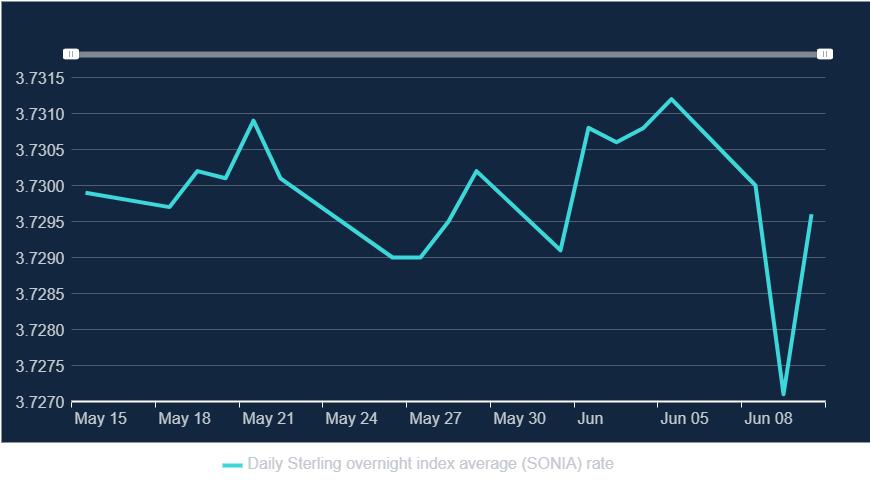
The SONIA (Sterling Overnight Index Average) rate is basically the risk-free rate for sterling markets which is governed by The Bank of England (BoE) while the Tom Next rate is a forex transaction that moves trade settlement from the next business day to the day after.
As a guide, the following chart taken from the BoE’s website shows that the current SONIA rate sits at around 3.7295.
Worked Example: Overnight Funding Using a GBP/USD Spread Bet
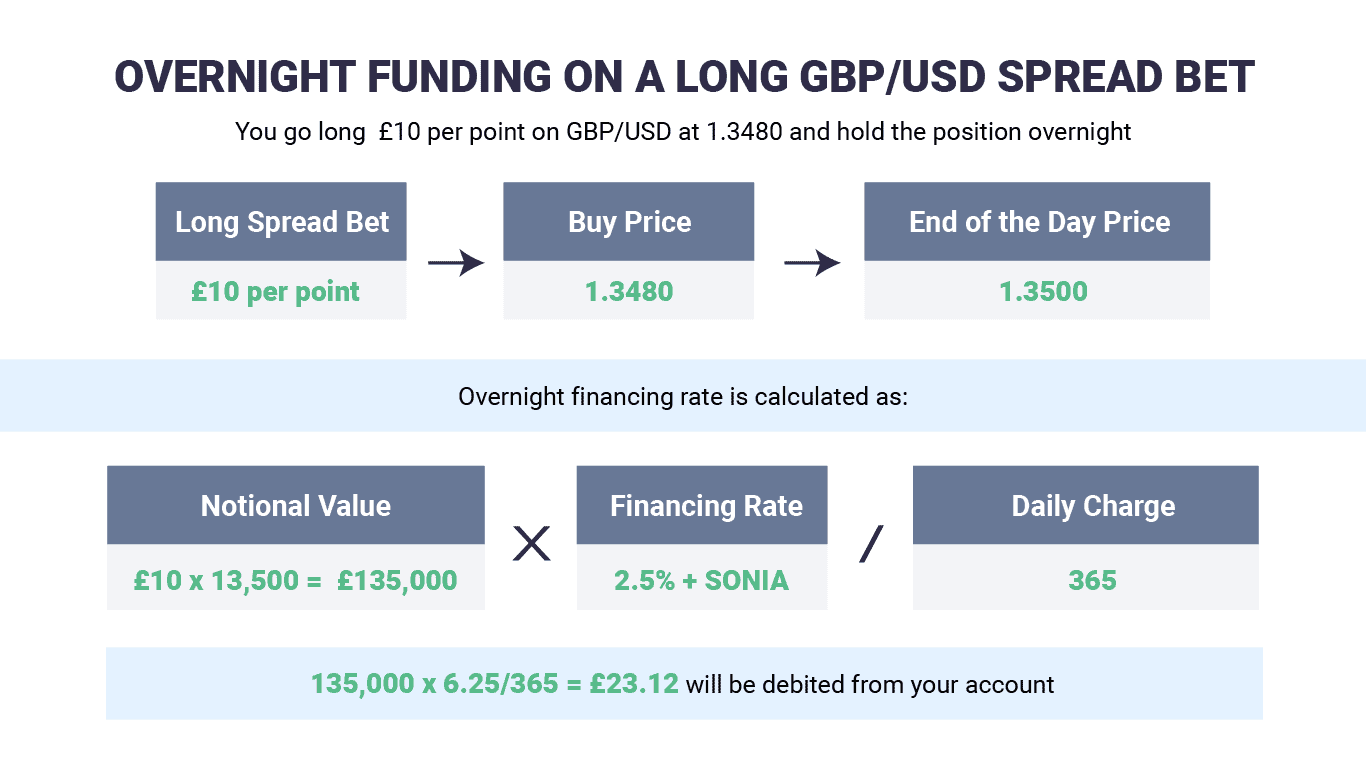
Let’s assume you open a long spread betting position on GBP/USD at £10 per point at 1.3480 and hold the trade overnight, where the market closes at 1.3500.
For illustration purposes, we’ll use the same financing methodology that City Index applies to many daily funded spread bets:
Daily Overnight Funding = (Stake × End-of-Day Price × Annual Financing Rate) ÷ 365
Here are the relevant figures to plug into your formula, which I’ve tried to match as closely as possible with the current market rates:
- Stake size: £10 per point
- GBP/USD closing price: 1.3500
- SONIA rate: 3.75%
- Provider’s financing adjustment: +2.50%
- Total annual financing rate: 6.25% (3.75% + 2.50%)
Step 1: Calculate the notional value
Multiply your stake by the end-of-day price:
£10 × 13,500 = £135,000
At £10 per point (where one point equals a 0.0001 move in GBP/USD), your position is equivalent to a £100,000 trade. The notional value at 1.3500 is therefore £100,000 × 1.3500 = £135,000.
Step 2: Apply the annual financing rate
£135,000 × 6.25% = £8,437.50
Step 3: Convert to a daily charge
£8,437.50 ÷ 365 = £23.12
Based on this simplified example, the overnight funding charge would be approximately £23.12 for holding the position for one night.
If you held the trade for five nights under the same conditions, the total financing cost would be roughly:
£23.12 × 5 = £115.60
Although the exact amount charged by your provider will vary depending on its methodology and prevailing market conditions, this example demonstrates an important point: the larger your stake and the longer you hold a leveraged position overnight, the greater the impact overnight funding can have on your overall return.
In practice, some providers calculate forex overnight funding on currency pairs such as GBP/USD using swap points or tom-next rates, rather than a SONIA-based formula.
Given this example only relates to City Index’s treatment of GBP/USD, it’s important to check your provider’s product specifications to understand how overnight financing is applied to the specific market you’re trading and the broker you’re trading with.
Is Overnight Funding Always a Cost?
Depending on market conditions and the provider’s pricing model, some short positions or certain markets may generate a small overnight credit instead of a charge.
However, in my observations from over 20 years of trading experience, beginner spread bettors should generally assume overnight funding will reduce returns rather than increase them.
Specific overnight fees vary between providers and per market, so it’s always advisable to check the product details before opening a position.
Even the terms used by providers can be different (E.g. CMC Markets uses ‘holding costs’ while City Index says ‘overnight financing fees’) which is even more reason to check with your broker and confirm what these costs are.
Which Markets Have Overnight Funding?
Overnight funding commonly applies to the following markets:
- Forex spread bets
- Stock indices
- Individual shares
- Commodities
- Exchange-traded funds (ETFs)
Daily funded bets are the products most likely to incur financing adjustments. This is to reflect the broker’s cost of funding your position, hence the term ‘daily funded bet’. A daily funded bet will incur an interest adjustment each day that you hold an open position, no matter what the expiry date is.
By contrast, some spread bets are priced like futures contracts, where the cost of holding a position is already reflected in the quoted price, so you don’t pay a separate overnight financing fee each day. For example, a forward contract is not subject to holding costs given they have a fixed expiration date.
Each market may have a slightly different rate calculation which is important to be aware of. For example, CMC Markets bases its overnight fees for both spread bets on indices and shares on the underlying interbank rate +/-0.0082% while for forex they use the Tom Next rate +/- 0.0027%.
Therefore, understanding which product you’re trading and what the associated charges are is important before opening any position.
How Overnight Funding Affects Long-Term Traders
The longer you keep a position open, the more overnight funding matters. The following table highlights a simple example of how your costs can add up over time.
| Holding Period | Daily Funding | Total Cost |
|---|---|---|
| 1 day | £2 | £2 |
| 10 days | £2 | £20 |
| 30 days | £2 | £60 |
| 90 days | £2 | £180 |
Over extended periods, financing costs can become a large expense, which add to all the other costs associated with trading.
Traders planning to hold positions for several months should always estimate overnight funding alongside your expected profit target to ensure you accurately incorporate financing charges into your trading strategy.
Does Overnight Funding Apply over the Weekend?
Many providers apply multiple days of financing before weekends or public holidays because markets will remain closed while your exposure continues.
For example, a position held on Friday evening may incur three days of overnight funding to account for Friday, Saturday and Sunday.
This is important to remember if you’re new to trading, as you may incur a larger-than-usual adjustment on your account statement should you hold an open position over a weekend.
How Is Overnight Funding Different from the Spread Cost?
The difference is in the cost and the timing of each, with the spread cost paid at the start while overnight funding is paid each day, should you hold onto the position.
The spread is the difference between the buy and sell price quoted by the provider and represents the immediate cost of entering a spread bet.
Overnight funding, on the other hand, only applies if you continue holding the position beyond the daily funding cut-off.
If you open and close your position within the same day you will pay the spread but avoid overnight funding altogether.
How Leverage and Margin Relate to Overnight Funding
One reason overnight funding exists is because, similar to CFD trading, spread betting uses leverage.
Leverage allows you to control a large market position with a comparatively small initial deposit, known as margin.
For example, let’s say that you buy £10 per point of the FTSE 100 at 10,430 and your margin requirement is 5%. The value of the trade is £100,430 (£10 x 10,430) but at 5%, you only need to have £5,215 in your account to open the position.
Because your provider effectively finances the remainder of the exposure, financing adjustments are applied when positions remain open overnight.
If you’re new to these concepts, check out our guides on how leverage and margin work in spread betting.
Can You Avoid Overnight Funding?
The simplest way to avoid overnight funding is to close your position before the provider’s daily cut-off time.
If you’re a day trader that routinely enters and exits positions within the same session, you will incur no overnight financing charges. Alternatively, futures-based spread betting products and forward contracts typically do not incur overnight fees.
However, avoiding overnight funding should not become the sole reason for closing an otherwise well-performing trade.
For this reason, making sound trading decisions is usually more important than saving a financing charge that might only be quite modest (especially if your profit potential outweighs your costs).
Should Beginners Worry About Overnight Funding?
Beginners should certainly understand overnight funding, but they shouldn’t fear it.
For short-term traders who regularly close positions on the same day, overnight funding will have little impact.
For investors holding positions over weeks or months, however, financing costs can significantly affect your overall profitability.
When planning a trade, ask yourself:
- How long do I expect to hold this position?
- How much overnight funding am I likely to incur?
- Will those costs materially affect my expected return?
Answering these questions in advance can help prevent unpleasant surprises later.
Common Mistakes Beginners Make
Ignoring Financing Costs
Many traders calculate potential profits without accounting for overnight funding. This can lead to unrealistic expectations, particularly on long-term positions.
Holding Losing Trades Too Long
Every additional day a losing position remains open may generate further financing costs. Combined with market losses, overnight funding can increase the total cost of delaying an exit.
Confusing Margin with Funding
Margin is money set aside to support your position while overnight funding is a financing adjustment for holding that position open. Although related through leveraged trading, they are not the same thing.
Summary
Overnight funding is an important concept that every spread bettor should understand. While the daily cost may appear small, it can accumulate quickly on positions held for weeks or months.
If you plan on putting on long-term trades, it’s important to treat overnight funding as just another part of your overall trading plan. You do this by estimating your financing costs in advance, understanding how leverage influences those charges and considering whether the expected return justifies keeping a position open.
By factoring overnight funding into your decision-making from the outset, you’ll gain a more realistic view of potential profits and losses and avoid being caught out by unexpected charges on your account.
Key Takeaways
- Overnight funding usually applies when a position remains open overnight.
- The charge reflects financing costs plus, in many cases, a provider admin fee.
- Long positions more commonly incur an overnight financing charge, although short positions can also be affected.
- Providers may use benchmarks such as the SONIA rate or Tom Next rate when calculating overnight funding adjustments.
- Always factor overnight fees into your expected profit before deciding to keep a trade open overnight.
FAQs
Is overnight funding charged every night?
Generally, yes, whenever a daily funded spread betting position remains open beyond the provider’s cut-off time. Weekend adjustments may combine multiple days into a single charge.
Can overnight funding be positive?
Occasionally, depending on market conditions and the provider’s methodology, certain positions may receive a small credit rather than incur a charge. However, many retail traders will more commonly experience a cost.
Does every spread bet have overnight funding?
No. Daily funded bets commonly incur overnight funding, while some futures-style spread bets like forward contracts already include financing costs in the quoted price, so you may not see a separate overnight funding charge.
How can I find my provider’s overnight funding rates?
Most UK providers publish their methodology and applicable rates within their product specifications or help centre. It’s advisable to review these details before opening a long-term position.


