

A stop limit order is an advanced trading order that combines a stop price and a limit price to control how a trade enters or exits the market. Unlike a standard stop order, which executes at the best available price once triggered, a stop limit order will only execute at your chosen limit price or better.
In spread betting and leveraged trading, stop limit orders are commonly used to manage slippage during volatile conditions on markets such as the FTSE 100, GBP/USD and gold.
Understanding how stop limit orders work can help traders gain more control over execution price, although there is also a risk the trade may not execute at all if the market moves too quickly.
If you are new to risk management orders, we recommend you read our guides on:
What Is a Stop Limit Order?
A stop limit order is effectively a two-part order:
- A stop price activates the order
- A limit price controls the maximum or minimum execution price
Once the market reaches the stop price, the order becomes a limit order rather than a market order. In other words, a regular stop order prioritises execution, while a stop limit order prioritises price control.
This is particularly important in fast-moving leveraged markets where slippage can become significant.
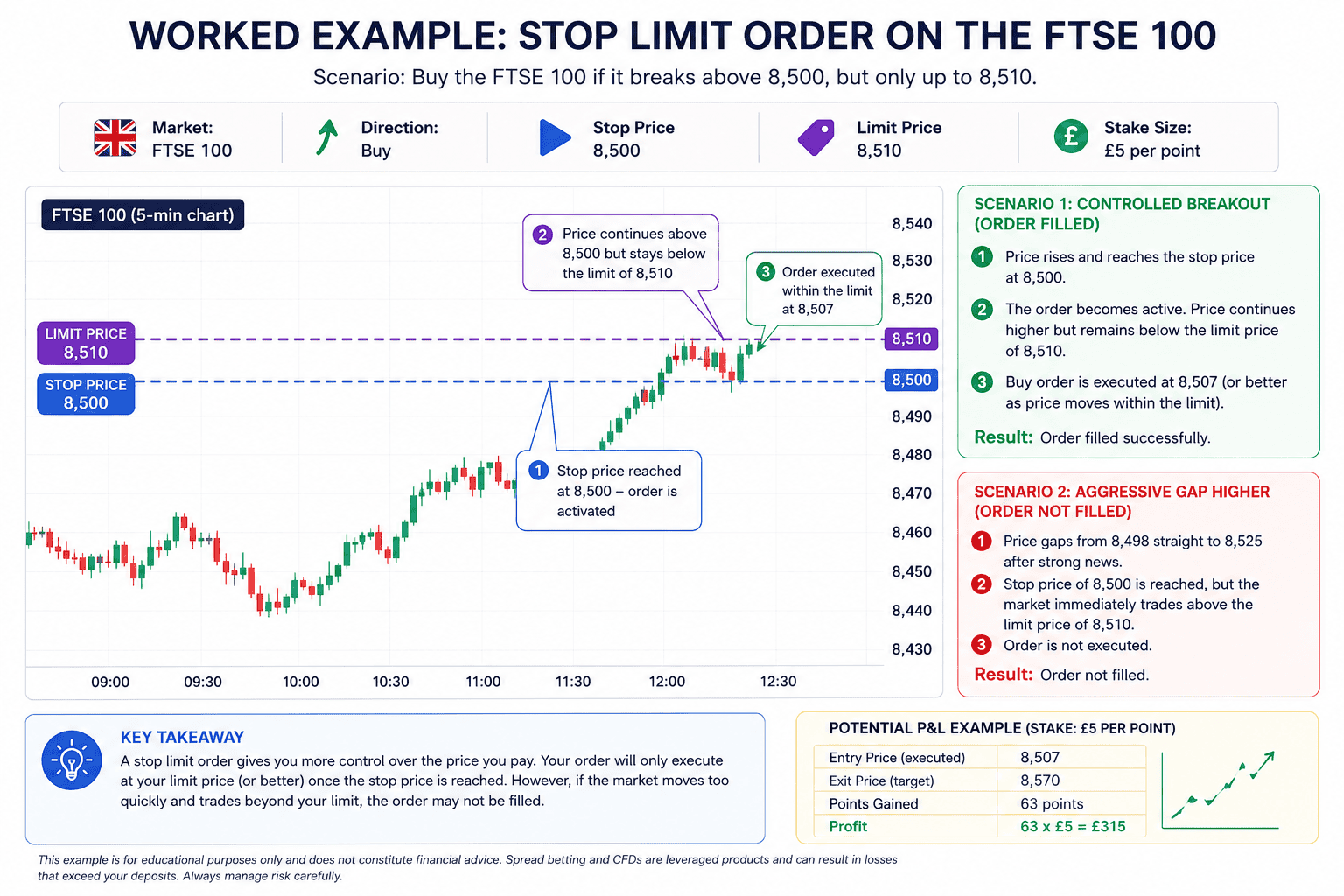
For example, I want to buy the FTSE 100 if it breaks above resistance at 8,500 but I’m only willing to enter up to 8,510, so I set my stop price at 8,500 and my limit price at 8,510. If the market gaps straight to 8,530, the order will not execute because my limit price was exceeded.
That is both the strength and weakness of stop limit orders.
How Stop Limit Orders Work
The easiest way to understand a stop limit order is to separate the two prices into a limit and stop price.
The Stop Price
The stop price is the trigger price. Once the market reaches this level, the order becomes active. This could be a buy or sell order. A buy order will be above the current market price; a sell order will be below the current market price. Basically, you are selling if the market is trending downwards and you expect it to keep trading lower and vice versa.
The Limit Price
The limit price is the execution boundary which means the trade will only fill at the limit price, or a better price.
For buy orders the market must stay at or below the limit price. For sell orders the market must stay at or above the limit price.
Stop Limit Order vs Stop Order
A stop order and a stop limit order may sound similar, but they behave very differently. The differences between the two are highlighted in the following table.
| Feature | Stop Order | Stop Limit Order |
|---|---|---|
| Prioritises | Execution | Price |
| Can suffer slippage? | Yes | Reduced risk |
| Guaranteed execution? | More likely | No |
| Suitable for fast markets? | Executes but with slippage | Sometimes risky |
First of all, it’s important to distinguish a stop order from a stop limit order. A stop order can be broken down into three main types:
- Stop-entry
- Stop-loss
- Trailing stop-loss
All three types of stops are designed to limit your losses or take advantage of market breakouts. Both a stop-loss and a trailing stop-loss are used to limit losses on an existing trade, while a stop-entry is a new order that anticipates the market will continue trending upwards or downwards (I.E. buying as the market is going up, selling as the market is coming down).
In addition, a trailing stop-loss order will move up or down price levels if the market moves in your favour. Some brokers also offer what’s called a guaranteed stop, which is a type of stop-loss order that gives you tighter price control over your execution for a premium fee.
In my experience testing stop limit orders on demo spread betting platforms, the biggest surprise was how often they simply did not trigger during sharp price spikes. I initially assumed “triggered” meant “executed”, but they are not the same thing.
That distinction becomes especially important during events such as central bank announcements, earnings releases or overnight market gaps because your order might get triggered but never actually executed if the market gaps through both your stop and limit levels.
Worked Example: Stop Limit Order on the FTSE 100
Let’s use a realistic UK spread betting example.
The Scenario
Assume the FTSE 100 is trading at 8,420 with resistance levels around 8,500 and I believe a breakout above 8,500 could trigger momentum buying.
However, I do not want to enter too far above the breakout level because my risk-reward deteriorates quickly if the stock price jumps aggressively.
My Stop Limit Setup
| Order Detail | Value |
|---|---|
| Market | FTSE 100 |
| Direction | Buy |
| Stop Price | 8,500 |
| Limit Price | 8,510 |
| Stake Size | £5 per point |
What Happens Next?
Scenario 1: Controlled Breakout
The FTSE gradually rises from 8,495 up to 8,507.
My stop activates at 8,500.
Because the market remains below my 8,510 limit, my order executes successfully.
Scenario 2: Aggressive Gap Higher
Instead, imagine the FTSE gaps from 8,498 straight to 8,525 after strong economic data.
My stop activates at 8,500, but the limit price was at 8,510 and the market immediately exceeds it.
Result: the order does not get filled.
These two scenarios illustrate why stop limit orders reduce slippage risk but increase the risk of your order not getting executed or filled.
Why Traders Use Stop Limit Orders
The main reason traders use stop limit orders is execution control.
Spread betting markets can become extremely volatile during events such as Bank of England decisions, US inflation releases, geopolitical events and corporate earnings announcements.
Without price protection, standard stop orders can fill significantly worse than expected, whereas a stop limit often won’t get executed if a market gaps after a major economic data announcement.
Example of Slippage
Imagine I place a regular stop order on GBP/USD at 1.2700 and some unexpected inflation data hits.
Instead of filling my order near 1.2700, the market gaps to 1.2675 and my order is filled there, 25-pips worse, which is the cost of my slippage.
With a stop limit order, you could avoid that type of poor execution if the market gaps like that. As an example, if I had a sell stop limit of 1.2700 – 1.2685, my stop price of 1.2700 will be triggered, but the market dropped below my limit price of 1.2685 so the order won’t be executed. Given it’s a sell order, my trade will only get executed if the market returns to 1.2685 or higher.
Stop Limit Orders in Spread Betting
Stop limit orders are actually quite rare and only a handful of UK spread betting brokers offer them. The reason a lot of proprietary platforms and third-party platforms like MT4 don’t offer native stop limits is because they model orders differently as market, limit, stop, trailing stop and/or guaranteed stop (or some variation of each).
It’s also important to note that the stop limit functionality varies slightly depending on the trading platform, the instrument and account type.
Based on my research, only Pepperstone and IG offer true stop limit order types using the following platforms:
| Broker | Platforms Supporting Stop Limit Orders |
|---|---|
| Pepperstone | MetaTrader 5 (MT5), cTrader, TradingView |
| IG | ProRealTime, L2 Dealer |
Having said that, there are other platforms and ways of simulating stop limit behaviour without being a true or native stop limit.
As an example, while there is no discrete stop limit order type, CMC Markets’ Next Generation platform does offer market, limit and stop-entry, plus boundary technology for slippage control, which controls the fill range without having the ‘stop-limit’ label.
In practice, you can also still use stop limit orders via custom Expert Advisors (EAs), scripts, bridge software, or other connected platforms. This is only recommended, however, for advanced traders who are tech savvy and know what they’re doing.
Buy Stop Limit vs Sell Stop Limit Orders
There are two main variations of stop limit orders:
Buy Stop Limit Order
These are used when expecting upward momentum.
For example, I can buy gold if the market breaks above resistance of 4575, but only up to a maximum acceptable price of let’s say 4585.
Sell Stop Limit Order
Sell stop limit orders are used when expecting downside momentum.
Using the FTSE 100 as an example, I can put a sell stop limit order in at 8,500 if I expect support to break below that level, with a limit price of 8,490 to avoid entering the trade after an excessive downward gap.
Stop Limit Orders vs Limit Orders
Another common source of confusion is the difference between stop limit orders and regular limit orders.
| Order Type | Trigger Required? | Purpose |
|---|---|---|
| Limit Order | No | Buy below market or sell above market |
| Stop Limit Order | Yes | Trade only after momentum trigger |
With a regular limit order, you aim to buy or sell at a better price than current market price, either selling above the market or buying below the market.
A stop limit order waits for your stop order to get triggered, before seeing if the market will continue its momentum into your limit price.
The other difference is, with a stop limit, you are buying and selling in the same direction the market is trading (I.E. buying at a high, selling at a low) whereas limit orders are in expectation of the market to reverse from that position (I.E. selling at a high, buying at a low).
The Risk of Non-Execution
One downside of stop limits is the risk your trade won’t get executed or filled.
A stop limit order may never execute even if the stop price is reached and the market moves strongly in your anticipated direction, as the stop activates the order and the limit controls the acceptable execution price.
If the price gaps beyond the limit you set, however, then the trade remains unfilled. In highly volatile markets, that can become frustrating.
I have had this happen to me when trading gold during US inflation releases. The market moved exactly in the direction I expected, but the price jumped straight through my limit range before it could get executed.
When Stop Limit Orders Work Best
In my experience, stop limit orders tend to work best during times of moderate volatility and in the biggest and most liquid markets (such as the FTSE 100 or GBP/USD).
For example, if there is a breakout in a FTSE 100 trend at 8,520 and it steadily traded higher up to 8,550, a stop limit of 8,520 – 8,530 would be very effective as my stop would get triggered and my limit executed in liquid and stable market conditions.
A stop limit will generally work less effectively during illiquid overnight sessions, major news releases, or thin holiday trading. This is because the market can skid through prices in illiquid conditions or times of sudden and high volatility, which each of these scenarios typically display. Therefore, your stop price might get triggered, but the market may skid through your limit price.
Stop Limit vs Guaranteed Stops
Some traders confuse stop limit orders with guaranteed stops. They are completely different tools, the key differences of which are highlighted in the following table:
| Feature | Stop Limit | Guaranteed Stop |
|---|---|---|
| Guarantees price? | No | Yes |
| Guarantees execution? | No | Yes |
| Protects against gaps? | Partially | Fully |
| Extra fee? | Usually not | Usually yes |
Guaranteed stops offered by brokers such as Pepperstone and IG provide stronger protection during extreme volatility but typically involve wider spreads and premium charges.
How to Place a Stop Limit Order
Although platforms vary slightly, the process is usually similar.
Step 1: Choose the platform
First of all, you need to pick a platform that has stop limit functionality. Trading platforms that allow you to trade stop limits include MT5, cTrader and TradingView. Make sure a broker you choose offers both spread betting and the ability to trade with stop limit orders.
Step 2: Choose the Market
Once you’ve picked your platform, you need to choose a market you can spread bet with whether it’s a stock, currency or commodity such as the FTSE 100, GBP/USD, gold or brent crude.
Step 3: Select Stop Limit Order
You can often find stop limit orders inside advanced orders, entry orders, or conditional order settings.
If you are trading on the MT5 mobile app, as an example, you can place a pending order at the desired level directly from the trading symbol chart, tap Pending Order on the chart and drag the newly added order line to your desired price level. Then you tap on the Stop Limit order type in the bottom panel.
Step 4: Set the Stop Price
This is the trigger level which is either a buy stop level above the current market price, or a sell stop level below the current price. In the MT5 mobile example above, you need to drag the stop price order line to your desired level directly on the chart.
Step 5: Set the Limit Price
This defines your maximum acceptable buy price (above the market) or minimum acceptable sell price (below the market). Again, in the case of MT5 mobile, you would need to drag your limit price order line to your desired level directly on the chart.
Step 6: Confirm Stake Size
Next, enter how much you’re willing to stake, such as £5 per point.
Step 7: Submit the Order
Lastly, make sure you go over all the details in the order ticket before submitting your order. The order will remain dormant until the stop price is reached.
Common Stop Limit Order Mistakes
One of the biggest mistakes newer traders make is setting the limit too tight.
For example, let’s say you set your stop at 8,500 and your limit at 8,501. In a volatile market, that one-point range may never realistically fill.
Another mistake is using stop limit orders during major economic announcements without understanding how rapidly prices can gap.
I have personally found that slightly wider limit ranges dramatically improve execution probability without excessively increasing my slippage.
FCA Rules and Retail Protection
UK spread betting brokers regulated by the Financial Conduct Authority (FCA) must provide these key protections:
- Negative balance protection
- Leverage restrictions
- Standardised risk disclosures for retail traders
All of the brokers we’ve highlighted on this page are regulated by the FCA, which includes Pepperstone, IG, CMC Markets, City Index and Spreadex.
However, stop limit orders themselves do not eliminate trading risk, they simply provide greater control over your trade execution.
Are Stop Limit Orders Good for Beginners?
Given their complexity, I’d advise beginners to steer clear of stop limit orders. New traders often benefit more from straightforward stop-loss and limit orders, as they are simple to use and easy to manage your risk with.
Stop limit orders require understanding of factors such as market volatility, liquidity, execution mechanics of the order itself and slippage risk.
That said, once traders gain more experience, stop limit orders can become very useful tools for managing breakout entries and reducing poor fills.
Final Thoughts: Should You Use Stop Limit Orders?
Stop limit orders can be extremely useful for traders who prioritise execution quality over guaranteed entry.
They are particularly effective when trading breakouts, entering trending markets, or avoiding excessive slippage.
But they are not perfect.
The trade-off is that you have better price control, but higher risk of non-execution.
In my experience, stop limits work best on liquid markets during normal trading conditions rather than major news events or overnight volatility.
Used carefully, stop limit orders can improve trade discipline and execution consistency, especially for experienced spread bettors trading leveraged markets like the FTSE 100, GBP/USD and gold.