


A trailing stop loss is a stop order that automatically moves as your spread bet moves into profit, helping you lock in gains while still allowing the position to run. Unlike a fixed stop loss, a trailing stop only moves in your favour.
If the market reverses by your chosen trailing distance, the position will be closed out. This also means that if the market initially moves against you, your trailing stop loss stays where it is. UK spread betters commonly use trailing stops on markets such as the FTSE 100, GBP/USD and gold to manage risk without manually adjusting stop levels throughout the trade.
This guide explains how trailing stop losses work, what trailing distance to use, and when they perform better than fixed stops.
If you are new to stop-loss orders generally, it is worth first reading our broader guide to:
What Is a Trailing Stop Loss?
A trailing stop loss is a dynamic stop order that adjusts automatically as the market moves in your favour. With a regular stop loss, the stop level remains fixed unless you manually change it.
With a trailing stop:
- The stop “trails” behind the market price
- The stop moves only when the trade becomes more profitable
- The stop never moves backwards
For example:
- You buy the FTSE 100 at 8,200
- You set a 40-point trailing stop
- The FTSE rises to 8,280
- Your trailing stop rises from 8,160 to 8,240
If the FTSE then falls back to 8,240, the stop triggers and closes the trade.
This allows you as a spread better to protect your profits, reduce emotional decision-making and avoid constantly watching the trading screen.
Most UK spread betting brokers including Pepperstone, IG, CMC Markets and Spreadex offer trailing stop functionality on their platforms.
How a Trailing Stop Loss Works
The core idea behind a trailing stop is simple.
The stop follows the market when the trade moves into profit but stays fixed when the market price moves against you.
Trailing Distance
The amount of space between the current market price and the stop level is called the trailing distance. This can be measured in points, pips or percentages depending on the platform. For tighter control over your exit price, see how a stop limit order works.
For example:
- FTSE 100 trailing stop: 50 points
- EUR/USD trailing stop: 30 pips
- Gold trailing stop: 300 points
The Trigger Mechanism
Once the market reverses by the trailing distance from its highest point (for long trades or when you buy) or lowest point (for short trades or when you short sell), the stop gets triggered.
Here is the basic sequence:
- Enter the trade
- Market moves in your favour
- Trailing stop adjusts upward automatically
- Market reverses
- Stop triggers when reversal reaches trailing distance
One thing I noticed when testing trailing stops on demo platforms is how easy it is to set the distance too tight initially.
As an example, when trading GBP/USD, I was using a trailing stop of 25 points, which looked sensible on the chart until normal intraday volatility got close to knocking my trade out when it was trading in a 1.3450 – 1.3430 trend.
That is one reason experienced spread betters often base trailing stops on volatility rather than arbitrary numbers.
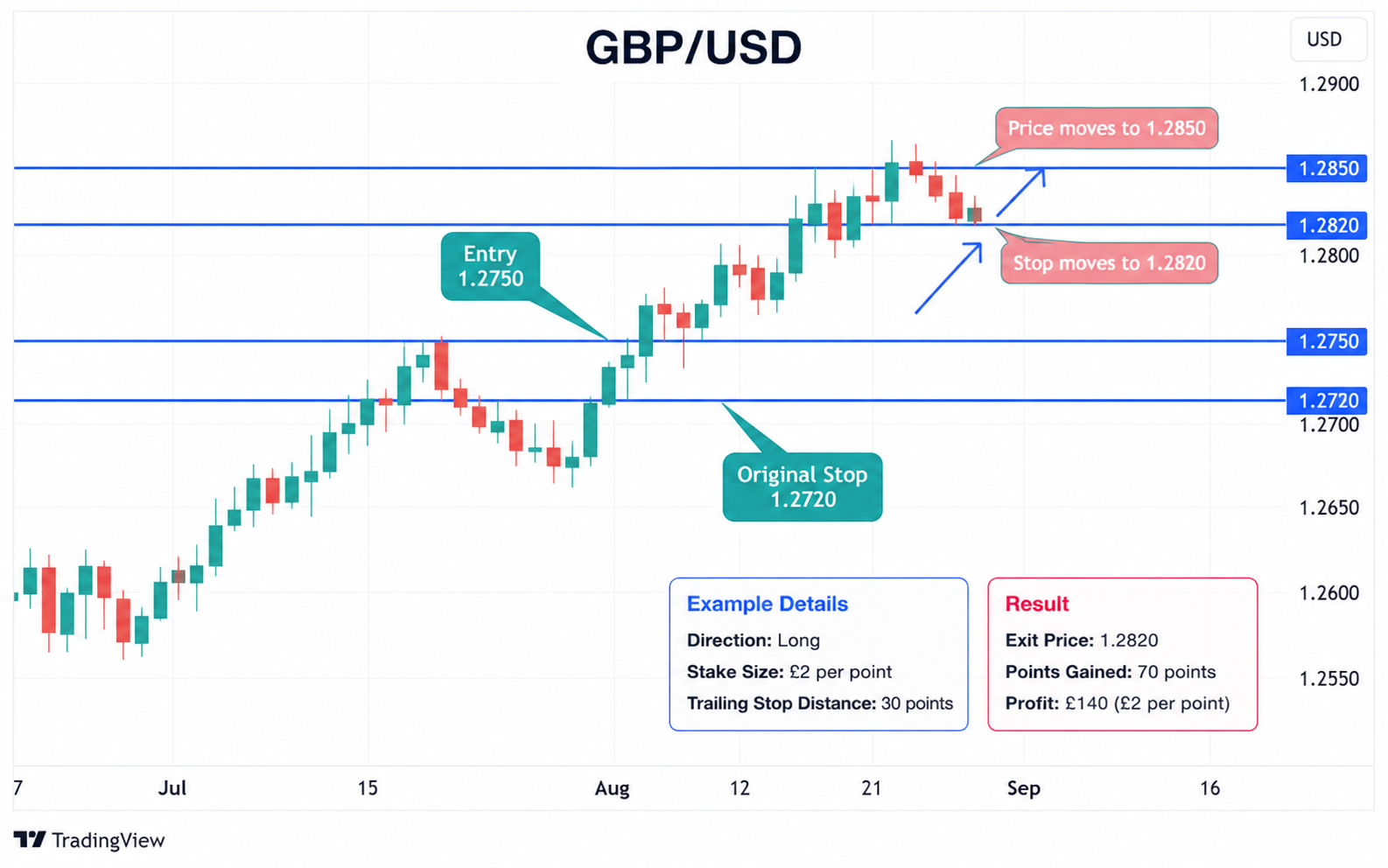
Worked Example — Trailing Stop on a GBP/USD Spread Bet
Let’s walk through a realistic UK spread betting example.
Trade Setup
| Detail | Value |
|---|---|
| Market | GBP/USD |
| Direction | Long |
| Entry Price | 1.2750 |
| Stake Size | £2 per point |
| Trailing Stop Distance | 30 points |
Step 1: Entering the Trade
I buy GBP/USD at 1.2750 with a 30-point trailing stop.
The initial stop sits at:
1.2750 − 0.0030 = 1.2720
Step 2: Market Moves Higher
GBP/USD rallies to 1.2850.
That is a 100-point gain.
Unrealised profit calculation:
100 × £2 = £200
The trailing stop rises to:
1.2850 − 0.0030 = 1.2820
Step 3: Market Reverses
GBP/USD falls back to 1.2820.
The trailing stop triggers and closes the position.
Given the market price rises 70 points from 1.2750 to 1.2820 before my trailing stop is triggered, my final profit is as follows:
70 × £2 = £140
Final realised profit: £140
Because UK spread betting profits are generally tax-free, that £140 is effectively gross and net profit for most UK retail clients.
What If I Used a Fixed Stop Instead?
If I had used a regular 30-point fixed stop, my stop would remain at 1.2720, which means the trade may never have locked in a profit. Therefore, a full reversal could still produce a loss for me.
Because fixed stops don’t move and trailing stops only move if the market is trending up, this illustrates why trailing stops can be very effective in trending forex markets.
How Many Points Should Your Trailing Stop Be?
There is no universal answer because the ideal trailing stop distance depends on factors such as market volatility, timeframe, leverage and strategy style. When considering how many points your trailing stop should be, it’s important to think through and plan your trading strategy with all of these factors front of mind.
Is 5% a Good Trailing Stop Loss?
Sometimes. A 5% trailing stop can work reasonably well for slower-moving indices, swing trading and medium-term positions.
On highly volatile markets like gold or leveraged forex trades, however, 5% may either be far too wide or too tight depending on the timeframe.
A 5% trailing stop on a FTSE 100 swing trade may be manageable if the market is moving sideways with little volatility while a 5% trailing stop on intraday gold trading could be enormous based on its popularity as a safe haven asset during times of economic uncertainty.
While having a percentage approach appears simple, I find it quite an arbitrary measure and it ignores volatility, which varies based on market and the time of day you’re trading.
The Volatility-Based Approach (ATR)
Many experienced spread betters use the Average True Range (ATR) to set trailing stops. ATR measures how much an instrument typically moves over a given period.
A market like the FTSE 100 could have an ATR of 45 points in a normal trading session whereas gold could average 320 points over a short-term period. If you’re looking at the forex market, GBP/USD might have 55 pips during intraday trading.
A common strategy is setting the trailing stop at 1 x ATR, 1.5 x ATR or 2 x ATR. This gives the market room to fluctuate naturally without triggering unnecessary exits.
You can learn more about ATR calculations at Investopedia ATR Guide.
What Is the 7% Stop-Loss Rule?
The “7% rule” comes from William O’Neil and his CAN SLIM investing strategy. This idea focuses on cutting your losses once a position falls 7–8% below the entry point of the initial trade.
Originally, this was designed for stock investing rather than leveraged spread betting. In spread betting, a direct 7% adaptation can be dangerous because leverage can magnify your losses dramatically.
For example, a 7% move in a leveraged FTSE 100 position could represent a very large percentage loss on your account equity.
Most active spread betters therefore use tighter stops, volatility-based stops or monetary risk limits instead.
Suggested Trailing Stops by Market
| Market | Typical Trailing Stop Range |
|---|---|
| FTSE 100 | 30–80 points |
| EUR/USD | 20–50 pips |
| Gold | 200–500 points |
| Brent Crude | 50–150 points |
These are not fixed rules, but realistic starting points based on normal volatility conditions. As always, it’s important to do your own market analysis and calculate your trailing stops on your findings of the specific marking you’re trading.
Trailing Stop vs Fixed Stop Loss: Which Is Better?
There is no right answer here as whether you use a trailing stop or fixed stop depends entirely on market conditions, based on the following scenarios.
When Trailing Stops Work Best
Trailing stops generally perform better in trending markets, swing trades and longer-term positions. They allow profits to run while still protecting gains.
This is especially useful on strong FTSE trends, sustained GBP/USD momentum, or commodity breakouts.
When Fixed Stops Work Better
Fixed stops often perform better during range-bound markets, short-term scalping and major news events.
In choppy conditions, trailing stops may repeatedly trigger due to normal price noise.
Combining Both Approaches
Many experienced spread betters use both a fixed stop initially before switching to a trailing stop once the trade moves into profit.
As an example, if you were to enter a FTSE 100 trade with a 40-point fixed stop, once the trade gains 60 points, you could then convert it to a 30-point trailing stop.
More often than not, I’ve found that this hybrid approach works for me as it eliminates any intraday volatility risk while also getting a sense of how the market is trading. If the market continues to trend upwards, that’s when I would change my approach to a trailing stop.
Trailing Stops vs Guaranteed Stops
Some UK brokers offer guaranteed stop loss orders (GSLOs) alongside trailing stops. A guaranteed stop ensures the exit price will be honoured even if the market gaps.
This matters during events such as:
- Weekend gaps
- Flash crashes
- Major news events
- Overnight volatility
The downside is cost as guaranteed stops usually involve wider spreads, or an additional premium fee. A guaranteed stop also doesn’t move as the market price rises like a trailing stop, meaning it is a static order like a regular stop loss.
Guaranteed Stop Availability
| Broker | Guaranteed Stops | Notes |
|---|---|---|
| Pepperstone | Limited depending on platform/instrument | Strong MT5 and TradingView integration |
| IG | Yes | One of the more advanced guaranteed stop offerings |
| CMC Markets | Yes | Premium charged on guaranteed execution |
| City Index | Yes | Availability varies by market |
| Spreadex | Partial | Depends on instrument |
| Trade Nation | Limited | Simpler order structure |
How to Set a Trailing Stop on Your Spread Bet
Although platforms vary slightly, the general process is similar across UK spread betting brokers.
Step 1: Open the Order Ticket
Select the market, whether it be FTSE 100, GBP/USD, gold or another instrument.
Step 2: Choose “Trailing Stop”
From my experience, most platforms list trailing stops under stop-loss options, advanced orders or the risk management settings of the user interface. It’s also important to note that some mobile apps don’t offer trailing stop functionality, like MT4.
If you were to use MT4 on desktop, however, trailing stops are available. Once you open a position, you need to right click on your open order (such as EUR/USD) on the Trade Terminal, which brings up the context menu. From there, you will see “trailing stop” with a list of pre-set points or a “custom” option to choose your own and away you go.
Step 3: Enter the Trailing Distance
This may be points, pips or percentage based.
Stocks (like the FTSE 100) are generally measured in points whereas a forex currency pair like the EUR/USD is often measured in pips. Using those two markets, you could set a 40-point FTSE trailing stop or a 25-pip EUR/USD trailing stop based on the average intraday movement of each market.
Step 4: Confirm the Position
Once active, the stop gets updated and only moves in the profitable direction. Some brokers also require a minimum trailing distance depending on volatility.
Common Trailing Stop Mistakes
Setting Stops Too Tight
This is probably the most common mistake. If you set a trailing stop too close to the market price, it gets triggered by normal volatility, which doesn’t give your trade a chance to make a profit in relatively normal or “safe” market conditions.
Setting Stops Too Wide
The opposite problem of setting your stop too tight is setting it too wide, which means you’ll give back too much unrealised profit before the stop activates.
Getting the balance right when setting your stops is the key, which requires a well thought out trading strategy.
Using Trailing Stops During News Events
Markets can gap straight through trailing levels, which means your stop is triggered lower than it was set at, causing you a bigger loss than originally intended. Even normal stop loss orders can have the same gapping effect.
This is especially risky during major economic events such as:
- Central bank decisions
- US inflation releases
- UK budgets
- Unexpected geopolitical headlines
This is why it’s incredibly risky to trade during major data announcements where markets can spike suddenly before returning to normal a few minutes later (or remaining highly volatile).
Confusing Pips and Points
Some platforms quote forex in pips, indices in points and commodities differently again. A simple unit mistake can completely distort risk levels which so it’s vital to ensure you fully understand the unit of measurement of the market you’re spread betting with.
Forgetting Weekend Gap Risk
Trailing stops do not protect against all overnight gaps, particularly over a weekend, which is where guaranteed stops become more useful.
FCA Rules and Retail Protection
UK spread betting firms regulated by the Financial Conduct Authority must comply with retail protection rules including:
- Leverage caps
- Negative balance protection
- Standardised risk warnings
However, these protections do not eliminate trading risk entirely. Trailing stops help manage risk, but they cannot guarantee profits.
Final Thoughts: Are Trailing Stops Worth Using?
For many UK spread betters, trailing stop losses are one of the most useful risk-management tools available. They help automate profit protection, reduce emotional decision-making and keep traders in winning trends longer.
But they are not perfect.
Trailing stops work best when markets are trending, volatility is manageable and the trailing distance (I.E. the number of points) matches the instrument.
Used incorrectly, they can lead to premature exits, excessive profit giveback or even greater losses.
In my experience, the biggest improvement came from widening my trailing stops slightly and focusing more on market volatility rather than arbitrary numbers. Once the stop reflected how the instrument actually moved, the strategy became much more effective.
FAQs
Is a trailing stop loss better than a fixed stop?
This depends on many variables. Trailing stops generally work better in trending markets, while fixed stops often perform better during sideways or highly volatile conditions.
Can trailing stops guarantee profits?
No, markets can gap through stop levels during extreme volatility. While guaranteed stops offer stronger protection with an extra cost, there is no guarantee of making a profit while trading, which is why you need to limit your downside and only trade what you can afford to lose.
What is a good trailing stop for the FTSE 100?
There is no “good” trailing stop or perfect number of points for the FTSE 100, or any market for that matter. Whether its 30 points or 80 points, how you many points you give your trailing stop loss is entirely up to you based on your trading strategy.
Do trailing stops work overnight?
Trailing stops will remain in place overnight, but they may not protect fully against overnight gaps or weekend moves if the market reopens significantly beyond the stop level.
Are trailing stop profits taxable in the UK?
Spread betting profits are generally exempt from capital gains tax and stamp duty in the UK because spread betting is classified as gambling rather than investing.
Risk Warning: Spread betting is a high-risk investment activity. You can lose more than your initial deposit. 70-80% of retail investor accounts lose money when trading spread bets with most providers. Spread betting is not suitable for everyone. Spread-bet.co.uk provides information only and does not provide financial advice. Tax treatment depends on individual circumstances and may change.
Consider whether you understand how spread betting works and whether you can afford to take the high risk of losing your money.


