


What is silver trading?
Silver trading through spread betting allows you to speculate on whether the price of silver will rise or fall without owning the physical metal. Instead of buying silver bullion or coins, you place a spread bet using a stake in pounds per point, with your profit or loss determined by how far the market moves.
For UK traders, silver is one of the world’s most actively traded commodities, offering opportunities in both rising and falling markets.
However, because spread betting uses leverage, it’s important to understand how silver prices move and the risks involved before opening a position.
If you’re interested in trading other raw materials, our guide to commodity spread betting explains how different commodity markets work, including other precious metals markets, and what influences their prices.
Why trade silver?
Silver attracts traders because it combines characteristics of both precious metals and industrial commodities. Given silver is increasingly used for its chemical properties, its industrial uses mean its price is also heavily influenced by economic activity.
Some of the main reasons traders choose silver include:
Higher volatility than gold
Silver generally experiences larger day-to-day price swings than gold.
One reason is that around half of annual silver demand comes from industrial applications (source: The Silver Institute), making prices more sensitive to changes in manufacturing activity and economic growth. Silver’s smaller market size also means buying and selling pressure can have a greater impact on prices than in the gold market.
For spread bettors, this can translate into more opportunities, provided you manage your risk carefully.
Leverage increases market exposure
Under the Financial Conduct Authority (FCA) rules, UK spread betting providers offer up to 10:1 leverage on silver (a 10% margin requirement). That means around £1 of margin gives you roughly £10 of market exposure. Note this is lower than gold, which is capped at 20:1: the FCA treats gold as a lower-risk commodity than silver and the other precious metals. Leverage magnifies profits and losses equally.
As such, spread betting allows you to control a larger market position with a relatively small initial margin deposit.
For example, a 10% margin requirement means a trader can gain exposure to a £10,000 position by depositing £1,000.
While this makes capital more efficient, it’s important to remember that leverage magnifies both your profits and your losses. A relatively small adverse move in the silver price can result in significant losses if your position is too large.
Strong liquidity
Silver is one of the world’s most actively traded commodities because it attracts both industrial users and investors, resulting in deep global liquidity.
High liquidity generally results in smoother price action and relatively competitive dealing spreads during normal market conditions.
Trade rising and falling markets
Spread betting allows you to profit whether silver prices increase or decrease. You can open a buy position if you expect prices to rise or open a sell position if you expect prices to fall.
This flexibility makes silver suitable for both bullish (rising) and bearish (falling) market conditions.
No Capital Gains Tax (CGT)
For traders in the UK, if you choose to spread bet on silver, your profits will often be completely tax-free. This is due to spread betting being classified as a form of gambling by the UK government.
No need to own physical silver
Buying physical silver means arranging secure storage, insurance and, in many cases, paying dealer premiums above the spot price.
Spread betting removes those practical considerations because you’re speculating purely on price movements. You never take delivery of the underlying metal, making it a more convenient way to gain exposure to the silver market.
How does silver spread betting work?
To spread bet on silver, your chosen provider quotes two prices: the bid (sell) and ask (buy), the difference of which is known as the spread. You then decide whether you think silver is going to rise or fall and how much you wish to stake per point. Your eventual profit or loss depends on the number of points silver moves, your stake per point and any overnight funding charges if you keep the position open overnight.
In addition to spread betting, silver can be traded through various financial instruments such as futures, ETFs, and CFDs, making it accessible to a wide range of traders and investors.
While the global spot price of silver is quoted in US dollars per troy ounce (31.103 grams), spread betting providers typically convert this into a points-based market, allowing traders to stake a chosen amount per point. Silver will typically be quoted by ticker as XAG/USD, although most platforms label the asset by its name (similar to gold, which has the ticker XAU/USD).
When you spread bet on silver, you never own the underlying asset (like you would if you purchased silver bullion itself). Instead, you are simply speculating on the movement of the silver price.
Worked example: silver spread betting in pounds
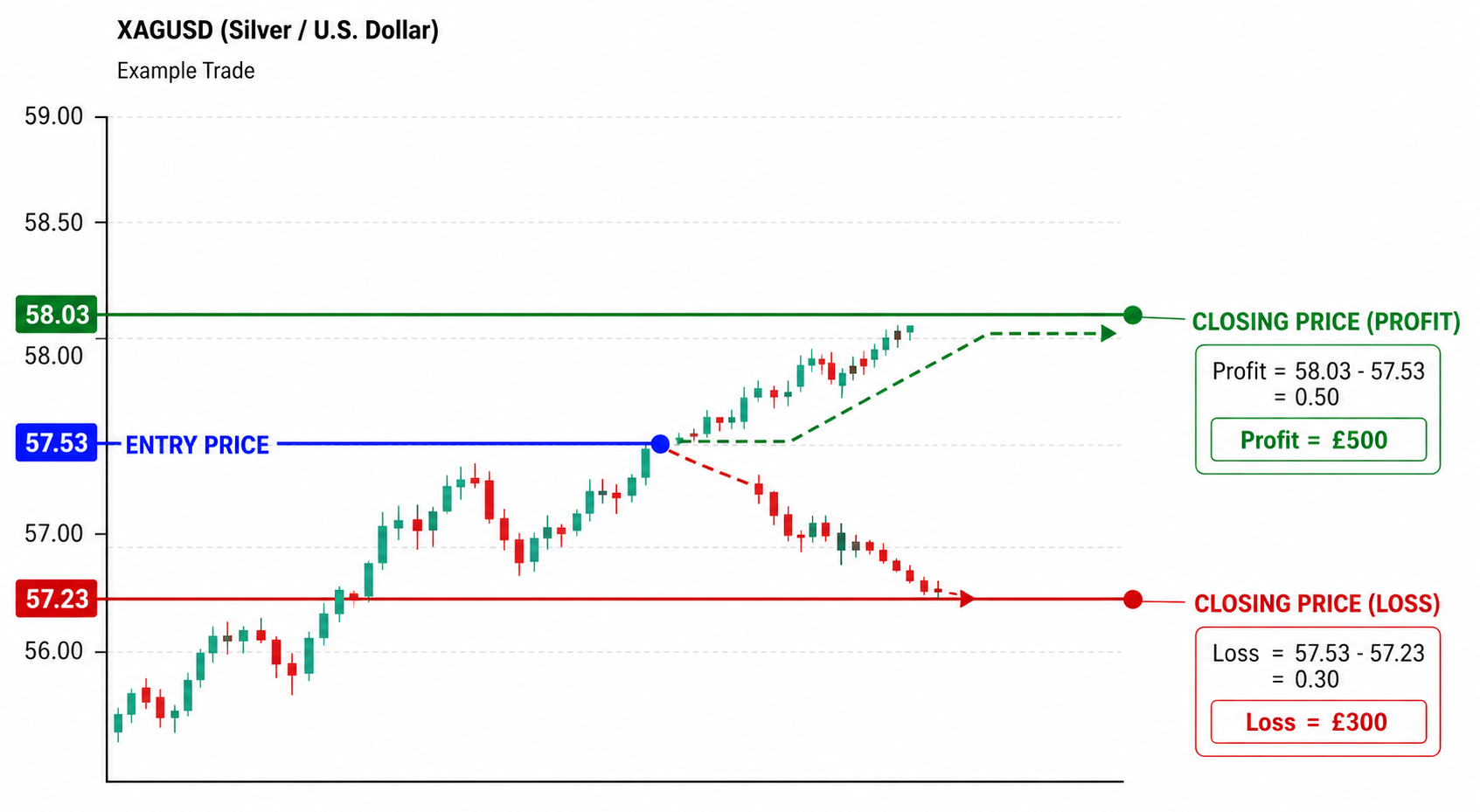
Suppose silver is currently quoted at 5753 (an illustrative level, not a live price).
You believe demand for industrial metals will increase following stronger-than-expected manufacturing data and decide to open a buy spread betting position.
Let’s say you decide to open a buy spread bet position at 5753 with a stake of £10 per point. Over the next three trading days, silver rises to 5803.
The market has moved by 50 points so your profit would be calculated as:
50 points × £10 = £500
If silver had instead fallen to 5723, your loss would have been:
30 points × £10 = £300
This example demonstrates why stake sizing is just as important as predicting market direction. Even relatively modest movements can have a significant financial impact when using leverage.
What moves the silver price?
Silver prices are driven by a combination of economic fundamentals, industrial demand and investor sentiment. Unlike many commodities, silver responds to both manufacturing activity and safe-haven buying.
Industrial demand
Silver behaves partly like a precious metal and partly like an industrial commodity.
Because roughly half of demand is industrial, the continued expansion of electronics, renewable energy and data centre infrastructure are expected to support long-term industrial demand for silver because of its excellent electrical conductivity.
Conversely, slower economic growth may reduce demand from manufacturers and weigh on the market.
The US dollar
Silver is priced internationally in US dollars. A weaker US dollar generally makes silver cheaper for overseas buyers, often supporting demand.
Conversely, a stronger dollar can have the opposite effect by making silver more expensive in other currencies.
Interest rates
Like gold, silver does not generate income.
When interest rates rise, income-producing assets such as bonds may become more attractive, reducing investor demand for precious metals.
When markets expect interest rates to fall, silver prices often receive additional support.
Inflation
Many investors use precious metals as part of a diversified portfolio during periods of elevated inflation.
Although silver is generally more economically sensitive than gold, expectations of persistent inflation can still increase investment demand.
Economic uncertainty
Periods of geopolitical tension or financial market volatility can encourage investors to increase their exposure to precious metals.
While gold typically benefits most from safe-haven demand, silver reacts to both safe-haven flows and manufacturing/economic data, so it moves more often and harder than gold. As such, position sizing and wider stops may be needed when trading silver compared with gold.
Given silver is more volatile than gold, holding leveraged silver positions overnight carries the same funding mechanics but higher gap risk.
Silver versus gold
Both silver and gold are popular precious metals, but they appeal to different types of traders. Gold is generally viewed as a defensive asset and often attracts investors during periods of economic uncertainty.
Silver, on the other hand, has a larger industrial component, meaning its price is influenced by both investment demand and global manufacturing activity.
As a result, silver typically experiences greater price volatility than gold, which can create more trading opportunities but also increases the potential for larger losses.
The gold-silver ratio is a measure used by traders to assess the relative value of gold to silver, indicating potential trading opportunities based on their price relationship.
If you’re considering trading both markets, our guide to gold spread betting explains how gold behaves during different economic environments and how its drivers compare with silver.
Risks of silver trading
Although silver offers attractive trading opportunities, it also carries several risks that beginners should understand before opening their first position.
Volatility can work against you
Like any market, silver can be highly volatile in certain circumstances.
It’s not unusual for the market to move several percentage points following major economic announcements or geopolitical events.
While increased volatility creates opportunities, it also means losses can accumulate more quickly than many new traders expect.
Leverage magnifies losses
Leverage is one of the defining features of spread betting.
Suppose you open a silver spread bet worth £15 per point. If the market moves against you by 80 points, your loss would be:
80 × £15 = £1,200
The market hasn’t moved very far, but the financial impact is significant because of your chosen stake size. This is why position sizing is an important aspect of managing risk when spread betting.
Overnight funding
If you keep a daily-funded spread betting position open overnight, your provider will usually apply overnight financing.
These charges may appear modest over a few days but can accumulate over longer holding periods.
This is why it’s important to always factor overnight funding into your overall trading costs before deciding how long you want to keep a position open.
Unexpected market events
Silver prices can react rapidly to the following factors:
- US inflation figures
- Federal Reserve announcements
- Employment reports
- Geopolitical developments
- Changes in industrial demand
Markets can gap higher or lower following unexpected news, meaning stop-loss orders may not always be filled at the exact level requested unless you’ve paid for a guaranteed stop.
Brief history of silver prices
Silver prices have undergone significant volatility since the 1970s (a cursory glance at a silver chart shows significant spikes at various stages in the last 50 years).
In the 1970s, silver prices experienced a dramatic increase influenced by high inflation, geopolitical tensions, and the Hunt Brothers’ attempts to corner the market, culminating in a historic peak in 1980.
Silver reached roughly $50 in the 1980 Hunt Brothers episode and again in 2011, but never broke decisively above that level for four decades. That changed in the 2025 to 2026 rally, when silver surged past its old ceiling to a nominal all-time high of about $121 per ounce in January 2026, a move of more than 140% across 2025.
This peak in 2011 was driven by a combination of factors such as quantitative easing policies, concerns about inflation, strong industrial demand and speculative trading.
During the COVID-19 pandemic in 2020, there was a sharp sell-off in silver during March as investors sought cash amid widespread market uncertainty. Prices then recovered strongly over the following months, supported by unprecedented government stimulus, ultra-low interest rates, a weaker US dollar and renewed investor demand for precious metals.
Silver has since pulled back sharply from that peak, a reminder that it is among the most volatile precious metals and can move a long way in either direction over short periods.
Silver vs other commodity markets
In addition to gold, silver is one of many commodities you can trade through spread betting.
The following table compares silver with other popular commodity markets:
| Commodity | Primary Price Drivers | Typical Volatility |
|---|---|---|
| Silver | Industrial demand, inflation, US dollar | High |
| Gold | Safe-haven demand, interest rates, central banks | Moderate |
| Crude Oil | OPEC production, inventories, geopolitical risk | High |
| Natural Gas | Weather, storage levels, seasonal demand | Very High |
Silver occupies a unique position because it behaves partly like a precious metal and partly like an industrial commodity.
That combination often creates opportunities that don’t exist in either gold or energy markets.
FAQs
Is silver a good market for beginner spread bettors?
Silver can be suitable for beginners because it is highly liquid and widely traded. However, its volatility means new traders should start with smaller stake sizes while learning how the market behaves.
Do I own silver when I spread bet?
No, spread betting on silver involves speculating on the market’s price movements rather than purchasing physical silver.
Can I profit if silver prices fall?
Yes, given that spread betting allows you to open a sell position if you expect silver prices to decline, in the same way that you can profit when opening a buy position if you expect silver prices to rise.
Is silver more volatile than gold?
Historically, yes. Silver often experiences larger percentage price swings because its price is influenced by both investment demand and industrial consumption.
What affects silver prices the most?
There are many important drivers of silver prices which include industrial demand, the strength of the US dollar, interest rate expectations, inflation, global economic growth and investor sentiment.
No single factor determines silver prices in isolation, which is why it’s important to monitor several economic indicators simultaneously.
Risk Warning: Spread betting involves investing in complex instruments and comes with a high risk of losing money rapidly due to leverage. You should consider whether you understand how spread betting works and whether you can afford to take the high risk of losing your money.


