


A margin call happens when your trading account no longer has enough funds to support an open leveraged position. In UK spread betting, this usually means losses on your trade have reduced your available margin below the broker’s required maintenance level, prompting the broker to ask for more funds or automatically close positions.
In short, a margin call is a warning that your losses are getting close to the amount of money you deposited to maintain a leveraged trade.
Spread betting traders in the UK encounter margin calls most often when markets move sharply against them on leveraged positions such as the FTSE 100, EUR/USD or gold. Understanding how margin works is essential because leverage magnifies both profits and losses. If you are new to leveraged trading, it is also worth reading our guides on margin requirements and leverage:
What Is a Margin Call in Spread Betting?
In spread betting, a margin call occurs when your account balance falls below the minimum amount required to keep your leveraged trade open.
Unlike traditional investing where you pay the full value upfront, spread betting allows you to control a much larger position using only a small deposit known as margin. UK spread betting brokers regulated by the Financial Conduct Authority set minimum margin requirements depending on the market and volatility.
For example:
- A FTSE 100 trade may require 5% margin
- Major forex pairs such as EUR/USD may require 3.33%
- Gold may require a higher margin during volatile conditions
The risk is that if the market moves against your position, losses accumulate quickly relative to your deposited funds.
When your remaining account equity approaches the broker’s minimum maintenance level, the broker may:
- Send a margin call notification
- Restrict new trades
- Automatically close positions to prevent further losses
This automatic closure process is commonly called a “stop out”.
How Margin Works in UK Spread Betting
Before understanding a margin call, you need to understand margin itself.
Margin is not a fee. It is a deposit held by the broker to cover potential losses on a leveraged trade.
For example, if you open a £10-per-point FTSE 100 spread betting position worth £80,000 with a 5% margin requirement, you do not need the full £80,000 upfront. Instead, you only need £4,000 in margin.
The benefit is increased market exposure with less capital. The downside is that even relatively small market moves can significantly impact your account balance.
Initial Margin vs Maintenance Margin
There are usually two key margin concepts:
| Margin Type | Meaning |
|---|---|
| Initial Margin | The deposit needed to open a trade |
| Maintenance Margin | The minimum equity needed to keep the trade open |
If your equity drops below the maintenance requirement, the broker may issue a margin call.
Margin Call on a GBP Spread Betting Position
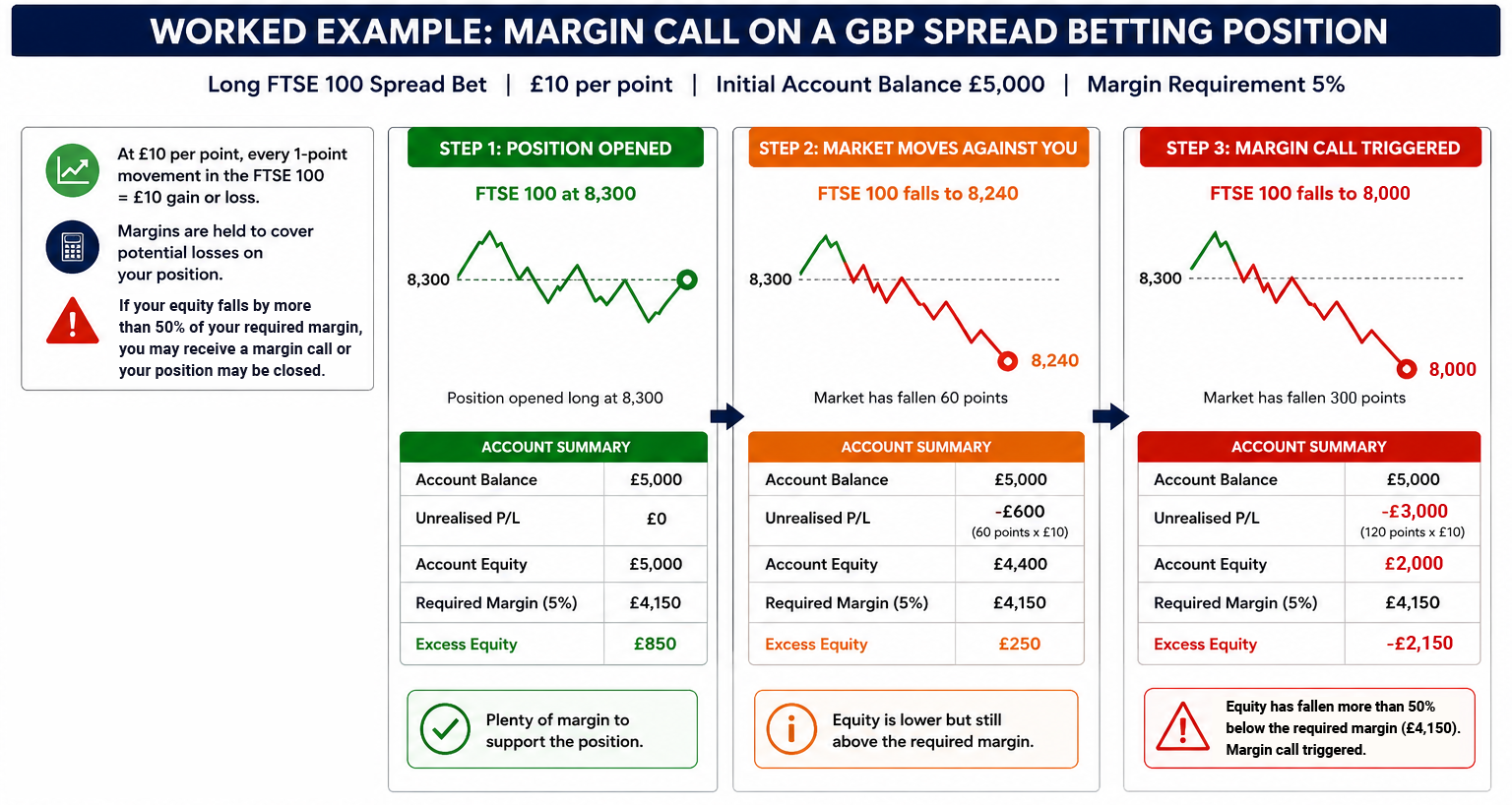
Let’s use a realistic UK spread betting example using GBP per point sizing.
Assume I open a long FTSE 100 spread betting position with the following details:
| Trade Detail | Value |
|---|---|
| Market | FTSE 100 |
| Stake Size | £10 per point |
| FTSE 100 Entry Price | 8,300 |
| Position Value | £83,000 |
| Margin Requirement | 5% |
| Initial Margin Needed | £4,150 |
| Account Balance | £5,000 |
Step 1: Opening the Position
At £10 per point, every one-point movement in the FTSE 100 equals a £10 gain or loss.
The broker requires 5% margin:
£83,000 × 5% = £4,150
So I need £4,150 to open the position.
Because my account has £5,000, I have £850 of excess equity available.
Step 2: The Stock Market Moves Against Me
The FTSE 100 then falls from 8,300 to 8,240.
That is a 60-point loss.
At £10 per point:
60 × £10 = £600
My unrealised loss is £600.
My account equity is now:
£5,000 − £600 = £4,400
I still have enough equity to maintain the trade.
Step 3: The Margin Call Trigger
The market continues falling to 8,000.
Total movement against me is now 300 points.
Loss calculation:
300 × £10 = £3,000
My remaining account equity becomes:
£5,000 − £3,000 = £2,000
The margin call triggers at 50% of the margin required to maintain the position, so in this example, the margin call trigger would be £4,150 x 50% = £2,075. Because my equity has dropped below the required £2,075 margin threshold, the broker may issue a margin call or automatically reduce my exposure.
This highlights why leveraged trading carries higher risk than traditional investing.
Why Margin Calls Happen
Margin calls are usually caused by one or more of the following:
Volatile Markets
Sharp market moves increase losses quickly.
This commonly happens during:
- Central bank announcements
- Inflation data releases
- Geopolitical events
- Earnings season
- Unexpected economic shocks
Forex markets such as EUR/USD can become especially volatile around interest rate decisions from the Bank of England (BoE) or the Federal Reserve.
Using Too Much Leverage
The higher the leverage, the smaller the market move needed to trigger losses.
In my experience testing spread betting platforms on demo accounts, what tripped me up initially was how quickly losses accumulated when increasing my stake size from £2 per point to £10 per point. The market barely moved, but my available margin disappeared much faster than expected.
That is one reason experienced traders often use lower effective leverage than beginners.
Holding Positions Overnight
Overnight financing charges and wider spreads can gradually reduce account equity.
This becomes more noticeable when positions are held for weeks rather than hours or days.
Lack of Risk Management
Many margin calls occur because many traders fail to take appropriate risk management measures including:
- Using stop-loss orders
- Sizing positions appropriately
- Diversifying exposure
- Monitoring available margin levels
What Happens After a Margin Call?
What happens next depends on the broker and market conditions.
Typically, the process looks like this:
- Your available margin falls below the required level (or maintenance margin requirement)
- The broker sends an alert via email, app or platform notification
- You may need to deposit additional funds
- If losses continue, positions may be closed automatically
FCA-regulated brokers are required to offer negative balance protection for retail clients, meaning you cannot lose more than the funds in your account under normal circumstances.
However, large market gaps can still create substantial losses before positions are closed.
How Different UK Spread Betting Brokers Handle Margin Calls
Margin policies vary slightly between brokers, although FCA rules standardise many protections for retail traders.
Below is a comparison of several major UK spread betting providers.
| Broker | Typical Retail Margin Features | Notes |
|---|---|---|
| Pepperstone | Dynamic margining, negative balance protection, platform alerts | Strong platform integration and transparent margin data |
| IG | Tiered margin rates, real-time notifications | One of the largest UK providers |
| CMC Markets | Automatic close-out protections | Detailed margin calculators |
| City Index | Maintenance margin monitoring | Good educational tools |
| Spreadex | Flexible spread betting account structures | Popular among active traders |
| Trade Nation | Fixed-spread focus with margin monitoring | Simpler pricing structure |
One thing I have noticed comparing these brokers is that platform visibility matters almost as much as the margin policy itself. Brokers that display available margin, maintenance requirements and exposure clearly tend to make risk management easier in fast-moving markets.
Margin Call vs Stop Out vs Close Out
These three terms are often confused. A margin call is effectively a warning. A stop out is forced liquidation. A close out is done manually by the trader or automatically via a stop loss order.
Here is the difference:
| Term | Meaning |
|---|---|
| Margin Call | Request for additional funds or warning about low margin |
| Stop Out | Automatic closure of positions by the broker |
| Close Out | A general term for closing a trade, either manually or automatically |
Many modern spread betting platforms move directly to stop outs without requiring manual intervention from the trader.
This is designed to protect both the trader and broker from escalating losses and to avoid margin calls.
How to Avoid a Margin Call
Avoiding margin calls comes down to disciplined risk management.
Here are some ways I recommend that will help prevent a margin call:
Use Lower Leverage
Just because a broker allows high leverage does not mean you should use it. Smaller position sizes reduce the chance of rapid account depletion.
Keep Excess Margin Available
Many experienced traders avoid using all available capital as margin. Maintaining a cash buffer allows trades more room to fluctuate.
Use Stop-Loss Orders
Stop-loss orders automatically close losing trades before losses become too large.
For example, if I enter a FTSE 100 trade at 8,300, I may place a stop at 8,250 to limit downside exposure.
Monitor Economic Events
Volatility often spikes around major economic data announcements including:
- UK inflation releases
- Non-farm payrolls
- Interest rate decisions
- GDP announcements
Checking the economic calendar before trading can help avoid unexpected market swings.
Diversify Exposure
Holding several smaller positions may reduce concentration risk compared to placing all capital into one highly leveraged trade.
Margin Calls in Forex Spread Betting
Margin calls are especially relevant in forex spread betting because currency markets can move rapidly on macroeconomic news.
For example:
- GBP/USD volatility often increases after Bank of England (BoE) announcements
- EUR/USD reacts strongly to US inflation data
- USD/JPY can move sharply during intervention speculation
Forex positions also commonly use higher leverage than indices, meaning traders may reach margin thresholds more quickly.
Margin Calls in Gold Spread Betting
Gold is another market where margin calls are common during volatile periods.
Gold prices react to factors such as interest rates, inflation expectations, US dollar strength and geopolitical uncertainty.
During major geopolitical events, gold can move tens of dollars within hours. At higher GBP-per-point stake sizes, that volatility can trigger margin calls surprisingly quickly.
Are Margin Calls Bad?
A margin call itself is not necessarily bad. In many ways, it is simply a risk-control mechanism built into leveraged trading.
The problem is that repeated margin calls often indicate excessive leverage, poor position sizing, emotional trading and a lack of a clear strategy.
Professional traders generally focus on preventing margin calls entirely through conservative risk management.
FCA Rules and Retail Trader Protections
The Financial Conduct Authority (FCA) introduced stricter leverage rules for retail traders following concerns about excessive losses in leveraged products.
Current FCA protections include:
- Negative balance protection
- Standardised leverage caps
- Risk warnings
- 50% margin close-out rules
These protections have reduced some of the more extreme risks associated with spread betting and CFDs.
However, leveraged trading still remains high risk in my opinion.
Is Spread Betting Tax-Free in the UK?
One reason spread betting remains popular in the UK is that profits are generally exempt from:
- Capital gains tax
- Stamp duty
This tax treatment applies because spread betting is legally classified as gambling rather than investing.
However, the leveraged nature of spread betting means traders still need to manage risk carefully, particularly around margin requirements.
A margin call can happen regardless of the tax advantages.
Common Margin Call Mistakes
Increasing Position Size After Losses
Some traders attempt to recover losses by increasing leverage. This often accelerates margin depletion.
Ignoring Available Margin Warnings
Most platforms provide clear margin indicators. Ignoring them is one of the fastest ways to trigger forced liquidations.
Trading During High Volatility Without Preparation
The following events can dramatically widen spreads and increase margin usage:
- UK budgets
- US CPI releases
- Emergency central bank meetings
Final Thoughts
To summarise, a margin call is a warning your leveraged trade no longer has sufficient funds supporting it.
In UK spread betting, margin calls occur when market losses reduce your available equity below the broker’s required maintenance margin.
Understanding leverage, margin requirements, stop-losses and position sizing is essential before trading markets such as the FTSE 100, EUR/USD or gold.
Used carefully, spread betting can provide flexible market exposure with tax advantages for UK traders. Having said that, leverage can magnify your losses equally as much as your profits, which is why managing margin properly is one of the most important skills any trader can develop.


