7 Spread Betting Strategies Worked Through In Pounds
A spread betting strategy is a fixed set of rules for entering a position, exiting it and sizing the stake. The seven are trend following, breakouts, swing entries, momentum, news events, paired bets and hedging a holding, each with entry, exit and stop rules and a worked example. The stake per point is the money you are willing to lose divided by the stop distance in points. Currency spreads come from our read of each broker’s figures on 18 Sep 2026.
Our spread bet content is supported by broker partners, who pay us on a retainer basis rather than per referral.
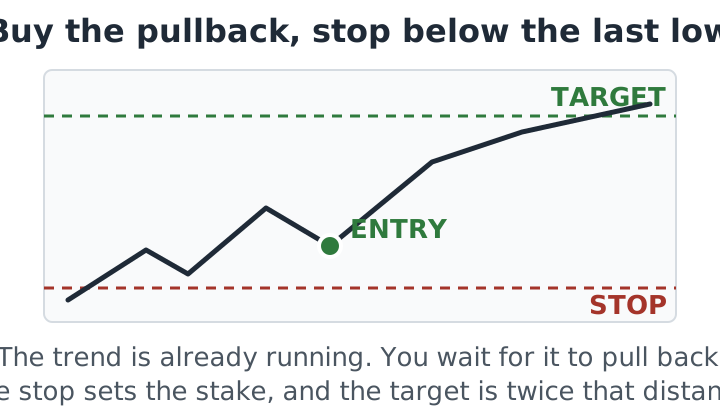
The first setup: buy the pullback in a running trend, with the stop below the last low and the target twice that distance above it.
Which Spread Betting Strategy Should You Use?
Pick the setup that fits the time you can give the screen. The table gives three starting points.
Three reader situations, with which strategy to start with and why.
If you are
Start with
Because
New to spread betting
Trend following at the smallest stake your provider allows
One decision a day, on a daily chart, and a wrong call costs pounds rather than hundreds
Trading around a job
Breakouts, with a guaranteed stop attached
The order sits at a price level and fills without you, so the bet does not need watching
Already running a written plan
Momentum and news setups
Both need you at the screen while the move happens, and both reward a plan you already follow
Every worked example below uses one of two quotes. Index examples take the FTSE 100 around its close of 10,854 on 24 August 2026. Currency examples take the pair’s level from our rate snapshot of 21 August 2026. The spread comes from our monthly read, each broker’s own published figure, read from its UK site on 18 Sep 2026 and re-read monthly. Nothing here predicts what a market will do, only what the arithmetic does when it moves. Anyone new to the mechanics can start with our spread betting guide, which covers stake per point, margin and the spread first.
1. Trend Following
Trend following buys a market that is already rising and sells one that is already falling. It works when a market moves in one direction for weeks, and it fails in a range, where the same signal fires in both directions and both are wrong.
Entry. Buy a pullback into the 20-day moving average while the 50-day average is rising.
Exit. Close on the first daily close back below the 20-day average.
Stop. 10 points below the last swing low, and set when the bet opens.
GBP/USD sat at 1.3629 on 21 August 2026. You buy at £2 per point with the stop 40 points away, so £80 is the money at risk. The pair runs to 1.3749 and the 20-day average catches up behind it; you close there. That is 120 points at £2, or £240.
Across the 5 brokers that publish a comparable GBP/USD figure, the average is 1.2 points in our spread read of 18 Sep 2026. At £2 per point the bet opens £2.40 down, which is 3% of the £80 at risk.
2. Breakout Trading
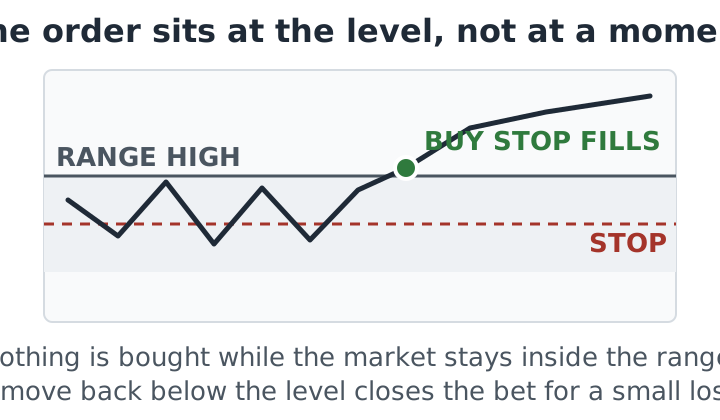
A breakout bet is placed at a price level rather than at a moment. You mark the high of a range, leave a buy stop above it, and the market decides whether the bet happens.
The breakout entry. The buy stop rests above the range high and fills only when the market trades through it; the stop goes back inside the range the market just left.
Entry. A buy stop 5 points above the range high. No manual entry, because the level is the signal.
Exit. First target at the height of the range added to the breakout level.
Stop. 15 points below the entry, back inside the range the market just left.
Say the FTSE 100 has spent three sessions between 10,780 and its 24 August 2026 close of 10,854. You leave a buy stop at 10,859 with a £3 stake and a stop at 10,844. The order fills, the index trades to 10,866, turns, and the stop closes the bet at 10,844. That is 15 points at £3, a £45 loss. False breaks like this one are the routine cost of the setup, and the reason the stop goes in with the order rather than after it.
The stop in that example is an ordinary order, so once triggered it closes at the next available price. In a gap past 10,844, the close would land beyond that level, and the loss would exceed £45 by £3 for every extra point. A guaranteed stop closes at your level even in a gap. Of the 14 brokers we rank, 8 offer one. The stop-loss order guide covers both order types and what the guarantee costs. The page on slippage on stop orders explains the gap between the level you set and the price you get.
3. Swing Trading
A swing bet holds for two to ten days and takes one leg of a move rather than the whole trend. The entry is a support or resistance level that has already held, and the exit is a fixed target, not a trailing rule.
Entry. Buy at a support level that has held twice in the last month, on the first daily close back above it.
Exit. The prior high, as a limit order left in the market.
Stop. 30 points below the support level.
Take EUR/USD at its 21 August 2026 level of 1.1678, and say it sells back to 1.1610, a support level it has already held twice. The entry rule is the first daily close back above that support, and it comes at 1.1625, where you buy at £5 per point. The stop sits at 1.1580, 45 points away, so £225 is at risk. The exit is the prior high at 1.1710, left as a limit order, and it fills. That is 85 points at £5, or £425.
EUR/USD averages 0.7 points across the 5 brokers that publish a comparable figure, in our spread read of 18 Sep 2026, so a £5 stake opens £3.50 down.
4. Momentum
A momentum bet buys the strongest market in a group and holds it while it stays strongest. The signal is relative: the market has to be outrunning its peers, not merely rising.
Entry. Of the five indices you follow, buy the one with the highest 12-week gain, on the first day it makes a new 12-week high.
Exit. Close when it drops out of the top two on the same 12-week measure.
Stop. A fixed 120 points below the entry, set when the bet opens.
You buy the FTSE 100 at 10,854 with £2 per point and the stop at 10,734, so £240 is at risk. The index holds its place at the top of the group for six weeks. It slips to third and you close at 11,120, which is 266 points at £2, or £532.
Overnight funding is charged for every night the bet is held, and the daily arithmetic, with a calculator, now sits in the overnight funding section on daily funded and quarterly bets in our spread betting guide.
5. News Events
A news bet is a position taken around a scheduled release: a Bank of England rate decision, a US payrolls print, a company’s results. The rule that matters most is the one about when not to be in.
Entry. Only after the release, once the first five-minute candle has closed. Never before it.
Exit. The same session, whatever the result.
Stop. Guaranteed, because an ordinary stop can fill well past its level when a market gaps.
This is the bet the entry and stop rules exist to prevent, a position held into the release. GBP/USD sits at 1.3629 before a rate decision, and someone sells at £2 per point with an ordinary stop 40 points away at 1.3669, sizing the bet at £80. The decision surprises, the pair gaps to 1.3702, and the stop fills there. That is 73 points at £2, a £146 loss on a bet sized at £80. A guaranteed stop would have closed it at 1.3669 for the £80 intended, plus its premium. Waiting for the first five-minute candle after the release keeps the bet out of that gap.
6. Paired Bets
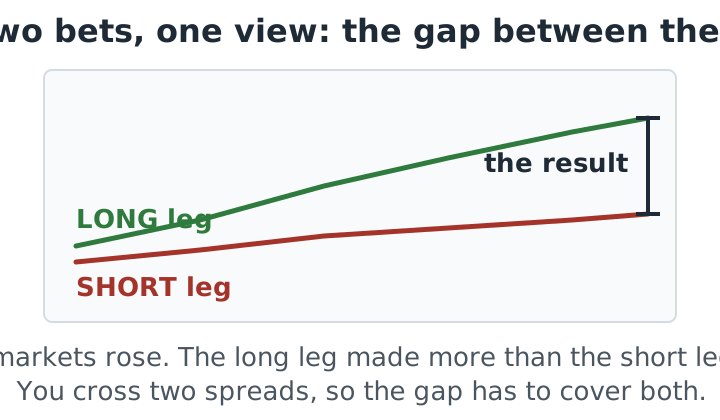
A paired bet is two positions at once: long the market you expect to do better, short the one you expect to do worse. What is left after the two legs cancel is a bet on the gap between them rather than on either direction.
A paired bet. Both legs rise; the result is the gap that opens between the long leg and the short leg, not either direction on its own.
Entry. Both legs at the same stake per point, opened together, on markets that move in comparable point sizes.
Exit. Both legs together, when the gap has closed or the reason for it has gone.
Stop. On the combined result, not on either leg, because one leg is supposed to lose.
On 21 August 2026 EUR/USD was 1.1678 and GBP/USD was 1.3629. You go long EUR/USD at £2 per point and short GBP/USD at £2 per point, which leaves a bet that the euro outruns the pound. Two weeks later EUR/USD is 1.1750, up 72 points and worth £144, while GBP/USD is 1.3680, up 51 points and worth −£102. The pair of bets returns £42 before costs.
You cross two spreads instead of one. In our spread read of 18 Sep 2026, EUR/USD averages 0.7 points across the 5 brokers that publish a comparable figure. GBP/USD averages 1.2 points across the 5 that do. Together that is £3.80 at £2 per point on each leg, which is 9% of the £42 the legs returned.
The same-stake rule only holds where both markets move in similar numbers of points. Even the example’s two pairs differ. Over the 20 trading days to 28 Aug 2026, GBP/USD’s average daily range was 1.3 times EUR/USD’s, so the short leg swings more on an ordinary day. Pair the FTSE 100 near 10,854 against an index quoted near 24,000 at equal stakes and the second leg carries 2.21 times the exposure of the first. That position is a short with a partial hedge rather than a paired bet.
7. Hedging A Holding
A hedge is a spread bet placed against something you already own, so you can hold a position through a fall without selling it. The purpose is to buy time, not to make money on the bet.
Entry. Short the index your holdings track, at the stake that matches their exposure to it.
Exit. Close the short when the reason for it has passed, not when it happens to be in profit.
Stop. None on the hedge itself. The holding is the other side of it.
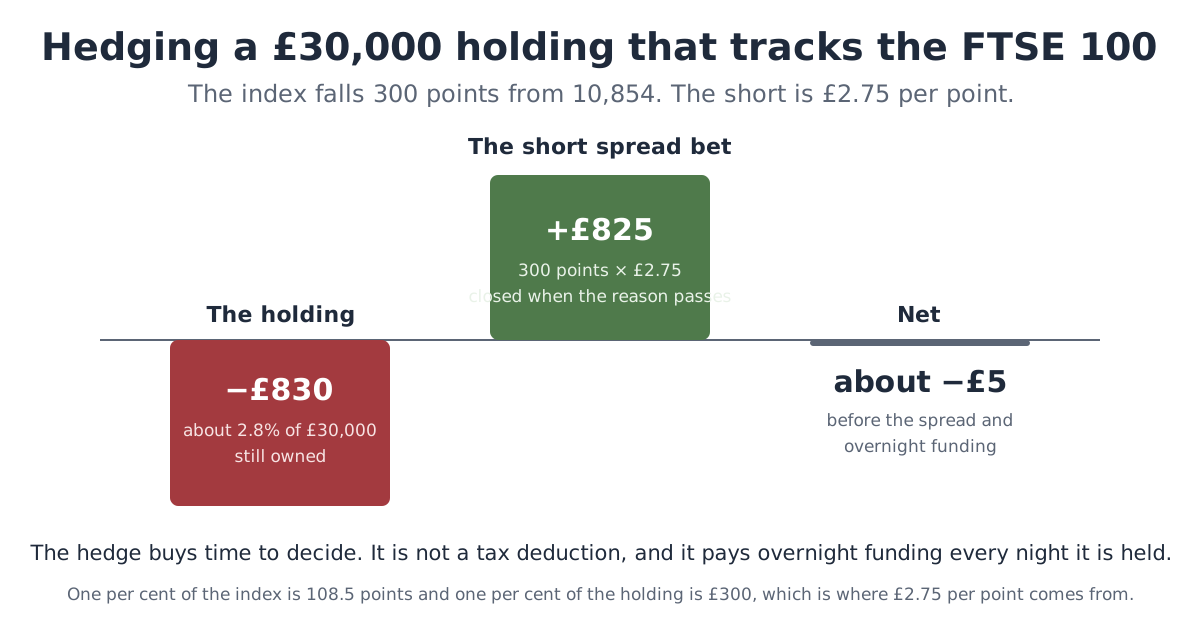
Take a £30,000 UK equity holding that tracks the FTSE 100 at 10,854. One per cent of the index is 108.5 points and one per cent of the holding is £300. A stake of £2.76 per point offsets it, rounded to £2.75. The index falls 300 points. The holding loses £829.19 and the short makes 300 points at £2.75, or £825. The net result is £4.19 down, before the spread and overnight funding.
The holding loses £829.19 on a 300-point fall, and the short at £2.75 per point makes £825. The net is £4.19 down before the spread and overnight funding.
Overnight funding is charged every night the short is held. A losing spread bet cannot be set against a gain on the shares. The treatment that keeps spread betting profits out of Capital Gains Tax keeps the losses out too. That holds for most retail traders. Tax treatment depends on your individual circumstances and can change, so you should seek professional tax advice if you’re unsure. Our spread betting tax guide sets out that position.
How Do You Size A Spread Betting Position?
Divide the money you are willing to lose on the bet by the distance in points to your stop. The answer is your stake per point, and it is the only part of the setup you control completely.
Stake per point = risk in £ ÷ stop distance in points. At 1% of the account per bet the table runs like this, with every stake rounded down to the penny so the risk is never exceeded.
Three account sizes, with the 1% risk in pounds and the stake per point at 30, 60 and 120 point stops.
Account
1% risk
30-pt stop
60-pt stop
120-pt stop
£1,000
£10
£0.33
£0.16
£0.08
£5,000
£50
£1.66
£0.83
£0.41
£10,000
£100
£3.33
£1.66
£0.83
The margin a position ties up comes from spread betting leverage, while the stop sets the money at risk. The FCA’s rule for retail clients puts margin at 5% of the exposure on a major index such as the FTSE 100. At that rate the momentum example ties up £1,085.40 and the hedge example £1,492.43. Source: FCA COBS 22.5.11R, read .
The £1,000 row is the one that bites. IG’s minimum of £0.50 a point on the FTSE 100 and GBP/USD sits above every stake in that row, so those stakes cannot be placed at IG. Providers such as CMC Markets and Spread Co publish minimums from £0.01 a point, so those stakes can be placed there. At £0.08 a point, a 40-point day turns into £3.20, so the account is a sizing problem before it is a strategy problem. Widening the stop to fit a stake you like reverses the arithmetic and is the mistake in the list below.
The sizer below runs the same sum on your own balance, risk and stop, and shows the stop against the market’s measured daily range. Volatility, measured from our daily-bar dataset over the 20 trading days to 28 Aug 2026, shows GBP/USD’s average daily range at 57.9 points and EUR/USD at 44.7 points; your stop has to survive that range. Cost, margin and the broker comparison live on our spread betting calculator page.
Stake per point from your risk
Turn a money risk and a stop distance into a stake
Risk on this bet
Daily range window: 20 trading days to 28 Aug 2026
Risking £50.00(1% of £5,000) with a 40-point stop on GBP/USD gives a stake of £1.25 per point. If the stop is hit you lose £50, though a normal stop can fill beyond its level if the market gaps.
Stop 40 points
Average daily range 57.9 points
02957.9
The 40-point stop is 69% of GBP/USD's average daily range, measured at 57.9 points over the 20 trading days to 28 Aug 2026. The same £50 risk with a stop the full width of that range is a stake of £0.86 per point.
Range is the average daily high-to-low over the stated window, from our dataset of daily bars (5pm New York day boundary). The calculator rounds the stake down to the nearest £0.01, so the risk figure is never exceeded. A stake below a provider's minimum bet cannot be placed. A guaranteed stop holds the loss at exactly the stop for a premium; a normal stop can fill beyond it in a gap.
We hold no measured daily-range dataset for this market, so no range comparison renders. The calculator rounds the stake down to the nearest £0.01, so the risk figure is never exceeded. A stake below a provider's minimum bet cannot be placed. A guaranteed stop holds the loss at exactly the stop for a premium; a normal stop can fill beyond it in a gap.
Spread Betting Tips That Matter
These are execution habits rather than strategies. They decide whether a setup that works on a chart survives contact with a live account.
Set the stop when the bet opens, in the same ticket, not once the position has moved.
Write the exit before the entry. A bet with no exit rule closes on feeling, usually at the wrong end.
Trade one market until you know its normal day. A stop set inside a market’s ordinary daily range is noise, and one market watched for a month is how you learn what that range is.
Record every bet with its entry, stop, exit and the reason you took it. Thirty rows tell you which setup is paying for the others.
Close the platform between setups. Screen time creates bets the plan never asked for.
Check the overnight funding before holding past the close. A six-week momentum bet pays it 42 times.
Holding periods shorter than a session are their own discipline, and our day trading page covers what changes at that speed.
What Are The Most Common Spread Betting Mistakes?
Sizing from the stake instead of the stop. On a £5,000 account, choosing £5 per point first and then placing the stop 60 points away puts £300 at risk. That is 6% of the account against a rule of 1%.
Adding to a loser. Averaging down improves the entry price on paper and doubles the exposure in fact.
Running four setups at once. Thirty bets spread across four rules is seven or eight each, which is not enough to tell you which of them works.
Spread Betting Strategy FAQs
Is Any Spread Betting Strategy The Most Profitable?
No spread betting strategy is the most profitable one, because a strategy manages risk rather than producing a return. Between 60.7% and 76.6% of retail investor accounts lose money across the 14 brokers we compare. Judge a new setup over about 30 bets rather than three, starting at the smallest stake the provider allows.
How Much Should You Risk Per Trade?
The sizing table on this page stakes 1% of the account on each bet. With the stake fixed from the starting balance, 10 losing bets at 1% each cost 10% of the account. At 10% each, the same run costs 100%, the whole account.
Do Spread Betting Strategies Work In Falling Markets?
Going short is the same ticket as going long, so every setup on this page reverses. You sell the rally in a downtrend instead of buying the pullback in an uptrend.
How Long Should You Demo Trade First?
Long enough to place 20 to 30 bets under the rules you intend to trade. That is a few weeks on a daily-chart setup and a few days on an intraday one. The purpose is to learn the order ticket and prove you can follow your own exit rule. The discipline of risking real money is learned only live, so move to the smallest live stake after that. Our page on demo accounts covers what each provider offers.
Bear in mind that there is always a risk involved with spread betting, and only capital you can afford to lose belongs in the account. This page is information rather than financial advice. Which provider you place these bets with is a separate decision. Our ranking of UK spread betting platforms covers spreads, markets and risk tools across the brokers we rank.
Justin Grossbard co-founded Spread-Bet.co.uk with Noam Korbl in 2024, and co-founded the broker comparison network CompareForexBrokers with him in 2014. He has written for Kiplinger, Entrepreneur, Finance Magnates and MoneyShow since 2022, with articles on forex and trading at MoneyShow, Finance Magnates and Kiplinger.
Updated . Updated on 14 Oct 2026: The loss-figure range across the 14 brokers now starts at 60.7% at Spread Co, from 61% at Spreadex. The highest figure is unchanged at 76.6% at OANDA.