
Spread betting indices means staking pounds per point on the level of a stock market index, such as the UK 100, the FTSE 100, where one point is one index point. A £2 per point bet gains £100 on a 50-point rise and loses £100 on a 50-point fall. The FCA caps retail leverage on a major index at 20:1, so the margin is 5%. IG listed 69 index markets for spread betting on its UK site when we read it on 25 Aug 2026.
Why Spread Bet With Indices?
Market Diversification
Indices represent a basket of stocks, offering traders diversified exposure to various companies and sectors within a specific market.
When you spread bet on indices, you’re betting on the overall market, and not just a single stock that could fluctuate for the smallest of reasons, such as a change of CEO or a bad showing at an industry event.
Betting on the overall market rather than a single stock is the same mechanics as any spread bet, and our guide sets out how spread betting works from stake to settlement.
No Commissions
Index spread bets are commission-free at the brokers whose charges we read, IG, StoneX Trading and Pepperstone, so the spread is where the dealing cost sits. The spread is not the whole cost. A position held past the broker’s daily cut-off pays an overnight funding charge, and a guaranteed stop carries a premium where one is used.


What Is an Index?
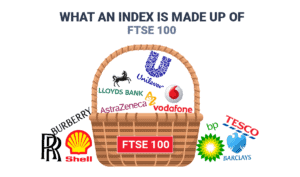
An index is a numerical representation of the prices of a collection of underlying stocks. Market indices, such as the FTSE 100 and S&P 500, track the value of top companies within their respective markets.
How Does Spread Betting With Indices Work?
Price an index bet with the calculator: enter the level from your platform’s deal ticket, your stake per point and your provider’s spread.
Spread betting calculator
Cost, profit or loss, and margin on one bet
On one point is a move, so £ per point is £ per pip. is points.
UK 100 is quoted in index points: one point is a 1.0 move of the level, and the bet is priced per index point.
Opening level from the Fri 2 Oct 2026 5pm New York close Opening level: your own figure, from your platform's deal ticket Spread: published, 18 Sep 2026 Spread: your own figure
A buy at £2 per point that closes 80 points higher makes £ before the spread. -point spread costs £ on this bet, leaving £. The margin held to open it is £.
Enter the level from your platform's deal ticket and your provider's spread in points; the ledger then prices the bet.
HMRC's Capital Gains Manual (CG56105) states that no chargeable gains or allowable losses arise from spread betting. For most UK retail traders, profits are therefore free of Capital Gains Tax. Tax treatment depends on individual circumstances and can change. See how spread bets are taxed. Overnight funding is not included; see overnight funding in spread betting. Spreads are the brokers' own published figures, read on 18 Sep 2026, or your own figure where you type one; neither is a quote at the moment you deal. Margin uses the FCA COBS 22.5 retail leverage cap for the market class.
Examples of Indices Spread Betting
Example 1: Going Long On FTSE 100
You’ve been closely analysing the FTSE 100 and you’ve noticed strong support at 7100. Believing that the market is poised for an upward movement, you decide to go long on the FTSE 100.
- Entry Point: You enter the trade at 7115 with a stake size of £3 per point.
- Outcome: Over the next week, the FTSE 100 indeed climbs, reaching 7260. You decide to close the position, making a profit of 145 points (7260 − 7115) or £435 (£3 x 145 points).
Example 2: Going Short On UK 100
After a period of extended gains in the FTSE 100, you start observing signs of overvaluation and foresee a correction. To capitalise on the potential downward movement, you decide to go short on the FTSE 100.
- Entry Point: You initiate the short position at 7325 with a stake size of £4 per point.
- Outcome: Unfortunately, the market sentiment changes, and the FTSE 100 rallies to 7380. You decide to cut your losses and close the position, resulting in a loss of 55 points (7380 − 7325) or £220 (£4 x 55 points).
What Are the Most Popular Index Markets?
Spread-betting index markets tend to be made up of most of the world’s largest stock markets.
Some of the most popular index markets for spread betting include:
- FTSE 100: Represents the top 100 companies listed on the London Stock Exchange.
- DAX (Germany 40): Tracks the 40 largest Frankfurt Stock Exchange companies that meet quality and profitability requirements. (STOXX, read )
- S&P 500: An index of 500 of the largest publicly traded companies in the United States.
- Dow Jones Industrial Average: Tracks the performance of 30 large publicly-owned companies in the U.S.
- NASDAQ 100: Consists of 100 of the largest non-financial companies listed on the NASDAQ stock exchange.
- CAC 40: Represents the top 40 companies on the Euronext Paris market.
- Nikkei 225: A price-weighted index of 225 Tokyo Stock Exchange Prime Market stocks, selected for liquidity and sector balance. (Nikkei Inc., read )
- Hang Seng Index: Follows the performance of 95 constituents listed on the Hong Kong Stock Exchange. (Hang Seng Indexes, read )
Index bets sit among the other markets you can spread bet on, alongside currencies, commodities and shares. What each broker publishes for index bets, and how its figures compare, follows below.
How Do UK Spread Betting Brokers Compare On Indices?
Only StoneX Trading and Spread Co publish fixed index spreads, so theirs are the only index spread figures that compare like for like. StoneX Trading’s FTSE 100 spread is fixed, and Spread Co’s FTSE 100 spread is fixed during the London session and wider before and after it. IG publishes floors, Pepperstone publishes a minimum and ThinkMarkets publishes targets, and none of those is what a typical trade pays.
| Broker | Index markets | Index spreads it publishes | Guaranteed stops |
|---|---|---|---|
| Pepperstone | 20+ | S&P 500: 0.4 points (minimum) | No |
| Spreadex | 30+ | Yes | |
| IG | 69 | FTSE 100: from 1 point Germany 40: from 1.2 points Wall Street: 2.4 points (minimum) | Yes |
| Capital.com | 35+ | Yes | |
| ThinkMarkets | 18 (our count) | FTSE 100: 0.9 points (target spread) S&P 500: 0.4 points (target spread) | |
| StoneX Trading | 40+ | FTSE 100: 1 point (fixed) | Yes |
| Trade Nation | over 40 | Yes | |
| CMC Markets | over 80 | Yes | |
| Spread Co | 12 (our count) | FTSE 100: 0.6 points fixed, 08:00 to 16:30 (4.1 pre-market, 1.1 post-market) S&P 500: 0.4 points fixed, 14:30 to 20:59 Nasdaq 100: 0.5 points fixed, 14:30 to 20:59 | Yes |
These are each broker’s own published figures, read from its UK site on 22 Sep 2026. "(our count)" marks a market count we made from the broker’s own instrument list on 22 Sep 2026. These index figures are separate from our monthly spread read, which covers forex pairs.
To help traders we built a page where you can compare spread betting platforms matched to the needs of different segments.
How the guaranteed stop premium is charged differs by broker. Capital.com charges it only if the order is triggered, shown on the deal ticket before the position opens. CMC Markets charges it when the order is placed and refunds it in full if the stop is never triggered. StoneX Trading shows it on the next statement. IG’s FTSE 100 premium is 0.8 points. A guaranteed stop closes at the level set, whatever the market does, and how reliably ordinary stops filled is what our timed FTSE 100 orders measured.
How Did FTSE 100 Orders Fill In Our Execution Test?
Our execution test measured FTSE 100 order fills, with a median slippage of 0.25 points. The test placed 98 orders on live funded accounts across 14 FCA-regulated spread betting brokers between 18 and 27 August 2026. Slippage is recorded unsigned, in points: the distance from the requested level, not the direction.
Triggered ordinary stop orders saw median slippage of 1.00 points, with the largest at 2.50 points. Of the filled limit orders, 0 of 28 filled away from the requested level. 6 of the 98 orders were requoted or rejected. The gap between an ordinary stop level and its fill is part of the cost of the bet. We would not treat an ordinary stop on the FTSE 100 as a guaranteed exit level. Every broker and both instruments sit in the full slippage dataset.
What Is the Leverage for Indices Spread Betting?
The FCA permits leverage of 20:1 (5% margin) for major indices and 10:1 (10% margin) for minor indices. Leverage allows you to take a position of 10 or 20 times the trading margin you have in your account.
FAQs
What Is A Good Spread In Indices?
A good spread in indices spread betting is one that is narrow or tight, indicating a smaller difference between the bid (sell) and ask (buy) prices. The spread represents the cost of entering a trade, and a narrower spread can be more favourable for traders as it reduces the overall cost.
Is Index Spread Betting Profitable?
Index spread betting is not shown to be profitable for most retail clients: at every broker we rank, most retail investor accounts lose money. Between 61% and 76.6% of retail investor accounts lose money across the 14 brokers we rank, from Spreadex to OANDA. These figures cover each firm’s retail accounts as a whole, spread bets and CFDs together, and they do not isolate index bets. Our review of what UK firms are required to publish collects these disclosures in one place.
Can You Spread Bet Crypto Indices?
No, retail traders in the UK cannot spread bet crypto indices. The FCA banned the marketing, distribution and sale to retail consumers of derivatives referencing certain cryptoassets. The ban covers crypto indices as well as single coins, as the FCA’s policy statement PS20/10 sets out. IG lists a Crypto 10 Index spread bet, available only to professional clients.


Reader Questions
Do you need to follow the news closely to trade indices?
Definitely. News plays a huge role in how indices move, so stay on top of current events.
What’s the best strategy for spread betting on indices?
I like to use a mix of technical analysis and news — watching key levels on the chart is important.