Spread betting leverage lets you control a large position with a small deposit, called margin. The FCA limits retail leverage to 30:1 on major currency pairs (3.33% margin), 20:1 on major indices and gold (5% margin) and 5:1 on individual shares (20% margin). Losses are calculated on the full position. Your broker closes positions when account equity falls to 50% of the margin required.
Updated on 3 Sep 2026: the page moved onto the site’s guide layout, with the FCA leverage ladder drawn beside the answer and a step-by-step diagram of the margin call example. One correction in that example: the loss on a 100-point fall at £1 per point now reads £100, which is what the margin figures beside it were already computed on; the sentence had said £10.
Reviewed on 25 Aug 2026 in a site-wide accuracy pass: broker figures were re-checked against each broker’s own UK source, claims that disagreed with the source were corrected, and figures no broker publishes were removed. Each month we also update the average spreads data published by the brokers.
Our spread bet content is supported and we may receive payment when you visit a partner site.
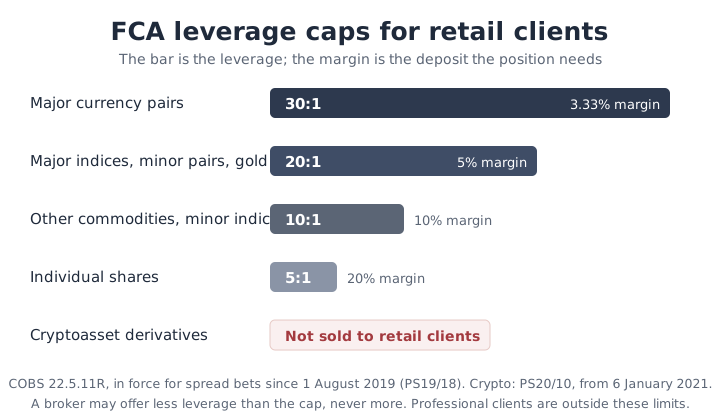
The retail leverage caps by asset class, from 30:1 on major currency pairs to 5:1 on individual shares. The bar is the leverage; the margin is the deposit the position needs.
What Is Spread Betting Leverage?
Spread betting leverage allows you to use a small amount of your own capital to control a much larger position size and potentially amplify your profits (and losses).
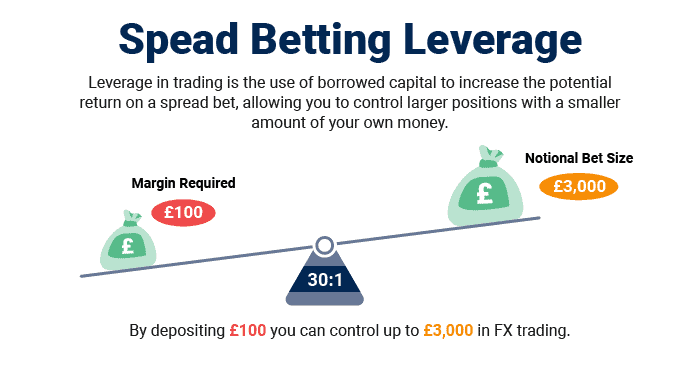
For example, if a broker offers 30:1 leverage, you can open a £30,000 trade with just £3,000 in your account. If the market moves in your favour, you’ll earn profits based on the full £30,000 position, which is why leveraged-based trading is a popular option for UK traders. However, it’s crucial to remember that leverage is a double-edged sword. While it can amplify your gains, it can also magnify your losses by the same amount.
You will find that your broker expresses leverage as a ratio, such as 30:1, 10:1, or 5:1. So if a broker is offering a 10:1 leverage, this means for every £1 you put up as a margin (collateral) the broker will loan you £10 to open the position.
The higher the ratio, the less capital you need to open a position. In spread betting, the leverage available varies depending on the market, with the most liquid markets offering the highest leverage:
For a retail client of an FCA-authorised broker these are not the broker’s choice: the FCA has capped them since 1 August 2019, and the caps still stand as of 25 August 2026. A broker may offer less leverage than the cap, never more.
Major currency pairs: 30:1
Non-major currency pairs, gold and major stock indices: 20:1
Commodities other than gold, and non-major stock indices: 10:1
Individual shares and other reference values: 5:1
Cryptocurrency derivatives are not on the ladder at all: the FCA banned their sale to retail clients in January 2021. These are the figures used everywhere on this page.
How Spread Betting Leverage Works
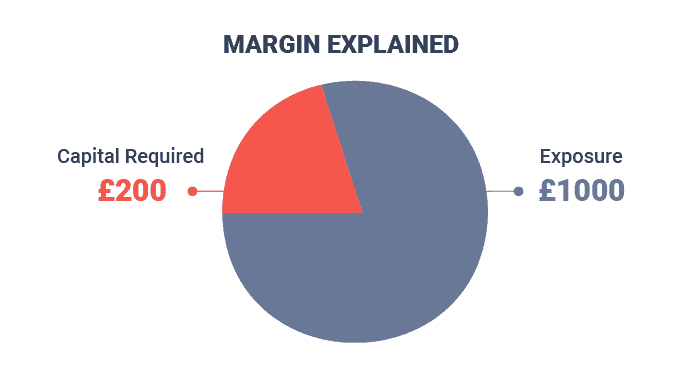
Leverage is a key feature of financial spread betting, allowing you to control a larger position with a small amount of capital, known as the margin. For example, a 10% margin means I only need to deposit £500 to control a £5,000 position. If the market moves in my favour, my profits will be based on the full position value (£5,000), not just my deposited amount.
While leverage can drastically increase potential profits, it equally heightens the risk of losses. I can’t stress enough how paramount effective risk management is for safeguarding my capital. If I open a position at the 30:1 maximum and the trade goes against me, my losses accumulate thirty times faster than the price move.
What is the maximum leverage available in UK for spread betting?
30:1, on the major currency pairs such as EUR/USD and GBP/USD. Every other market sits lower, on the ladder set out above. The FCA capped leverage for spread betting in 2019 to stop retail traders taking positions they could not fund.
If you are an elective professional, you can waive your retail trader status and the FCA’s consumer protections in favour of higher leverage. This professional status allows you to access leverage of up to 300:1, depending on which broker you spread bet with.
Margin Requirements In Spread Betting
In spread betting, the margin is the capital you need in your trading account to place a spread bet. Since spread betting is a leveraged product, your account must have enough funding to cover the margin requirements to open and maintain a betting position. Margin essentially acts as a guarantee you can fulfill the terms of the bet.
The amount of margin you will need in your trading account is based on a percentage of your total position size. Margin requirements (also called the ‘notional trading requirement’ will vary depending on the financial market you bet on. More volatile assets, typically require larger deposits in your trading account.
To open a leveraged spread bet, you must meet the minimum margin requirement, which is a percentage of the full trade value called the initial margin.
The initial margin is expressed as a percentage of the notional trade value, such as 20% for stocks or 3.33% for major forex pairs. So, if you want to open a position on EUR/USD, you must have 3.33% of the total trade size as the initial margin.
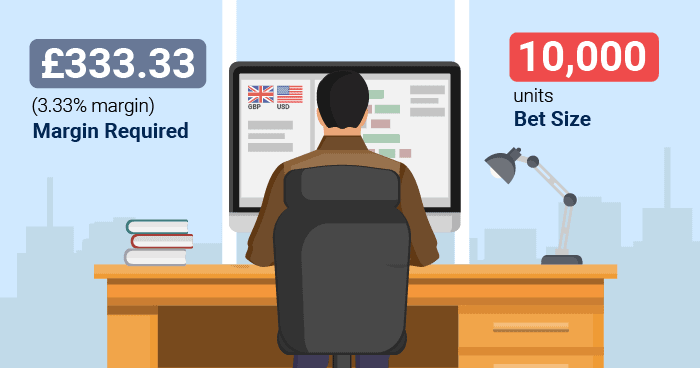
For example, if you wanted to open a micro lot trade (10,000 units) on GBP/USD, you would need a 3.33% initial margin to place your spread bet. The margin you need to deposit would be £333.30 to control £10,000. Fortunately, the broker provides all of this information for you, so you won’t have to do the maths.
If your trade starts moving against you, your broker may request additional funds to keep the position open, known as a margin call. This ensures you have enough capital to cover potential losses.
Initial margin vs. maintenance margin
When spread betting, you will come across two different margins, which are called initial and maintenance. The initial margin is the required amount to open a position, while the maintenance margin is the minimum required to continue holding it without facing a margin call. Below, I have broken down what each means:
Initial Margin
Minimum amount of funds to open a spread bet position to use the full amount of leverage offered
Typically higher than the maintenance margin
You can deposit more as a margin, which lowers your leverage
Maintenance Margin
The minimum amount of funds that must be maintained in the margin account to keep the spread bet open to avoid a margin call
Lower margin compared to the initial margin, typically 50% of the initial margin required
If the value of your margin drops below the maintenance margin, the broker will issue a margin call for you to top up your funds or prepare to close the bet.
The maintenance margin ensures you have sufficient capital to protect the brokerage from losses.
Margin Call Example
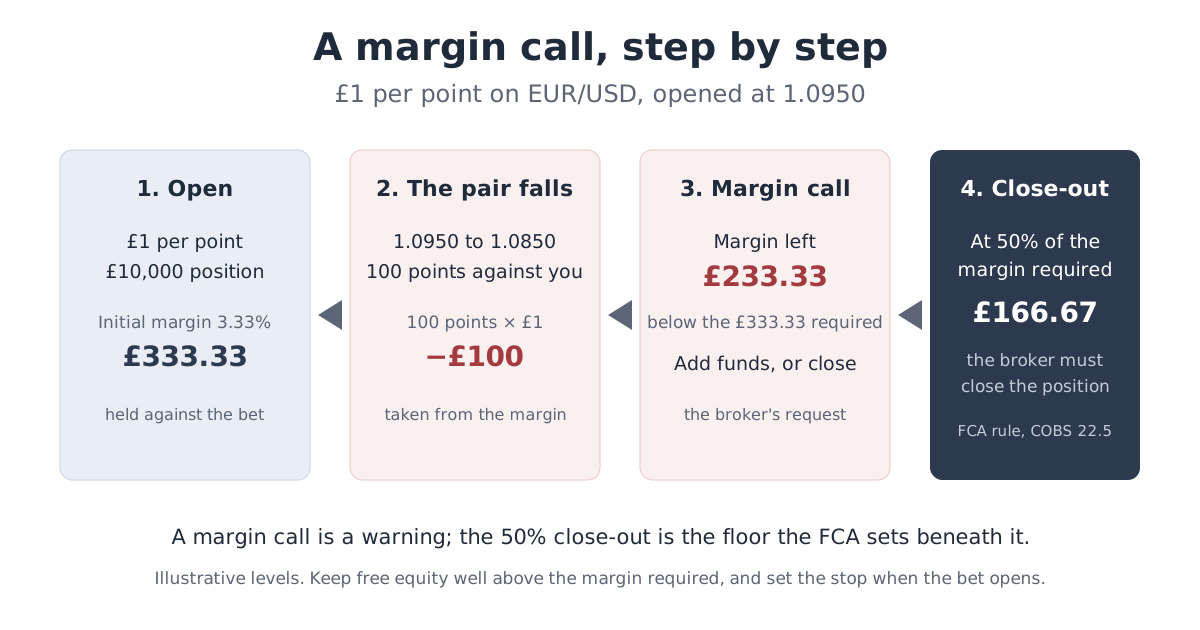
Let’s say you want to open a £1/point (£10,000 position) spread bet on EUR/USD at 1.0950. The margin requirement is 3.33%, so you need £333.33 as the initial margin.
EUR/USD then falls to 1.0850, resulting in a loss of £100 (100 points x £1/point). This means your margin has dropped to £233.33. As your margin is now below the £333.33 margin required to maintain the open position, your broker may request you deposit additional funds or close the trade.
The margin call example, step by step. £1 per point on EUR/USD is a £10,000 position, so 3.33% initial margin is £333.33. A 100-point fall costs £100 and leaves £233.33, below the margin required, which is the margin call. At £166.67, half the margin required, the FCA’s close-out rule obliges the broker to close the position.
To avoid margin calls, you should monitor your positions, use stop losses, and not have multiple trades open at once in your account. Keep your free equity comfortably above margin requirements at all times.
Enter a bet and an account balance to see the margin held at the FCA cap, and the level at which the 50% close-out rule would require the broker to act.
Margin and close-out level
Margin at the FCA cap, and where a 50% close-out would land
Direction
Level 1.3521, Fri 4 Sept 2026 5pm New York closeLevel: your own figureMajor pair: FCA cap 30:1, margin 3.33%
£5 per point on GBP/USD at 1.3521 is £67,605 of exposure and needs £2,253.50 margin. With £3,000 in the account, a fall of 375 points to 1.3146 takes equity to 50% of that margin, the point at which FCA rules require the broker to close the bet.
£5 per point on GBP/USD needs £2,253.50 margin, and the £3,000 balance is below it: the bet cannot be opened at this size.
Enter the level from your platform's deal ticket; the ledger then computes the margin and the close-out level.
1.3146close-out (50% of margin)375 pointsthe balance absorbs first1.3521opening level
Exposure13,521 points × £5.00 per point£67,605.00
Margin heldExposure ÷ 30£2,253.50
Equity at which close-out triggers50% of margin held£1,126.75
Loss the balance can absorb first£3,000.00 − £1,126.75, at £5.00 per point = 375 points£1,873.25
Balance below the margin required: the bet cannot be opened at this size£746.50 short
Margin uses the FCA COBS 22.5 retail cap for the market class, which every FCA-regulated broker must apply; a broker may hold more, never less. Close-out is the FCA's 50% margin rule; brokers may act sooner. The walk ignores the spread and overnight funding.
Leverage and margin set the deposit a spread bet needs on day one. A position held past the daily cut-off then pays overnight funding, and this page explains how overnight funding is charged.
Benefits and risks of leveraged spread betting
While leverage is a powerful tool that can boost your profits, it’s essential to understand and manage the inherent risks. Below, I’ve highlighted the key points I think you should know:
Advantages
It allows you to capitalise on smaller market movements by controlling larger positions with fewer funds and profiting as if you owned the full bet size.
Leverage enables you to trade multiple assets at once with fewer funds, helping spread the risk.
It enables you to go short and profit from falling markets, as you are betting on the price direction while not owning the asset.
Disadvantages
It amplifies your losses as easily as it does your winners. As you control a larger position, you’ll also suffer larger losses if you get the price direction wrong.
If you hold a spread bet overnight, you are charged financing, which is charged on the full position size (not your margin). So, it isn’t ideal for long-term trading.
Encouraged to trade with maximum leverage for every bet
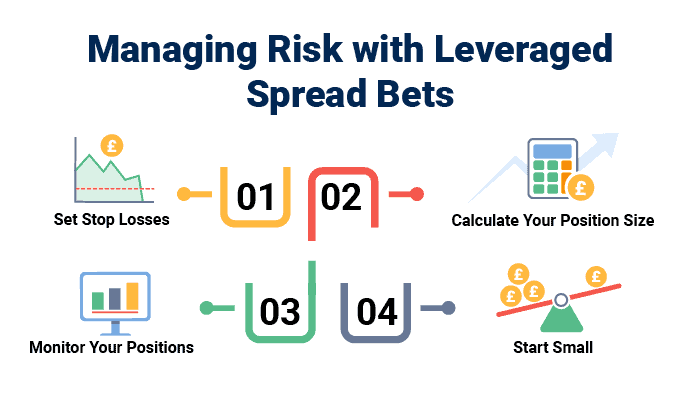
Leverage makes markets like forex and gold seem volatile, so you must focus on risk management to help reduce your risk. Without it, leverage can magnify your losses quickly and wipe out your trading account. Below are some key risk management tips that you may find useful.
1. Set Stop Losses
To help limit your downside risk, you can use a stop loss order that automatically closes your bet if the market moves against you by a certain amount (set by you). There are two stop-loss orders you can use, these are:
Regular stop loss: Once the stop level is reached, you close your trade at the best available price. However, due to market volatility, you may face slippage if the market gaps. Slippage can increase your losses by exiting at the next best price, which could be a few pips worse than you originally wanted.
Guaranteed stop loss: This option closes your trade exactly at the specified level, even if the market gaps past your stop loss level. Brokers charge a premium for guaranteed stops. Most, including IG and City Index, only charge it if the stop is triggered; CMC Markets charges at placement instead and refunds it if the order never fires.
Always use a stop loss and place it at a level that prevents you from losing more than you can afford on each trade.
2. Calculate Your Position Size
Position sizing is a way to determine how much you can risk for each bet you place, helping you limit losses for each trade and protecting the overall health of your account. Most professional traders risk no more than 1-2% of their account balance on any single bet, as they understand that not every trade is a winner.
For example, if you have a £10,000 account and risk 2% per trade, your maximum loss per position would be £200. If the market requires a 5% margin, you could open a position worth up to £4,000 (£200 / 5%).
3. Monitor Your Positions
You should frequently check your open positions, especially during volatile market conditions, to ensure your margin levels aren’t falling. If a trade is going well, be ready to adjust your stop loss levels to help lock in profit while releasing some of the margins back to your spread betting account. I think it’s also important to be disciplined to close losing trades promptly before losses grow.
A top spread betting broker will offer you multiple spread betting trading platform mobile apps. You can use the app to monitor your positions away from the desktop and receive push notifications that help you stay connected with your open bets.
4. Start Small
If you’re new to spread betting, start with small position sizes until you gain experience and confidence. Make sure you have first practised trading on a demo account. Focus on preserving your capital, not chasing large gains, as this can quickly ruin your trading account. As you become more skilled, you can gradually increase your risk per trade.
Applying these risk management techniques can protect your trading capital and give you staying power in the markets. Remember, the most successful traders are disciplined risk managers first and profit seekers second.
Examples of Spread Betting Leverage
Leverage is a great tool in spread betting that can significantly increase your potential profits, but it’s important to understand that it also amplifies your potential losses. Let’s look at a spread betting example to illustrate how it works in practice.
Leverage Magnifying Profits
Let’s say you want to spread bet on the price of gold, currently trading at $1,800 per ounce. Your broker offers a spread bet with a margin requirement of 5%, which means you have leverage of 20:1.
You decide to place a long bet of £10 per point (per ounce in this case), expecting the price of gold to rise. To open this position, you only need to put up 5% of the total trade value as a margin and place your bet at the buy price of $1,800 on your deal ticket:
Total trade value: $1,800 x 10 = $18,000
Margin required: $18,000 x 5% = £900
If your prediction is correct and gold rises to $1,850, you would make a profit of £500:
Price increase: $1,850 less $1,800 = $50
Profit: £50 x £10 per point = £500
That’s a 55.56% return on your initial margin of £900, thanks to leverage magnifying your returns on a small $50 move. Without leverage, you would have to invest the full $18,000 to make the same $500 profit, a return of just 2.78%.
Leverage Amplifying Losses
Now, let’s consider how leverage can amplify losses when the markets move against you.
Using the same example as above, suppose you open a £10 per point long position on gold at $1,800 with 20:1 leverage (5% margin). But instead of rising, the price of gold falls to $1,750.
In this case, you would incur a loss of £500:
Price decrease: $1,800 less $1,750 = $50
Loss: $50 x £10 per point = £500
That’s a 55.56% loss on your initial margin of $900. If gold fell further to $1,720 (an 80-point drop), your entire margin would be wiped out:
Price decrease: $1,800 less $1,720 = $80
Loss: $80 x £10 per point = £800
At this point, you would either need to deposit more funds upfront to keep the position open, or your broker would close it automatically.
What is a Margin Call?
A margin call happens when your trading account no longer has enough funds to support an open leveraged position. In UK spread betting, this usually means losses on your trade have reduced your available margin below the broker’s required maintenance level, prompting the broker to ask for more funds or automatically close positions.
In short, a margin call is a warning that your losses are getting close to the amount of money you deposited to maintain a leveraged trade.
Spread betting traders in the UK encounter margin calls most often when markets move sharply against them on leveraged positions such as the FTSE 100, EUR/USD or gold. Understanding how margin works is essential because leverage magnifies both profits and losses. If you are new to leveraged trading, it is also worth reading our guides on margin requirements and leverage:
Let’s use a realistic UK spread betting example using GBP per point sizing.
Assume I open a long FTSE 100 spread betting position with the following details:
Trade Detail
Value
Market
FTSE 100
Stake Size
£10 per point
FTSE 100 Entry Price
8,300
Position Value
£83,000
Margin Requirement
5%
Initial Margin Needed
£4,150
Account Balance
£5,000
Step 1: Opening the Position
At £10 per point, every one-point movement in the FTSE 100 equals a £10 gain or loss.
The broker requires 5% margin:
£83,000 × 5% = £4,150
So I need £4,150 to open the position.
Because my account has £5,000, I have £850 of excess equity available.
Step 2: The Stock Market Moves Against Me
The FTSE 100 then falls from 8,300 to 8,240.
That is a 60-point loss.
At £10 per point:
60 × £10 = £600
My unrealised loss is £600.
My account equity is now:
£5,000 − £600 = £4,400
I still have enough equity to maintain the trade.
Step 3: The Margin Call Trigger
The market continues falling to 8,000.
Total movement against me is now 300 points.
Loss calculation:
300 × £10 = £3,000
My remaining account equity becomes:
£5,000 − £3,000 = £2,000
The margin call triggers at 50% of the margin required to maintain the position, so in this example, the margin call trigger would be £4,150 x 50% = £2,075. Because my equity has dropped below the required £2,075 margin threshold, the broker may issue a margin call or automatically reduce my exposure.
This highlights why leveraged trading carries higher risk than traditional investing.
Why Margin Calls Happen
Margin calls are usually caused by one or more of the following:
Volatile Markets
Sharp market moves increase losses quickly.
This commonly happens during:
Central bank announcements
Inflation data releases
Geopolitical events
Earnings season
Unexpected economic shocks
Forex markets such as EUR/USD can become especially volatile around interest rate decisions from the Bank of England (BoE) or the Federal Reserve.
Using Too Much Leverage
The higher the leverage, the smaller the market move needed to trigger losses.
In my experience testing spread betting platforms on demo accounts, what tripped me up initially was how quickly losses accumulated when increasing my stake size from £2 per point to £10 per point. The market barely moved, but my available margin disappeared much faster than expected.
That is one reason experienced traders often use lower effective leverage than beginners.
Holding Positions Overnight
Overnight financing charges and wider spreads can gradually reduce account equity.
This becomes more noticeable when positions are held for weeks rather than hours or days.
Lack of Risk Management
Many margin calls occur because many traders fail to take appropriate risk management measures including:
Using stop-loss orders
Sizing positions appropriately
Diversifying exposure
Monitoring available margin levels
What Happens After a Margin Call?
What happens next depends on the broker and market conditions.
Typically, the process looks like this:
Your available margin falls below the required level (or maintenance margin requirement)
The broker sends an alert via email, app or platform notification
You may need to deposit additional funds
If losses continue, positions may be closed automatically
FCA-regulated brokers are required to offer negative balance protection for retail clients, meaning you cannot lose more than the funds in your account under normal circumstances.
However, large market gaps can still create substantial losses before positions are closed.
How Different UK Spread Betting Brokers Handle Margin Calls
Margin policies vary slightly between brokers, although FCA rules standardise many protections for retail traders.
Below is a comparison of several major UK spread betting providers.
Strong platform integration and transparent margin data
IG
Tiered margin rates, real-time notifications
One of the largest UK providers
CMC Markets
Automatic close-out protections
Detailed margin calculators
City Index
Maintenance margin monitoring
Good educational tools
Spreadex
Flexible spread betting account structures
Popular among active traders
Trade Nation
Fixed-spread focus with margin monitoring
Simpler pricing structure
One thing I have noticed comparing these brokers is that platform visibility matters almost as much as the margin policy itself. Brokers that display available margin, maintenance requirements and exposure clearly tend to make risk management easier in fast-moving markets.
Margin Call vs Stop Out vs Close Out
These three terms are often confused. A margin call is effectively a warning. A stop out is forced liquidation. A close out is done manually by the trader or automatically via a stop loss order.
Here is the difference:
Term
Meaning
Margin Call
Request for additional funds or warning about low margin
Stop Out
Automatic closure of positions by the broker
Close Out
A general term for closing a trade, either manually or automatically
Many modern spread betting platforms move directly to stop outs without requiring manual intervention from the trader.
This is designed to protect both the trader and broker from escalating losses and to avoid margin calls.
How to Avoid a Margin Call
Avoiding margin calls comes down to disciplined risk management.
Here are some ways I recommend that will help prevent a margin call:
Use Lower Leverage
Just because a broker allows high leverage does not mean you should use it. Smaller position sizes reduce the chance of rapid account depletion.
Keep Excess Margin Available
Many experienced traders avoid using all available capital as margin. Maintaining a cash buffer allows trades more room to fluctuate.
Use Stop-Loss Orders
Stop-loss orders automatically close losing trades before losses become too large.
For example, if I enter a FTSE 100 trade at 8,300, I may place a stop at 8,250 to limit downside exposure.
Monitor Economic Events
Volatility often spikes around major economic data announcements including:
UK inflation releases
Non-farm payrolls
Interest rate decisions
GDP announcements
Checking the economic calendar before trading can help avoid unexpected market swings.
Diversify Exposure
Holding several smaller positions may reduce concentration risk compared to placing all capital into one highly leveraged trade.
Margin Calls in Forex Spread Betting
Margin calls are especially relevant in forex spread betting because currency markets can move rapidly on macroeconomic news.
For example:
GBP/USD volatility often increases after Bank of England (BoE) announcements
EUR/USD reacts strongly to US inflation data
USD/JPY can move sharply during intervention speculation
Forex positions also commonly use higher leverage than indices, meaning traders may reach margin thresholds more quickly.
FAQs
Does Leverage Make Spread Betting More Profitable?
Leverage changes the size of an outcome rather than its direction, so it magnifies a loss by exactly as much as it magnifies a gain. No UK provider publishes a client profitability rate at all, and our page on the disclosures UK firms are obliged to make collects what they do publish, which is the share of retail accounts that lose money. Professional traders can use leverage to capitalise on smaller market movements, and you should never bet more than you can afford to lose.
Is Leveraged Spread Betting Legal In The UK?
Yes, and the leverage cap is part of what makes it sellable to a retail client at all. Only FCA-authorised firms may offer spread betting to UK residents, and our page on who authorises UK spread betting firms sets out what that authorisation requires of them.
How much do I need to start spread betting?
Most UK spread betting brokers require a minimum initial deposit of around £100 to £200 to open an account and start trading. However, starting with a larger amount of money is recommended so you’re not over-leveraged. An ideal range to start with is £1,000 to £2,000, giving you plenty of room to open your bets.
What are the risks of using leverage in spread betting?
The main risk of leverage in spread betting is that it amplifies potential losses (and profits), and it only takes a few pips to have a bad impact on your position. A highly leveraged bet can quickly drain your trading account if the market moves against you, which is why you should always use stop losses and proper risk management to protect your capital.
Justin Grossbard co-founded Spread-Bet.co.uk with Noam Korbl in 2024, and co-founded the broker comparison network CompareForexBrokers with him in 2014. He has been investing since 1998 and actively trading since 2014, and has written on forex and CFD trading for Kiplinger, Entrepreneur, Finance Magnates and MoneyShow since 2019.