The Difference Between Spread Betting and CFD Trading
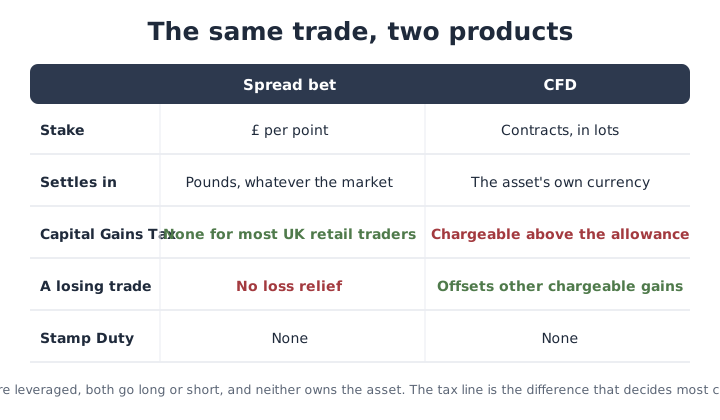
Spread betting vs CFD trading are two leveraged derivatives where you own no asset. Spread bet profit sits outside Capital Gains Tax for most UK retail traders; CFD gain is taxed; CFD loss offsets other gains. Spread bets stake pounds per point in sterling at IG; CFDs are sized in units of the underlying, in its own currency. Tax treatment depends on your individual circumstances and can change, so you should seek professional tax advice if you’re unsure.
Spread bet or CFD: what you keep after tax
Capital Gains Tax on the same profit, 2026/27 rates
On a £10,000 winning trade, a spread bettor keeps £10,000. A higher-rate CFD trader with the £3,000 exemption unused pays £1,680 CGT and keeps £8,320; the difference is £1,680.
Spread bet
Gross profit£10,000
Stamp dutyNone
Capital Gains TaxNot chargeable
Kept£10,000
CFD
Gross profit£10,000
Annual exempt amount− £3,000
Taxable gain£7,000
CGT at 24%£1,680
Kept£8,320
Reverse the trade and the ranking reverses. Under HMRC CG56105 no allowable losses arise from spread betting, so a spread betting loss cannot be set against other gains. Under HMRC CG56100 a CFD closed at a loss produces an allowable loss, which can be set against other chargeable gains. Tax treatment depends on your circumstances and can change; this applies the published 2026/27 figures and is not advice.
The £3,000 annual exempt amount is a whole-year allowance, not a per-trade one. The comparison assumes the whole gain falls inside the chosen tax band. HMRC CG56100 says all debits and credits to a CFD account, including commission and sums equivalent to interest, are brought into the CFD's gain or loss, so the tool shows the CFD's tax before those costs. Rates and allowance: HMRC, 2026/27. HMRC's Capital Gains Manual (CG56105) states that no chargeable gains or allowable losses arise from spread betting. For most UK retail traders, profits are therefore free of Capital Gains Tax. Tax treatment depends on individual circumstances and can change. See the tax treatment of spread bets.
At the default settings the CFD route costs £1,680 more in tax on a £10,000 profit, and on a losing trade only the CFD loss offsets other gains. Sources: HMRC CG56105, read ; HMRC CG56100, read .
Updated on 28 Sep 2026: a short answer opens the page with the tax, stake unit and currency differences, and the tax calculator moved beneath it, with one line reading its result. One table covers tax, loss relief, stake unit, currency, FCA leverage limits, margin close-out rule and how many ranked brokers offer both, each from a named source. The tax answers rest the spread bet’s treatment on BIM22020’s contract-terms test, not gambling. A question on whether CFDs are more risky was added, and the costs section lost two unsourced claims. No tax figure changed.
Our spread bet content is supported by broker partners, who pay us on a retainer basis rather than per referral.
The same trade as a spread bet and as a CFD. Both are leveraged and neither owns the asset; the tax line and the loss line are where they part.
The comparison below applies the 2026/27 figures to a profit of your own.
Spread Betting vs CFD Trading Compared
Tax on profits, loss relief, stake unit, currency, FCA leverage limits, the margin close-out rule and ranked brokers offering both, spread bet against CFD.
Feature
Spread bet
CFD
Tax on profits
Profit outside Capital Gains Tax for most UK retail traders
A chargeable gain, taxed at 18% or 24% above the £3,000 allowance in 2026/27
Loss relief
No allowable loss arises, so the loss offsets no other gain.
An allowable loss, which can be set against other chargeable gains.
Stake unit
Pounds per point, as in HMRC’s example of £5 per point
Position sized by the value of the underlying, as in HMRC’s example of shares worth £100,000
Account currency
Sterling at IG, whatever the underlying market
The underlying asset’s own currency at IG
FCA leverage limits
The same FCA retail limits for both, minimum margin 3.33% on a major currency pair, 5% on a major index, 20% on a share
Margin close-out rule (COBS 22.5)
The same rule for both, the firm closes positions when equity falls below 50% of the margin required
Ranked brokers offering both
14 of the 14 brokers we rank offer both a spread bet and a CFD
How Does HMRC Tax A Spread Bet Compared With A CFD?
A spread bet’s tax treatment rests on the terms of the contract and what is actually done (BIM22020). CG56105 says no chargeable gains or allowable losses arise from spread betting, so for most UK retail traders the profit is outside Capital Gains Tax. A retail CFD is charged under the capital gains regime unless its profits are taxable as trading income (CG56100). The treatment does not rest on spread betting being classed as gambling. The full detail of how each is taxed is on our spread betting tax guide page. Tax treatment depends on your individual circumstances and can change, so you should seek professional tax advice if you’re unsure. Sources: HMRC Business Income Manual BIM22020, read ; HMRC CG56105, read ; HMRC CG56100, read .
What Is Better, CFD Or Spread Betting?
The answer depends on your tax position and on how you size a trade. A spread bet profit escapes Capital Gains Tax for most UK retail traders, and staking in pounds per point suits traders who think that way. A CFD suits a trader whose losses offset other chargeable gains and who accepts dollar pricing on a US share. Both products carry the same FCA retail leverage limits.
Do You Pay Tax On CFD Trading In The UK?
Yes, for most retail traders a CFD gain is a chargeable gain under CG56100. The tax is 18% within the basic band and 24% above it, after the £3,000 annual exempt amount in 2026/27. The exception is profits taxable as trading income. The full detail of the rates and the allowance is on our tax on trading profits page.
Is CFD Basically Gambling?
No, a CFD is a regulated investment sold by firms the FCA authorises and supervises, and HMRC’s CG56100 treats a retail CFD as a financial future. A spread bet’s tax treatment rests on its contract terms under BIM22020. Section 10 of the Gambling Act 2005 keeps financial spread betting outside the Gambling Commission. Neither product gives you ownership of the underlying asset. For whether spread betting counts as gambling, see our is spread betting gambling page. Sources: HMRC BIM22020, read ; HMRC CG56100, read .
Are CFDs More Risky Than Spread Betting?
No, the FCA lists leveraged CFDs and leveraged spread bets as restricted speculative investments, so the same retail rules apply to both. Those rules set the same margin limits and the same close-out rule, and both carry a high risk of losing money rapidly due to leverage. The one difference in risk lies in currency. A CFD priced in the asset’s own currency adds an exchange-rate move to the result, where a spread bet at IG is in sterling. Sources: FCA Handbook Glossary, read ; FCA Handbook COBS 22.5, read ; IG, read .
What Is CFD Trading?
A contract for difference (CFD) is a derivative product that lets you speculate on whether an asset’s price will rise or fall.
Spread Betting vs CFD: Key Differences
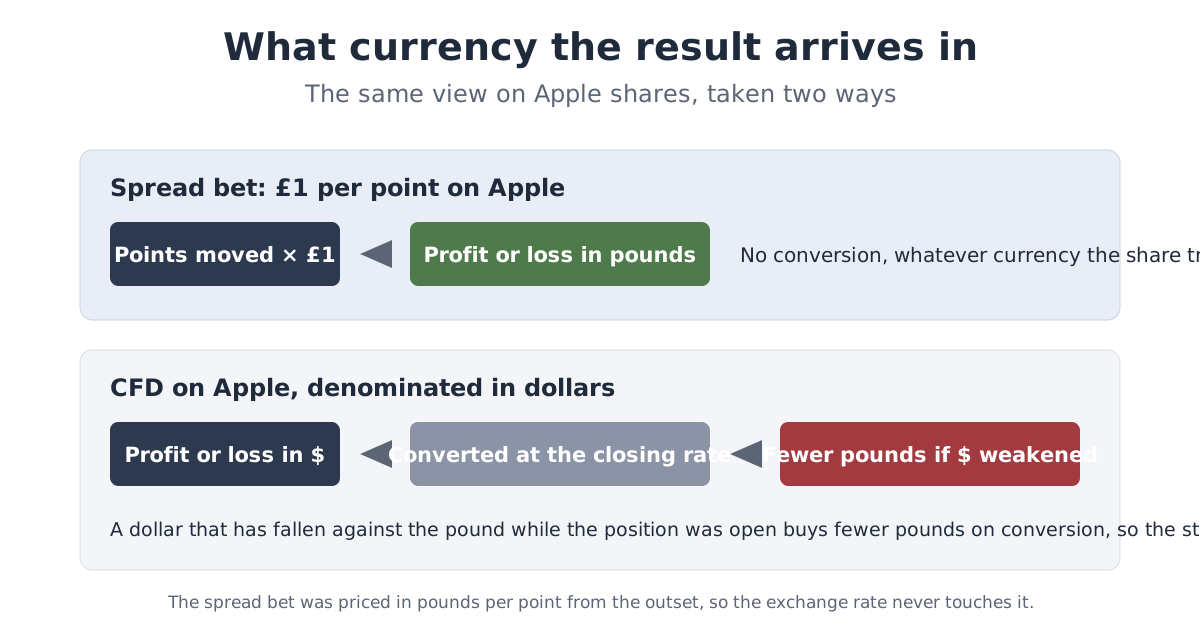
A spread bet settles in your account currency, so a £1 per point stake on Apple pays out in pounds whatever currency the share itself trades in. A CFD on the same share is denominated in dollars, and the profit or loss converts back to sterling at the prevailing rate.
For example, if the dollar weakens against the pound while a CFD position on Apple is open, the dollar profit buys fewer pounds on conversion and the sterling return is smaller. The equivalent spread bet is unaffected, because it was priced in pounds per point from the outset.
The same view on Apple, two ways. The spread bet is priced in pounds per point, so the result arrives in pounds and the exchange rate never touches it. The CFD is denominated in dollars.
A spread bet’s expiry is a further difference. A daily funded bet has no fixed expiry and rolls from one session to the next until you close it, while a quarterly bet expires on a fixed date. CFDs divide the same way, between rolling cash contracts and futures contracts that expire.
Leverage and margin set the deposit a spread bet needs on day one. A position held past the daily cut-off then pays overnight funding, and this page explains how overnight funding is charged.
The FCA caps the leverage a UK retail spread betting account can use, and the Spread Bet UK home page summarises those caps with UK rules.
The profit on a spread bet is the points moved times the stake per point, and our guide sets out how a spread bet works with worked examples.
Costs: Spread vs Commission
A spread bet’s cost is charged in the spread, the gap between the buy price quoted above the market and the sell price below it. A daily funded bet held past the daily cut-off pays overnight funding for each night it stays open. A guaranteed stop, where a broker offers one, can carry a premium if it is triggered.
A CFD’s costs are charged as debits to the account. Under HMRC’s CG56100, commission and sums equivalent to interest are brought into the CFD’s gain or loss when the contract is closed.
FAQ
Can I Use A Stop Loss In Spread Betting And CFD Trading?
DFBs are daily funded bets, spread bets that stay open until you close them and pay overnight funding for each night they are held. For how a quarterly bet differs on expiry, spread and financing, see daily funded and quarterly bets compared.
Why Do Spread Betting And CFD Forex Prices Look Different?
Depending on what broker you bet with, the prices may look different to make it easier to read the prices. CFDs are priced just like the underlying assets you are trading, so forex CFDs are quoted in the same pricing structure (1.0500), while spread betting may be displayed as 10500. These are the same prices, but the spread betting price is displayed in points vs actual price to help see price-per-point movements.
Can I Use The Same Strategies For Spread Betting And CFD Trading?
Justin Grossbard co-founded Spread-Bet.co.uk with Noam Korbl in 2024, and co-founded the broker comparison network CompareForexBrokers with him in 2014. He has written for Kiplinger, Entrepreneur, Finance Magnates and MoneyShow since 2022, with articles on forex and trading at MoneyShow, Finance Magnates and Kiplinger.
Change history: 8 earlier dated notes
Updated on 24 Sep 2026: the stop loss FAQ answer uses the site’s one wording, with its platforms link on "FCA-regulated spread betting brokers". A sentence after the leverage paragraph links the home page’s FCA retail leverage caps summary. No figure changed. A sentence was added that links our guide to what spread betting is and how it works.
Updated on 23 Sep 2026: A large amount of text was removed, mainly passages repeating basic definitions of spread betting and CFDs that other pages own. The CFD explanation was corrected, including its dollar denomination, and the tax wording was tightened. Details of our August 2026 timed order tests, including the stop orders placed, were added, and the author biography was updated.
Updated on 22 Sep 2026: The tax notes now rest on HMRC’s Capital Gains Manual, citing CG56105 for spread bets and CG56100 for CFDs, and no longer mention stamp duty. The wording now explains that spread betting losses cannot be set against other gains, while CFD losses can. The comparison note no longer says it ignores the spread and overnight funding.
Updated on 22 Sep 2026: The “No capital gains” list item in the benefits of spread betting now says there is no capital gains tax for most UK retail traders. No figure changed.
Updated on 22 Sep 2026: a section that named two brokers was removed with its contents entry. An unsourced claim that most spread bets are daily funded was removed, and the section now states only how each type expires. A mention of sports markets was removed from the list of benefits. No figure changed.
Updated on 21 Sep 2026: the FAQ answer on daily funded bets is now shorter. An unsourced claim that DFBs are the more popular type of spread bet was removed. The comparison with quarterly bets on expiry, spread and financing now sits in the spread betting guide, which the answer links. No figure changed.
Updated on 19 Sep 2026: a new heading and opening state the difference between the two products, and one side-by-side table replaces the old twelve-row table. The tax rows are taken from HMRC’s Capital Gains Manual, CG56100 and CG56105, read on 19 Sep 2026. The tax calculator moved up to sit under the table. Four reader questions are answered. We removed the sections that picked a winner, the separate tax section, and a statement about which countries allow each product that we could not source. No tax figure changed.
Updated on 3 Sep 2026: the page moved onto the site’s guide layout, with the five-point comparison drawn beside the answer. No figure changed. Reviewed on 25 Aug 2026 in a site-wide accuracy pass: broker figures were re-checked against each broker’s own UK source, claims that disagreed with the source were corrected, and figures no broker publishes were removed. Each month we also update the average spreads data published by the brokers.