
Day trading with spread betting means opening and closing spread bets within one trading day, staking pounds per point on a market’s move. A bet closed within the day pays no overnight financing; a rolling daily bet held past the cut-off does. The FCA’s retail leverage limits are 30:1 on major currency pairs and 20:1 on major indices. We timed 210 orders at 14 UK brokers between 18 and 27 August 2026, measuring fill speed.
Here is a summary of traditional day trading vs spread betting day trading in the UK.
| Aspect | Day Trading | Spread Betting |
|---|---|---|
| Taxation | Capital Gains May Apply | Tax-Free For Most Traders |
| Risk | Limited to the amount invested unless using leverage. | Leverage can magnify both profits and losses. |
| Holding Period | Trades are typically short-term, closed by the end of the day. | Generally short-term, but can also be used for longer-term bets. |
| Asset Ownership | You own the underlying assets like stocks, currencies, etc. | No ownership of the actual assets; it's a bet on the price movement. |
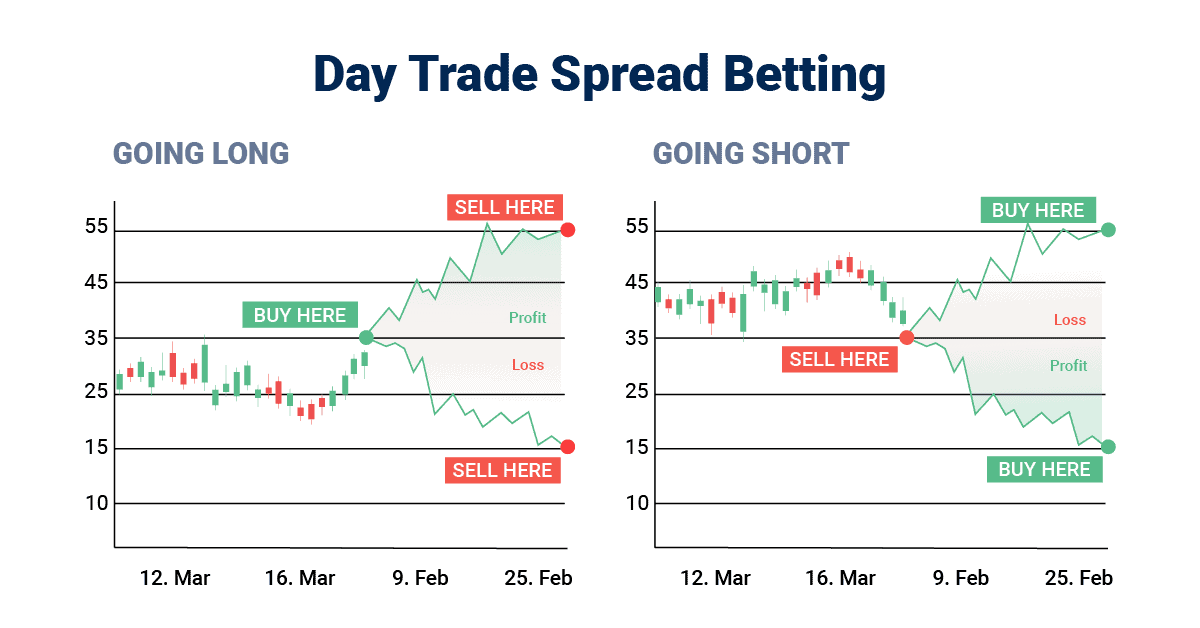
How Do Day Traders Make Money With Spread Betting?
Day traders can make money with spread betting by capitalising on short-term price movements of the underlying financial market. They deploy a range of strategies to find new spread betting ideas and execute them quickly, as these opportunities come and go fast while day trading.


What Are The Most Popular Markets To Day Trade Spread Betting
Spread betting brokers list thousands of markets: Spreadex offers over 10,000 and CMC Markets 21,000. The groups below are the main ones for day traders, and our markets page covers spread betting markets by type in full.
- Forex: consisting of major, minor and exotic pairs.
- Indices: indices from the US, EU, UK including the FTSE 100, and Japan
- Shares: availability differs by broker: FxPro’s spread betting covers forex, spot indices, spot metals, spot energy and no shares
- Commodities: metals such as gold and energy such as oil are the usual ones, and ranges differ by broker: ThinkMarkets lists 3 commodities
Pros and Cons
Pros of Day Trade Spread Betting
- Tax-Free Profits: For most UK retail traders, spread betting profits are exempt from capital gains tax and Stamp Duty, allowing you to keep more of your winnings.
- Go Long or Short on Markets: Spread betting allows you to profit from rising and falling markets, providing flexibility to adapt to various market conditions daily.
Cons of Day Trade Spread Betting
- Overtrading Risks: Watching prices move all day can tempt you to overtrade and act on impulse rather than on your plan.
- Stop Slippage: In our timed orders, 35 of 42 triggered stops filled beyond the stop level rather than at it.
- Retail Loss Rates: Each broker publishes its own risk warning, and across the 14 brokers we compare, between 61% and 76.6% of retail investor accounts lose money.
Risks of Day Trading Using Spread Bets
Small market movements can be insignificant on a longer timeframe and look like a volatile move. I.e.) the market jumps 20 pips on GBP/USD in a short time frame, this could wipe out your stop loss while on a longer timeframe, you may never have seen this jump.
With the short-term focus on day trading, emotions can also get the better of you as you’ll see the markets move all day. Sudden jumps in market price can indulge you with “quick profit potential” (which never works out well when you steer away from your trading strategy). These lapses in judgment can be costly and spiral you out of control by chasing losses, potentially ruining your day’s profit.
Winning Trade
You anticipate the FTSE 100 will rise, so place a long (buy) spread bet on the FTSE 100 at 6990 and risk £1 per point. For every point the market moves higher than 6990, you will make £1; for every point below 6990, you will lose £1.
Over the next hour, the FTSE 100 increased to 7000 (10-point increase), so you closed your bet. The profit of the bet is the amount of points difference from the open (6990) and close (7000) price, making you £10 (10-point increase x £1 per point staked) profit.
Losing Trade
You feel that the GBP/USD will fall, and place a short (sell) spread bet on GBP/USD at 1.2505 and risk £1 per point. For every one pip (point) the market moves lower than 1.2505, you will make £1. Meanwhile, for every pip above 1.2505, you will lose £1. You set a stop loss 20 pips higher at 1.2525, giving you a maximum loss of 20 pips on this trade.
Unfortunately, the GBP/USD increased after a major economic announcement that pushed the price higher and hit your stop loss, closing your bet at a 20 pip loss. Your total loss for this trade is £20 (20 pips x £1 staked per point).
That £20 loss assumes the stop fills at its level, and stops do not always do so. We placed 210 live orders at the 14 brokers we rank between 18 and 27 Aug 2026, on EUR/USD and the FTSE 100. Of 42 triggered stops, 35 filled beyond the stop level. On the FTSE 100 the median gap was 1.0 points and the largest was 2.5 points. At the FTSE 100 cash open, 4 of 28 market orders were requoted, and none of the 56 limit orders filled at a worse level than asked. The full slippage results by order type are on our slippage page. How much a loss like this takes from your margin is set by leverage, which we cover next.
How The Mechanics Play Out Intraday
Leverage means the margin you put up covers only part of the position. At 10:1 leverage the margin is 10% of the position, so a £1,000 position needs £100 of margin. A £10 loss on that position is 1% of its value but 10% of the margin you put up. The FCA caps retail leverage by market, as the margin subheading below sets out.
Margin
The margin is the funds you must have in your spread betting account to open a bet and is used as collateral against your losses. Each asset has a different requirement, varying from a 3.33% margin required on forex majors to 20% required for stocks.
Why Day Traders Use Spread Bets
1. Spread
The spread is the difference between the buy and sell price of the market you want to open a bet on. It’s the price you pay to the broker to enter the market, and it varies for every market. For example, if the broker offers USD/JPY at 110.50 buy / 110.48 sell, the difference is two pips (110.50 − 110.48), and if you had a bet size of £1 per pip, then it would cost you £2 to enter this bet.
2. Bet Size
The bet size is how much you wish to risk per point on the underlying market; you’ll either make or lose this amount for every point the market moves. The larger the bet size, the larger the potential profit/loss.
3. Duration
The standard rolling bet is the daily funded bet (DFB), which stays open until you close it or it is closed out. Some providers give theirs an expiry far in the future rather than none. A daily funded bet carries a tighter spread than a future, and pays overnight funding when held past the cut-off. A quarterly bet pays no overnight funding but has a wider spread instead.
A day trade closes before the broker’s daily cut-off and pays no overnight funding. A spread bet held past the cut-off pays a daily charge, and this page sets out how overnight funding is charged.
The calculator below prices the overnight charge on a daily funded bet: enter your provider’s annual admin fee from its charges page and the nights you expect to hold.
Overnight funding on a spread bet
What holding a position costs, or pays, per night
SONIA 3.7309%, Bank of England, 26 Aug 2026 Level from the Thu 17 Sept 2026 5pm New York close
A buy at £10 per point on GBP/USD at 1.3381 is £ of exposure. SONIA at 3.7309% plus the adjustment is an annual rate of , which costs £ a night; over 5 night(s) that is £.
Enter your provider's annual admin fee from its charges page; the ledger then prices each night held. The site's worked example uses City Index's published +3%.
Every provider's methodology differs: some price forex funding from tom-next swap points rather than a SONIA-based formula, and the admin fee is the provider's own published figure. A short position receives funding when the reference rate exceeds the fee. The figures ignore the spread and any guaranteed-stop premium; see the spread betting calculator for those.
Spread Betting Brokers For Day Trading
We rank 14 spread betting brokers, and the full ranking sits on our spread betting broker comparison. The three below are described on what a day trader checks: platforms, guaranteed stops, published spreads and minimum stakes. For day trading on a phone, see our spread betting app tests.
Pepperstone
Pepperstone offers spread betting on MetaTrader 4, MetaTrader 5, TradingView and cTrader. It offers no guaranteed stop. Its markets are available as spread bets and CFDs, covering 90+ forex pairs, 20+ indices and 40 commodities. It publishes an average spread on EUR/USD of 0.5 points for August 2026, across all trading sessions, which we read from its UK site on 18 Sep 2026.
IG Markets
IG’s UK spread betting page lists the IG web platform, its app, MetaTrader 4, TradingView, ProRealTime and L2 Dealer, and it does not list MetaTrader 5. IG offers options as spread bets. It lists 80+ forex pairs, 35 commodities and 69 indices for spread betting. Its minimum stake is £0.50 a point on the FTSE 100 and GBP/USD, read from its reduced-minimums page on 26 Aug 2026. IG states more than one total for its whole range, so we give no total.
City Index
City Index offers guaranteed stop-loss orders, as its UK costs page sets out. Its UK site now leads to StoneX, whose trading tools include Performance Analytics, described as helping you "discover unique insights that can reveal your trading strengths and weaknesses".
City Index provides spread betting markets on 84+ forex pairs, 40+ indices, 20+ commodities and shares it publishes no count for. It publishes a typical spread on EUR/USD of 0.8 points in our 18 Sep 2026 read, above the 0.7 points average of the five brokers that publish a comparable figure.
Day Trading FAQ
Can I Make A Living From Day Trade Spread Betting?
Whether you can make a living from day trade spread betting depends on beating the odds. Between 61% and 76.6% of retail investor accounts lose money across the 14 brokers we compare, as our spread betting statistics show. Spread betting is tax-free for most UK individuals, unless HMRC deems your activity a trade, and under BIM22017 earning a living from betting alone does not make it one. Tax treatment depends on your individual circumstances and can change, so you should seek professional tax advice if you’re unsure.
What Is The Best Way To Learn How To Day Trade Spread Betting?
You can use various methods to learn how to day trade spread betting, like our spread betting guide. There is no “correct” way for you to learn day trading; most of it is picked up from experience on a demo account.
Is Spread Betting Regulated?
Yes, spread betting is regulated by the Financial Conduct Authority, whose page on contracts for difference, read 19 Sep 2026, names it among its "CFD products". Firms that offer spread betting must be authorised by the FCA. As an FCA-regulated activity it falls outside the Gambling Act 2005, because section 10 of the Gambling Act 2005 excludes such bets from the Act’s definition of a bet.
Key Takeaways
- Day trading in spread betting focuses on profiting from small market movements amplified through leverage and opening and closing bets within the same day.
- Day trading is a high-risk activity, and having a sound trading plan and risk management strategy is essential.


Ask an Expert
Can I day trade on mobile with spread betting?
Yes, you can trade using a trading app for iOS or Android using phone or tablet.
How much do you need to make $100 a day trading?
That depends on your betting skills, the leverage you use and how many points the market moves in your favour.