
Spread betting is gambling for tax purposes and a regulated financial product for every other purpose. HMRC classifies it as betting, which is why the profits are not taxed; the Financial Conduct Authority, not the Gambling Commission, authorises and supervises the firms that offer it. Both answers are true at once, and which one applies depends on what you are asking.
However, I believe spread betting is closer to financial trading than gambling. While both involve risk, the key difference is that the outcomes of spread bets are based on movements in financial markets, which can be analysed and forecasted to some extent. After all, pension funds invest in the financial markets to protect and grow pension pots; you wouldn’t label them gamblers.
Conversely, gambling relies purely on the chance of an event happening within a certain timeframe. For example, the result of a football game is gambling, as anything can happen within 90 minutes.
Plus, you are betting against the bookmaker for an event to happen, with a limited profit potential based on the fixed odds you stake. With spread betting, you have unlimited profit potential based on getting your prediction correct.
Differences Of Spread Betting vs Gambling
There are some key differences between spread betting and gambling that I think are worth highlighting.
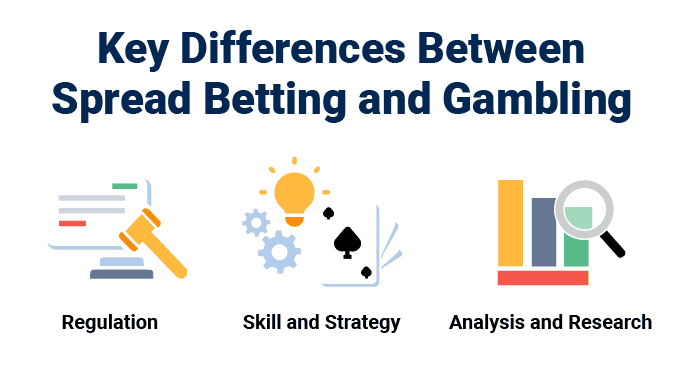
1. Regulation
Spread betting is overseen by the Financial Conduct Authority (FCA) as a trading activity, not by the Gambling Commission. This shows that it’s viewed as a legitimate form of financial trading.
2. Skill And Strategy
Successful spread betting requires developing trading strategies to seek profitable opportunities and manage risk. You’d associate these skills more with trading than gambling.
3. Analysis And Research
With spread betting, you’ll perform technical analysis, study economic data, and follow financial news to generate opportunities, which is the same as trading. This level of research isn’t typically associated with gambling.
While there are some surface-level similarities, I believe most traders view spread betting as a form of investing rather than gambling. It requires a different mindset and approach compared to traditional gambling activities.

Similarities Of Spread Betting Vs Gambling
Spread bets and CFDs are both leveraged products, and spread betting shares certain properties with gambling products.
The most obvious similarity is that spread betting and gambling involve the risk of financial loss. However, with spread betting, you can control your risk through risk management by closing a position early if necessary, limiting your losses. While with gambling products, you risk losing 100% of your stakes, even if you’ve changed your mind during the event.
You do not own the underlying markets you speculate on for either gambling or spread betting, so you do not gain any long-term benefits like you may receive from traditional investing.
Both offer high-risk, high-reward forms of speculation. With spread betting, you use leverage to open a position, which amplifies your profits (and losses) and allows you to profit from smaller price movements throughout the day.
So a small 10-pip move in EUR/USD would return 10 times your stake size, which is what makes leverage so appealing. However, if it were reversed, you’d lose 10 times your stake size, which is why risk management is vital.
Gambling’s high-risk nature lies in losing 100% of your stake size if you’re wrong about an outcome. However, I believe these similarities are largely superficial. The key difference lies in the level of control and analysis that can be applied in spread betting.
While you can’t control market movements entirely, you can analyse the markets and generate trade ideas based on proven strategies like breakout trading or chart patterns. It’s crucial to approach spread betting with a trader’s mindset, focusing on risk management and informed decision-making rather than treating it like a game of chance.
What Is Spread Betting Trading?
Spread betting is a financial derivative that allows you to speculate on the financial markets where you can profit from the price rising (or falling) without owning the underlying market.
To spread bet, you need an FCA-regulated spread betting platform in the UK to give you access to the financial markets through their platforms. A top Spread betting firm like Pepperstone offers a decent range of markets to spread bet on, with markets such as:
- Forex (currency pairs)
- Share dealing (UK and International shares like Apple or BMW)
- Stock indices (like the FTSE 100 or S&P 500)
- Commodities (such as gold, oil, or agricultural products)
- Bonds
- ETFs
- Options
- Gold and other precious metals
One key difference between traditional investing and spread betting is that you’re not buying or selling actual assets. Instead, you’re placing a bet on the price movement, allowing you to profit from the same move without owning the asset or paying additional commissions or taxes.
By not owning the underlying asset, you can potentially profit from both rising and falling markets, which is why spread betting offers more flexibility than traditional investing.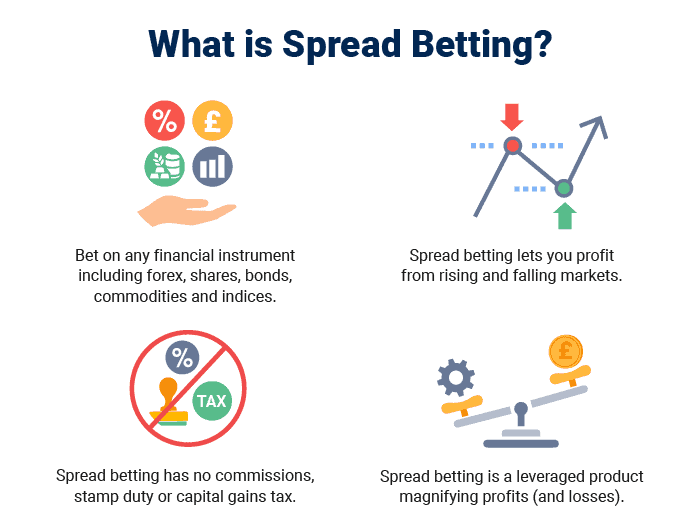
How Spread Betting Works
When you place a spread bet, you’re betting on whether the price of a financial instrument will go up or down. Your profits (or losses) are calculated based on the number of points the market has moved in (or out) of your favour. The more the market moves in your favour, the more you’ll profit, while the opposite is true if you’re in a losing position.
You size a spread bet with a stake per point, not contracts or lot sizes. Your profit or loss is the points the market moves multiplied by that stake.
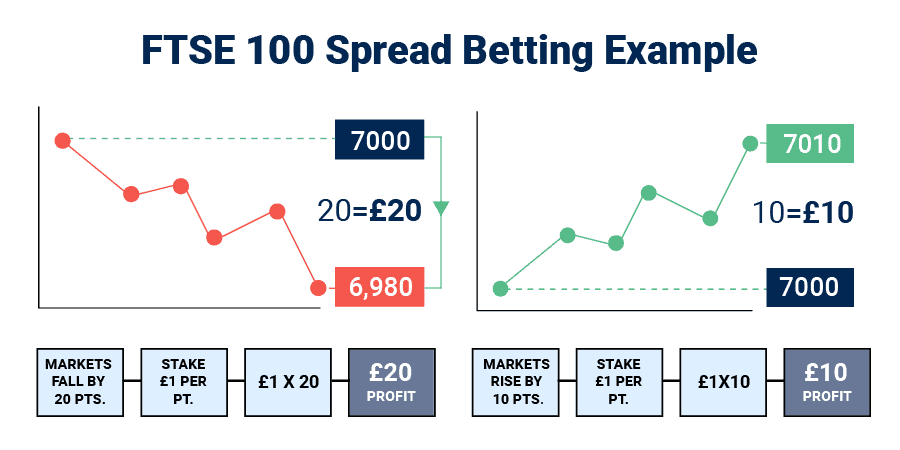
FTSE 100 Spread Betting Example
Let’s say you bought the FTSE 100 indices at 7000 with a stake size of £1 per point. If the price of the FTSE 100 increased to 7010 (10 points), you’d be £10 in profit. This profit is worked out by multiplying your stake size (£1) by the number of points increased (10), giving you a current profit of £10.
If the FTSE 100 decreased to 6980 (20 points), you’d be down £20. The opposite would happen where your stake size (£1) is multiplied by the number of points fallen (20), giving you a loss of £20.
View our spread bet examples page for more scenarios of winning and losing bets.
Is Spread Betting Regulated
Spread betting is regulated by the Financial Conduct Authority under the Financial Services and Markets Act 2000, not the Gambling Commission. Read how spread betting is regulated.
Is Spread Betting Taxable
For most UK retail traders, spread betting profits are tax-free and carry no Capital Gains Tax or Stamp Duty. Read how spread betting is taxed.
Is Spread Betting Profitable
Between 61% and 76.6% of retail investor accounts lose money across the 14 brokers we compare.
Managing Risk in Spread Betting
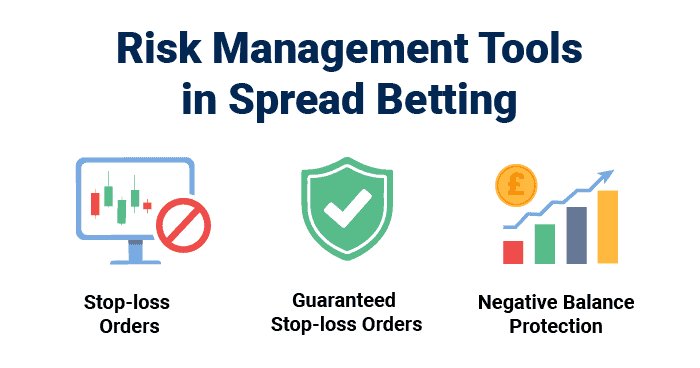
I think one of the key differences between spread betting and gambling is the ability to manage risk effectively. The UK spread betting brokers we rank offer several tools to help control potential losses:
- Stop-loss orders: These automatically close your position if the market moves against you by a certain amount.
- Guaranteed stop-loss orders: These work like regular stop-losses but guarantee execution at the exact price you set, even if the market gaps beyond that price, protecting you from price slippage. Eight of the 14 brokers we rank offer a guaranteed stop-loss order, and the premium and when it is charged vary by broker: see our stop-loss guide.
- Negative balance protection: All FCA-regulated brokers offer accounts where your maximum loss is limited to your deposit, protecting you from negative balances.
These risk management tools give you more control over your potential losses than traditional gambling. However, it’s important to use them wisely and understand that they don’t eliminate risk entirely.
FAQs
Is Spread Betting Illegal In The UK?
No, spread betting is completely legal in the UK. It’s a regulated financial activity under the Financial Conduct Authority’s oversight. Only FCA-regulated brokers can offer spread betting services to UK citizens and must follow strict frameworks set by the FCA to operate legally.
How Does Spread Betting Differ From CFDs?
Spread betting and CFDs (Contracts for Difference) are similar in many ways. They allow you to speculate on markets (like forex) without owning the underlying asset, and both are leveraged products. The differences that matter, how each is taxed, when each expires, and which currency your profit and loss settles in, are set out in our spread betting vs CFD trading comparison.
What Is The Minimum Deposit To Start Spread Betting?
Each broker sets its own minimum deposit, shown on its review page in our directory. Deposit only what you can afford to lose. A spread betting demo account lets you practise without depositing.
Is Spread Betting Safe?
Spread betting is safe as it is a regulated financial activity by the Financial Conduct Authority (FCA), which ensures the markets are transparent and fair. The FCA has policies to ensure your money is safe by ensuring all brokers offer Negative Balance Protection, ensuring you never lower more than your deposit.
Is Spread Betting Haram?
Islamic scholars consider spread betting to be haram in Islam. It is viewed as a form of gambling, which is prohibited by Islamic law. Spread betting involves speculation on price movements without owning the underlying asset, contains elements of uncertainty and can be seen as profiting from others’ losses.


Ask an Expert
Is spread betting considered gambling in the UK?
In the UK, spread betting is considered gambling for tax purposes, but it is regulated as a financial activity by the FCA.
What makes spread betting different from traditional gambling?
Unlike traditional gambling, spread betting involves predicting price movements in financial markets rather than betting on chance.