Pepperstone publishes a comparable figure on every pair in the table, and prices below the average of the brokers that publish one, three to five per pair, on six of the nine. That is a narrower claim than the cheapest average and a more useful one, because it holds for most of the pairs you might trade. This review shows the table it comes from, the criteria behind our score, and the two things Pepperstone does not publish.
Updated 19 Sep 2026. Added sections on whether you can trust Pepperstone, who owns it, what happens to your money if it fails and how long withdrawals took in our test, with sources and dates read (19 September 2026). The FCA register section now opens with whether Pepperstone is regulated, and the byline credits David Levy as fact-checker. A sentence notes Pepperstone also offers CFDs, linked to our comparison. The verdict now gives the range of criterion marks, the median fill in our August 2026 timed orders, and published spreads against the average of the brokers that publish one. The opening names that average and how many brokers are in it. The January 2024 video from our network’s channel was removed. No score, rank or spread figure changed. Earlier: Updated 18 Sep 2026. We changed how we read spreads: we now read each broker’s own UK site and record what kind of figure it publishes, average, typical, fixed, target or minimum. The cost section, the verdict and the pros and cons now follow what Pepperstone publishes. No score or rank changed. Earlier: Updated 6 Sep 2026. The FAQ answer on low spreads used to say Pepperstone was the only account of the seventeen we harvest priced under the industry average on every pair. Our harvest holds thirteen rows, so the count now reads thirteen and renders from the harvest data rather than being typed. The claim itself is unchanged, and no spread figure, score or rank changed. Earlier: Updated 5 Sep 2026. Two changes on the day. First, a section inviting readers who have traded with Pepperstone to tell us what a new customer should know now sits before the FAQ: a rating, how long they have traded, the markets, one thing to know, and their consent. Submissions are read by the team, only reviews we can verify are ever published, and none are published yet; nothing entered there appears on this page. Second, a head-to-head against IG and Capital.com now sits under the one against our ranking neighbours. Neither account sits either side of this one in our ranking, readers ask for the comparison and the ranking never produced it, and every cell comes from the same data and renders the same nine rows. No figure changed. Earlier: Updated 3 Sep 2026. Three changes on the day. First, a cost band now opens the page: what a spread bet costs at your stake and bet count against the industry average, computed from the same harvest as the spread table further down. Second, the FCA register entry for the authorised firm was re-read and captured, and the capture sits under the section on who you contract with, beside the licence list; the rail’s section list was cut to the sections readers use. Third, the page moved onto the new review layout: a head-to-head against the two accounts either side of it in our ranking, a dated testing log built from the August datasets, a licence list, a per-bet cost tool on the spread table, and a section carrying the third-party ratings read from the platforms themselves, each with the date it was captured. No spread figure, score or rank changed. Earlier: Updated 31 Aug 2026. Four dated tests were added and none was on the page before: a support question timed to first response, an account opening timed to approval, a withdrawal with its fee and its outcome, and both store builds of the app driven on an iPhone and a Pixel. The timed execution figure was already here and has not changed. The sentence saying we have published no assessment of how these platforms perform is retired, because the app test now measures part of what it disclaimed. No spread figure, score or rank changed.
Our spread bet content is supported and we may receive payment when you visit a partner site.
Minimum deposit£10
PlatformsMT4, MT5, cTrader, TradingView
Spread, nine-pair average1.7 pts vs industry 1.79
Spread data read18 Sep 2026
What Does A Pepperstone Spread Bet Cost?
Our Verdict On Pepperstone
Pepperstone scores 98/100 and ranks 1 of 14. Its criterion marks run 9 to 10 of 10; August 2026 median fill 104ms. Its published spread is below the average of the brokers that publish one on six of nine pairs, over EUR/JPY.
How We Scored Pepperstone
Our overall score for Pepperstone is 98 out of 100. Below is the assessment behind it: Pepperstone marked on each of the criteria we score every account against, each one out of 10.
Criterion
Pepperstone
Trading Cost
10 / 10
Trading Experience
10 / 10
Trading Platform
10 / 10
Trust
10 / 10
Range Of Markets
9 / 10
Customer Service
10 / 10
These marks do not add up to the score above, and they are not meant to.The criteria are weighted rather than totalled. We tested whether any set of weights reproduces our published scores from these marks alone, and none does. The table tells you the shape of the assessment rather than its arithmetic. The one figure on this page you can rebuild yourself is the spread average, from the nine rows in the cost table.
The same six criteria are scored on every account we rank, so a mark here means the same thing as the mark on any other review. Our scoring methodology sets out what each criterion covers, where the data behind it comes from, and which parts of an account we assess rather than test.
For Pepperstone specifically, the strongest mark is Trading Cost and the weakest is Range Of Markets. That gap is the useful part of the table. Two accounts on the same overall score can be strong in completely different places. The one that suits you is the one scoring well on what you care about.
What The Marks Say About Pepperstone
Pepperstone’s marks are close to level across the criteria, with cost at the top and range at the bottom. An account that scores evenly is one with no obvious weakness rather than one with a standout feature, and that is a fair description of what this is.
The range mark is the one worth reading against your own trading. Pepperstone carries fewer markets than the widest accounts in our ranking, and if you trade one asset class that gap costs you nothing. If you want a long shares list or the exotic end of a market, check the breakdown further down this page before the spread table.
Who You Contract With At Pepperstone
Spread bets at Pepperstone are placed with Pepperstone Limited (FRN 684312). The brand and the authorised company share a name here, which is not true of every provider we cover. A register search for Pepperstone therefore returns the firm you were looking for.
Pepperstone runs separate companies under separate regulators in several other countries. Each is a different firm, and material published by one of them is not a statement about the UK business. The risk warning percentage on this page is the UK firm’s own.
Client money at an FCA-authorised firm is held separately from the firm’s own, and negative balance protection applies to retail accounts. The FSCS and the Financial Ombudsman Service are open to you. That is a floor every provider in our ranking clears rather than a reason to choose this one. Our guide to spread betting regulation in the UK publishes the authorised entity and reference number for every provider we track. It also names the brands whose register entry does not return the company you searched for. Our spread betting broker reviews directory covers every brand on this site.
Is Pepperstone Regulated By The FCA?
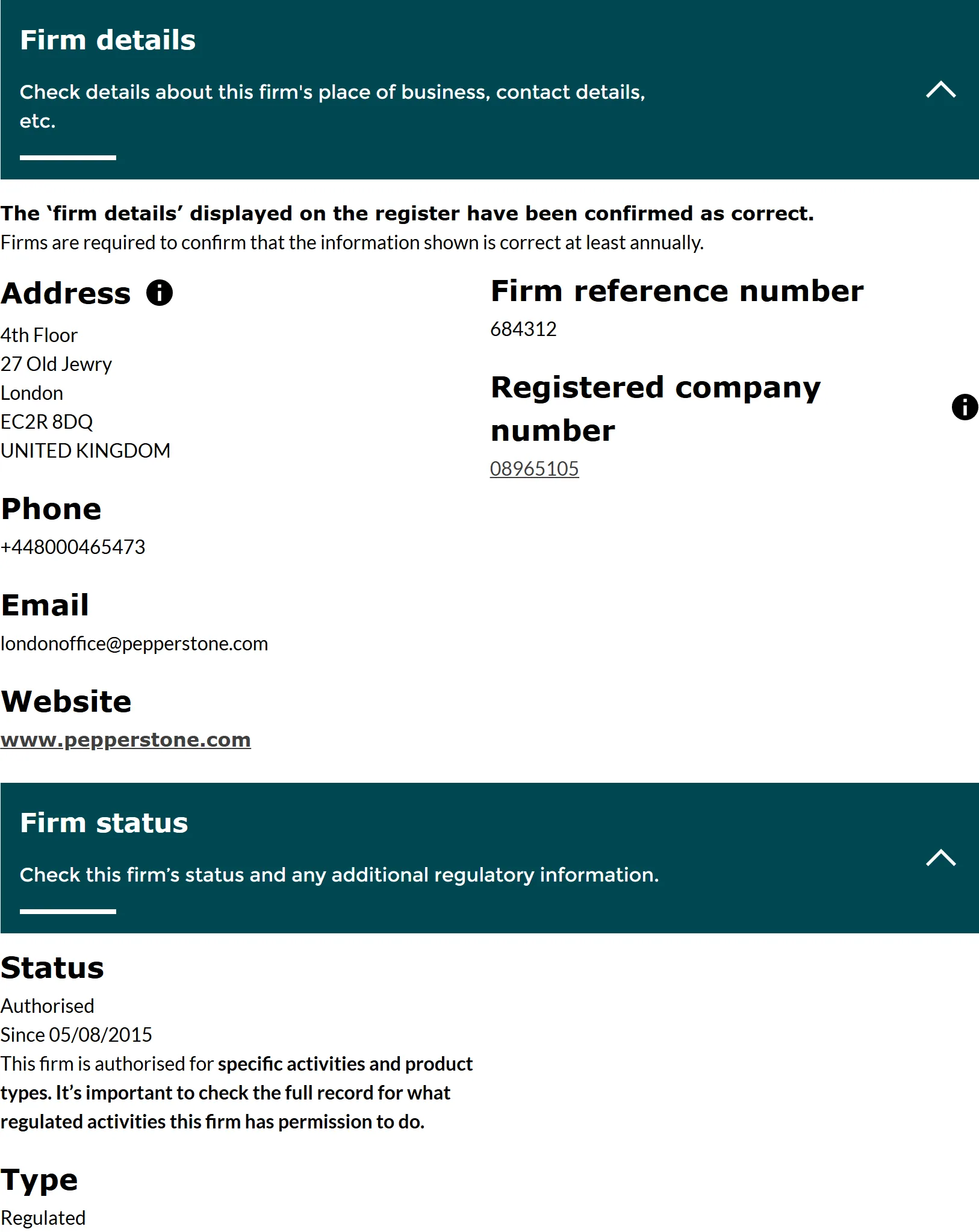
Pepperstone Limited is on the Financial Services Register under firm reference number 684312, and its status panel reads Authorised, since 5 Aug 2015. We read the entry on 3 Sep 2026, and the capture below is what the register showed that day.
Pepperstone Limited, FRN 684312, on the FCA Financial Services Register: status Authorised, since 5 Aug 2015. Captured 3 Sep 2026. Source: the firm’s register entry, Financial Conduct Authority.
The capture is the firm details and firm status panels of the entry as the register served them on that date, and the link opens the live entry. The permissions panel is not in it, so this page makes no claim about which regulated activities the authorisation covers. Our regulation guide sets out how to check a broker on the FCA register.
Pepperstone Trust, Ownership And Client Money Protection
Can You Trust Pepperstone?
Pepperstone Limited is Authorised by the FCA, a status it has held since 2015 (firm reference number 684312). It states that it deposits client money into a segregated client money account held with a credit institution and maintained in compliance with the FCA Client Money Rules. Retail clients are told they will not be liable for any negative equity balance, with the account equity balance adjusted to zero within one business day. (FCA register, read; Pepperstone's own site, read)
Who Owns Pepperstone?
Pepperstone Limited has two individuals registered as persons with significant control of the UK firm, according to the Companies House register of persons with significant control. (Companies House, read)
What Happens To Your Money If Pepperstone Fails?
Pepperstone states that it deposits the money you pay it into a segregated client money account held with a credit institution and maintained in compliance with the FCA Client Money Rules. It also states that if funds cannot be fully returned, eligible clients may be covered by the Financial Services Compensation Scheme. The FSCS's own figure is compensation up to £85,000 per eligible person, per firm, for a firm that failed after 1 April 2019. (Pepperstone's own site, read; Pepperstone's own site, read; FSCS, read)
How Long Do Pepperstone Withdrawals Take?
We requested a withdrawal on 27 August 2026. The fee was £0, and the money arrived the next working day. (our August 2026 withdrawal test, requested)
Every row is a value read off the FCA register or Pepperstone’s own UK site, with the date of the read held in our broker data. A term Pepperstone does not publish has no row.
Pepperstone Spread Betting Costs
For spread betting, Pepperstone publishes an average spread on all nine pairs. It prices under the industry average on six of the nine, matches it on two and prices above it on one. Its average of 1.7 points across the nine pairs sits under the industry figure of 1.79 points.
Why Pepperstone Beating Every Row Matters More Than Its Average
An average can be dragged under the industry figure by a single unusually cheap pair while the rest of the book sits above it. That is the shape of most cheap-looking accounts, and it means the saving depends entirely on what you trade. This table has no such row.
Compare the broker column with the industry average column, pair by pair. The pairs where the gap is widest are where this account earns its position, and the pairs where it is narrowest are where the choice between providers stops mattering much. Our spread betting statistics page publishes the full read, every pair against every account we collect. Read it if you want Pepperstone pair by pair against the field rather than against the average.
Spreads move, we re-read every broker’s site each month, and a table dated once is a claim about that date. The date is printed under the table for that reason.
The Pepperstone Minimum Stake We Will Not Publish
We hold no minimum stake for this account, and the absence is deliberate rather than an oversight.
A figure for it circulates on comparison sites. We could not find it on Pepperstone’s own UK site, and our rule is that a broker figure comes from the broker. A stake minimum decides whether an account is usable at all for somebody starting small. Publishing a third-party number here would put the least checkable figure in front of the reader who most needs a reliable one.
What this means in practice: if the smallest bet size is the thing that decides your choice, ask Pepperstone before you fund the account. The summary table below lists every attribute we did confirm.
Guaranteed Stops At Pepperstone
Pepperstone does not offer guaranteed stop-loss orders. An ordinary stop closes your trade at the next available price rather than at the price you set. A market that gaps overnight can therefore close you out below your stop, and the loss is yours.
Pepperstone runs no platform of its own. The list on our summary table below is third-party software, and that is unusual enough in our ranking to be worth stating plainly rather than leaving for you to notice.
The trade-off cuts both ways. Third-party platforms are the ones with the largest communities, the most tutorials and the most transferable habits, so what you learn here moves with you to another broker. What you give up is the integration a provider building its own software can offer. Neither is better in the abstract, and which one suits you is a question about how you already trade.
Pepperstone’s median fill was 104ms across the 15 live orders we timed between 18 and 27 August 2026, second-fastest of the 14 brokers we tested. We have published no assessment of how any of them performs in use. Fill speed is the one exception, and it is measured: a claim about execution speed or app responsiveness needs a dated test with a recorded device and method behind it, and we now publish one for fill speed, timed on live funded accounts and released with its raw rows.
Our app test counts rather than times. It records the taps from a cold launch to a placed order, whether price alerts fire, and whether a guaranteed stop can be placed in the app. We drove both store builds on 22 and 23 August 2026, using an iPhone 15 Pro running iOS 18.6 and a Google Pixel 8 running Android 15. It measures no speed, so no app here carries a responsiveness verdict.
On Pepperstone it took four taps to get from a cold launch to a placed order. Price alerts fired on both builds, and a guaranteed stop has to be placed away from the app. Neither build logged a crash or a stall.
Pepperstone publishes a demo account, and we read its terms off Pepperstone’s own demo page rather than inferring them: unlimited virtual balance, no fixed term. Expires after 60 days of inactivity (90 days on TradingView and Pepperstone Trader), no deposit to open, checked 26 August 2026.
Pepperstone resolved our live chat query of 24 August 2026 in 3 minutes. Its account, opened on 10 August 2026, was approved 18 hours later. A withdrawal on 27 August 2026 cost £0 and arrived the next working day.
Pepperstone resolved the question on that contact. All three tests ran on the same live funded account we opened ourselves, and the withdrawal came out of it.
Pepperstone Versus Spreadex And OANDA
The two accounts either side of Pepperstone in our ranking, on figures every review on this site renders from the same data. Pepperstone takes the first column. Spreads come from our 18 Sep 2026 read of each broker's own website, the fill time from the timed execution dataset, and the rest from each account's own published terms.
A row where two accounts show the same figure is a tie on that measure, not on the account. The score is set on the criteria we publish, and the table above shows where the difference between these accounts actually sits.
Pepperstone Versus IG And Capital.com
Pepperstone against IG and Capital.com, on the same figures the ranking table uses. These accounts do not sit either side of Pepperstone in our ranking, so the pair is a named comparison rather than one the ranking picked, and every cell is a field each rival’s own review renders in the same form. Pepperstone takes the first column. Spreads come from our 18 Sep 2026 read of each broker's own website, the fill time from the timed execution dataset, and the rest from each account's own published terms.
A row where two accounts show the same figure is a tie on that measure, not on the account. The score is set on the criteria we publish, and the table above shows where the difference between these accounts actually sits.
Pepperstone Testing Log
Every dated test we ran on this account and every dated read behind the figures on this page, oldest first, from the datasets those figures are rendered from. The log is the evidence trail rather than a summary of it.
Date
What we did and what we found
Account opened. Approved in 18 hours.
Both store builds driven on an iPhone 15 Pro running iOS 18.6 and a Google Pixel 8 running Android 15: four taps from a cold launch to a placed order, and price alerts fired on both builds.
Support contacted by live chat. Resolved in 3 minutes.
Criterion scores read from our master scoring sheet.
Demo account terms read from Pepperstone's own demo page.
Withdrawal requested. Fee £0; the money arrived the next working day.
15 live orders timed between 18 and 27 August 2026. Median fill 104ms, second-fastest of the fourteen accounts we timed.
We read the spread figures Pepperstone publishes for spread betting on its own UK site: an average figure on all nine pairs, averaging 1.7 points against the 1.79-point industry figure.
What Other Review Sites Say About Pepperstone
How popular is Pepperstone in the UK?
People in the UK made 9,130 branded searches for Pepperstone in August 2026, placing it 5th of the 14 platforms we review. Search interest measures attention, not quality; the score above is the review verdict.
5of 14Search interest rank
9,130
Brand searches, August 2026
+19.5%
vs July 2026
1,000
Login searches
7.4%
Share of all searches
Source: Google search volume, the UK, August 2026.
How this is measured
Google Ads reports how many times a month people in the UK searched each platform’s brand terms, and the platforms are ranked on that figure alone.
A term counts for a platform only when that platform’s own website holds the first organic Google result for it in the UK; bare brand words that any company could own are left out.
A month-on-month change prints only where the previous month reached 1,000 searches, because Google rounds smaller volumes.
The figures refresh on the 15th of each month with the newest month Google has published, and the first-result check repeats every quarter.
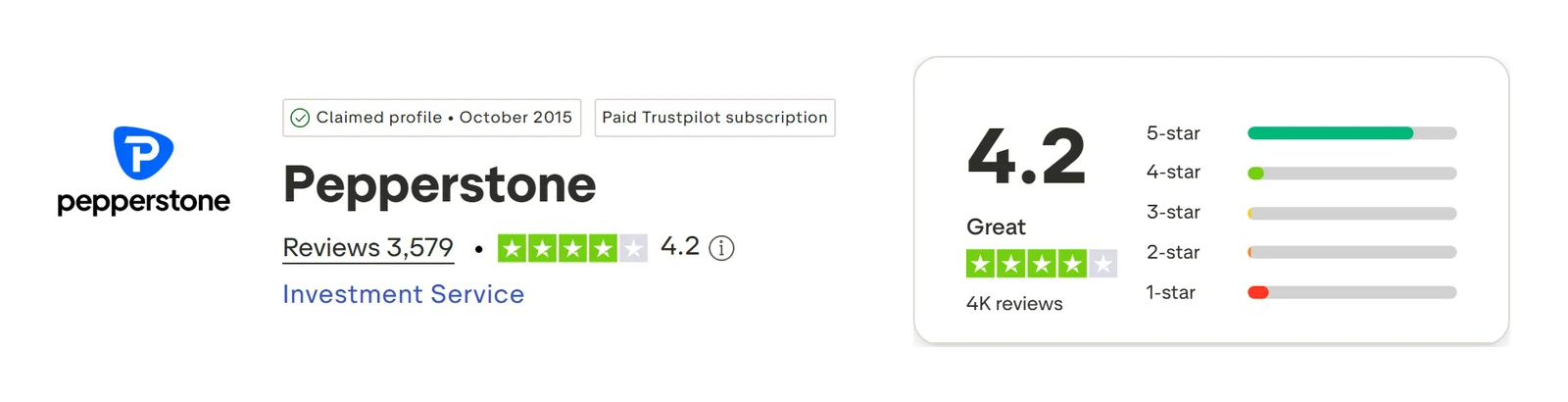
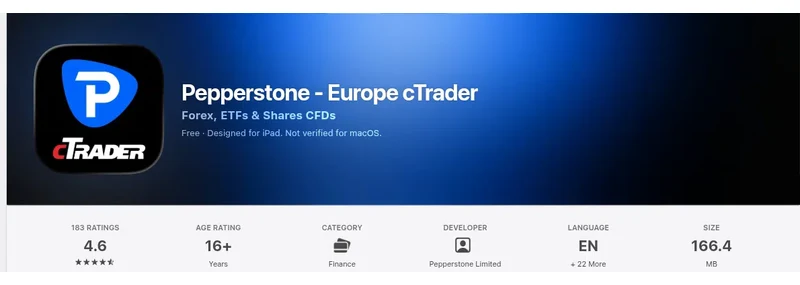
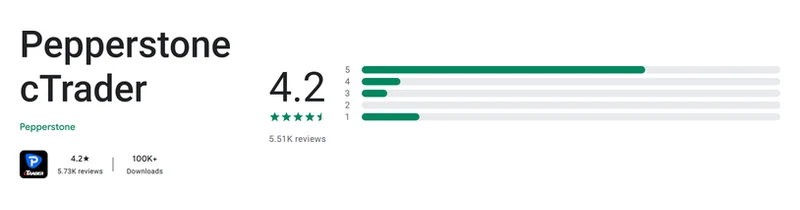
These are Pepperstone’s ratings on the platforms below, each read on the date shown and stated in that platform’s own scale. They are other people’s ratings, gathered on those sites’ own terms, and we publish them so you can weigh them against ours.
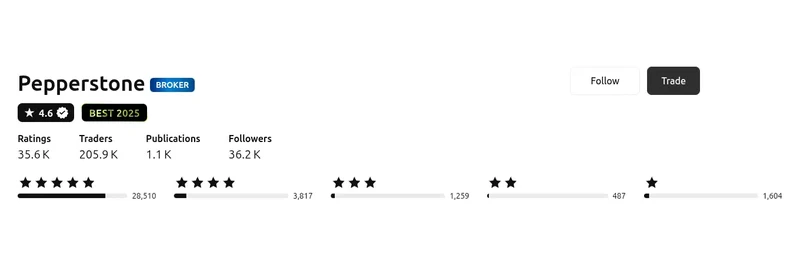
Pepperstone’s Trustpilot profile, captured 3 Sep 2026. We recapture these monthly, so the figure in the table is the one the platform showed on that date rather than a number typed in once and left to age.Pepperstone’s Apple App Store listing, captured 3 Sep 2026. We recapture these monthly, so the figure in the table is the one the platform showed on that date rather than a number typed in once and left to age.Pepperstone’s Google Play listing, captured 3 Sep 2026. We recapture these monthly, so the figure in the table is the one the platform showed on that date rather than a number typed in once and left to age.Pepperstone’s TradingView profile, captured 3 Sep 2026. We recapture these monthly, so the figure in the table is the one the platform showed on that date rather than a number typed in once and left to age.
Our own score is set on the six criteria we publish and is not influenced by any third-party rating. A high rating on a review platform and a low mark here can both be true of the same account, because they measure different things.
Pepperstone At A Glance
Every row below is a value we read on Pepperstone’s own UK site or hold in our broker data with a source and a date beside it. An attribute Pepperstone does not publish has no row here, because the alternative is a number we would be guessing.
🗺️ FCA regulated
Pepperstone Limited (FRN 684312)
💰 Minimum deposit
£10
📊 Spread bet platforms
MT4, MT5, cTrader, TradingView
🛍️ Markets available
2,700+
💱 Inactivity fee
no inactivity fee
🛡️ Guaranteed stops
Not offered
What You Can Bet On
Pepperstone publishes these counts on its own market pages. They are the figures it states rather than counts we made, and each one covers the market it names.
Forex pairs: 90+
Indices: 20+
Commodities: 40
Shares: 1,100+
ETFs: 90+
The market rows above are Pepperstone’s own published counts, each read from the page it publishes them on. Its total covers spread bets and CFDs together rather than spread betting alone, which is how Pepperstone words it, and we have not split it because Pepperstone does not. Our spread betting markets guide covers what these counts do and do not tell you about an account.
Pepperstone Pros And Cons
Pros
Below the Industry Average on six of nine Pairs
EUR/USD at 0.5 Points Against the 0.7-Point Industry Average
£10 minimum deposit
Cons
Above the Industry Average on one of nine Pairs
No guaranteed stop-loss orders
Minimum stake not confirmed
Each line is a field in our broker data with a source and a date behind it, not an impression. Where Pepperstone does not publish an attribute, that absence is listed as a cost rather than left blank.
The cons list is where the two absences on this page end up. Neither is a charge and neither is a bad number. Both are things Pepperstone has not published and we would not guess.
Your Experience With Pepperstone
If you have traded with Pepperstone, tell us what a new customer should know. Submissions are read by the team. Only reviews we can verify are ever published, and none are published yet. Nothing you enter here appears on this page.
We are paid when a reader visits a partner site. Reviews are never paid for and never edited for a broker.
Pepperstone Spread Betting: FAQs
Which company do you contract with when you spread bet at Pepperstone?
Spread bets at Pepperstone are placed with Pepperstone Limited (FRN 684312). That is the firm named in your account terms and the one authorised to take UK retail clients. Pepperstone runs separate companies under separate regulators in other countries, and material published by one of them is not a statement about the UK business.
Does Pepperstone have low spreads?
Yes, on most of the pairs we read. It is below the industry average on six of the nine pairs, level on two and above on one, which is EUR/JPY, and its nine-pair average is 1.7 points against an industry figure of 1.79. Our read of 18 Sep 2026 puts each pair against its own industry average. The table on this page shows each pair against the row, so you can check the pairs you actually trade rather than trusting the average.
What is the minimum stake on a Pepperstone spread bet?
We do not publish one. Pepperstone's own UK site does not state a minimum stake, and the figures circulating for this account come from third-party sites rather than from Pepperstone. Our rule is that a broker figure has to come from the broker. We leave the question open rather than repeat a number we cannot trace to its own source.
Does Pepperstone offer guaranteed stop-loss orders?
No. Pepperstone's own FAQ states that it does not provide guaranteed pricing, so an ordinary stop is the only stop available on this account. An ordinary stop closes your trade at the next available price rather than at the price you set. A market that gaps overnight can therefore close you out below your stop, and the loss is yours.
Opening A Pepperstone Spread Betting Account
Pepperstone suits a reader whose decision turns on cost and who trades the major pairs. On the evidence in our read its nine-pair figure of 1.7 points sits under the industry 1.79, below on six of the nine. It holds our top position because the rest of the assessment agrees, not because of the spread table alone.
It suits you less if a guaranteed stop is part of your plan, because this account does not offer one. It suits you less if you need to know the smallest bet you can place before you open an account, because that figure is not published. Both are on this page rather than buried, and both are the sort of thing worth settling before you fund anything.
Spread betting is leveraged, and losing more than you intended to risk is the ordinary outcome for most people who try it. If you came here for one market rather than for the account, our pages on spread betting indices and commodity spread betting cover how those bets are priced. Spread betting and tax covers where the UK exemption stops.
72.9% of retail investor accounts lose money when trading spread bets and CFDs with this provider.
Your capital is at risk. Spread betting is leveraged, so losses can exceed the amount you set out to risk on a bet. This page is not financial or tax advice.
Justin Grossbard co-founded Spread-Bet.co.uk with Noam Korbl in 2024, and co-founded the broker comparison network CompareForexBrokers with him in 2014. He has been investing since 1998 and actively trading since 2014, and has written on forex and CFD trading for Kiplinger, Entrepreneur, Finance Magnates and MoneyShow since 2019.
98
Pepperstone72.9% of retail investor accounts lose money when trading spread bets and CFDs with this provider.