What Is Spread Betting? How It Works in the UK (2026)
Financial spread betting is a leveraged derivative that lets you bet on whether a market’s price rises or falls without owning the underlying asset, staked in £ per point. Profit or loss means the points the market moves multiplied by your stake per point, and the spread between the buy and sell price is the broker’s charge. The published EUR/USD spread of Pepperstone and Trade Nation is 0.5 points, read on 18 Sep 2026, the lowest of the five brokers that publish a comparable figure. Spread betting is regulated by the FCA and profits are tax free for most UK retail traders. Losses on a position exceed the initial deposit when the market moves far enough against you, and negative balance protection stops them exceeding the money in your account.
How it works. You choose a market and decide whether to go long (buy) or short (sell). You stake a fixed amount per point of movement.
Leverage and risk. The FCA limits retail leverage to 30:1 on major currency pairs, which means a 3.33% margin. Brokers close positions at 50% of the margin required.
Tax and regulation. For most UK retail traders, profits are tax free and carry no Capital Gains Tax or Stamp Duty.
What it costs. In our 18 Sep 2026 data, the nine-pair average was 1.79 points, drawn from the five brokers that publish a comparable figure.
What a point is. One point on EUR/USD is a move of 0.0001 in the quoted rate; one point on the FTSE 100 is 1 index point. A bet at £5 a point gains or loses £5 per point move.
Updated on 22 Sep 2026: The calculator’s opening level was refreshed to the Mon 21 Sep 2026 New York close, so the worked example’s margin figures were recomputed. The tax note now rests on HMRC’s Capital Gains Manual (CG56105) and no longer mentions stamp duty. Earlier: Updated on 21 Sep 2026: the opening definition now says "financial spread betting", so the page cannot be read in the sports sense. A new section on daily funded and quarterly bets, with a table, folds in the FAQ on how long a bet stays open. The FCA’s category for spread bets, restricted speculative investment, is now stated with its source, and a new table sets spread betting beside CFDs, share dealing, futures and options. The FAQ on losing more than your deposit was rewritten with the FCA rule cited. A sentence on loss size was added to the risk FAQ, and a new FAQ asks whether spread betting is a good idea. Three subheadings now ask the questions they answer. Earlier the same day, the page was corrected to state that the FCA, not the Gambling Commission, regulates sports spread betting. The lowest EUR/USD figure now covers only brokers publishing a comparable figure. The gambling FAQ says profits are untaxed for most retail traders, with the tax qualifier. The pros and cons table says commission is usually absent, nightly funding applies to daily funded bets and losses of most retail traders get no tax relief. Repeated sentences, unsourced market descriptions, two duplicate FAQs and the At A Glance summary were cut. The lowest minimum stake, the EUR/USD count, stop-loss results from timed orders and the guaranteed stop count were added. No other figure changed. Earlier: Earlier: Updated on 6 Sep 2026: Item five of the opening answer used to say one point on EUR/USD is 0.0001 of the price. A point is a move of 0.0001 in the quoted rate, not a fraction of the price, and the sentence now says so. No figure changed. Earlier: Updated on 5 Sep 2026: The opening answer now runs to six items, adding what a point is and the line between financial and sports spread betting. A table showing what one point is and the FCA leverage cap for twelve markets sits under the stake-per-point section, and the unverified share point was removed from the prose. No figure changed. Earlier: Updated on 3 Sep 2026: the page moved onto the site’s guide layout, with the how-it-works diagram beside the answer and two diagrams added, the margin held against a £5 per point FTSE 100 bet and the long and short worked examples side by side. No figure changed. Earlier, on 2 Sep 2026: the two links after the legal and gambling FAQ answers now sit inside the last sentence of each answer rather than on a line of their own, and the closing link to the platform ranking names it as the monthly ranking of all {brokers.length} FCA-regulated providers. Rebuilt on 2 Sep 2026 as the site’s concept page. The title and the heading now ask the question the page answers. The opening is a one-paragraph definition followed by a four-part summary of how it works, leverage and risk, tax and regulation, and cost, with every spread figure rendered from our {v1HarvestDate} data. The how-to-start, legal-and-tax and risk-management sections were cut to a sentence and a link, a link, and a definition, because the beginners guide, the tax guide and the stop-loss guide own those answers. Four FAQ entries replaced three. Earlier: rebuilt on 25 Aug 2026 as the site’s single spread betting guide, absorbing the separate advantages, risks and examples pages; updated on 26 Aug 2026 with the section separating financial spread betting from sports spread betting and from the American “point spread”.}
Our spread bet content is supported and we may receive payment when you visit a partner site.
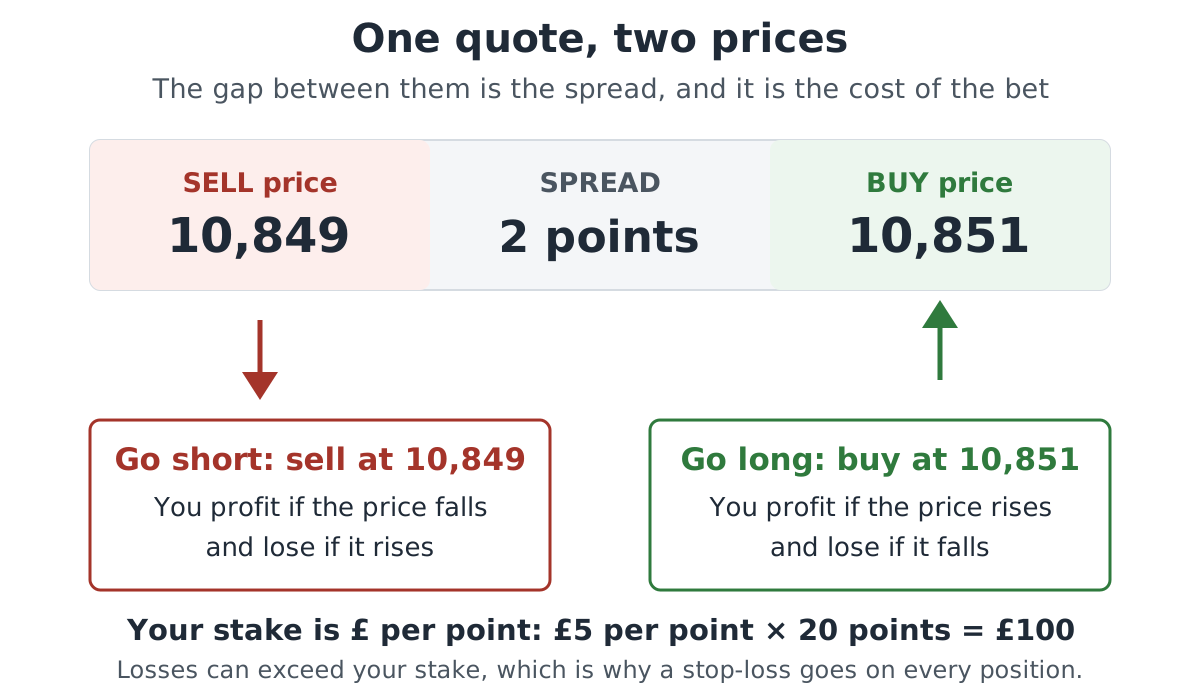
One quote, two prices. The gap between them is the spread, and it is the cost of the bet. Each point the market moves is worth your stake per point.
How Does Spread Betting Work?
{/* S5 (21 Sep 2026): unlinked to hold the page at ten in-content links (D-S4-13 precedent); text unchanged. harvestAnchor stays bound for the day it is relinked. */}
What that spread costs at each provider is published each month as the September 2026 spread read, with one row per broker and the date each figure was read.
{/* S5 item 13 (H01): the class, sourced to the FCA Handbook glossary (data-fact, Gate 33 check 7). */}
Financial spread betting is classed by the FCA’s own rulebook as a restricted speculative investment, the same category as a leveraged CFD. Source: FCA Handbook Glossary, read .
{/* S5 item 11 (M02, M03): the H3s ask the registered questions; ids are the registry anchors. */}
What Is Stake Per Point?
Your stake is what one point of movement is worth to you. At £5 per point on the FTSE 100, every one-point move in the index adds or removes £5, so a 20-point move is £100 either way. The lowest minimum stake published by any of the 14 brokers we compare is £0.01 per point, offered by OANDA, CMC Markets and Spread Co.
What Is A Point In Spread Betting?
A point in spread betting is the unit of price movement that your stake is multiplied by, and its size differs from one market to the next.
What a point is worth depends on the market; the margin your stake ties up depends on the market’s FCA class, as the table below shows.
Market
One point is
FCA leverage cap
Minimum margin
GBP/USD
0.0001
30:1
3.33%
EUR/USD
0.0001
30:1
3.33%
EUR/GBP
0.0001
30:1
3.33%
USD/JPY
0.01
30:1
3.33%
AUD/USD
0.0001
20:1
5%
USD/CAD
0.0001
30:1
3.33%
AUD/JPY
0.01
20:1
5%
EUR/JPY
0.01
30:1
3.33%
USD/SGD
0.0001
20:1
5%
UK 100
1
20:1
5%
US 500
1
20:1
5%
Germany 40
1
20:1
5%
Point sizes are the site’s market definitions; the leverage caps are the FCA’s retail limits under PS19/18, as held in the calculator configuration.
Going Long And Going Short
Going long means buying at the higher of the two quoted prices, and you do it when you expect the market to rise. Going short means selling at the lower price, and you do it when you expect the market to fall. A short position profits as the price drops and loses as it climbs, so your direction decides which way the arithmetic runs. Betting on a fall needs no extra permission and no borrowed stock, which is the practical difference from selling shares you do not own.
What Is The Spread In Spread Betting?
You start every position slightly behind. The market has to move by the spread before you break even. Across the five brokers that publish a comparable figure in our spread data, last updated on 18 Sep 2026 and re-read monthly, the average spread on EUR/USD is 0.7 points. A £1 per point bet on that pair therefore opens about 70p down, before the market moves at all.
The other nine brokers we compare publish something different, with three a minimum, two a target and four no EUR/USD figure at all. A minimum or a target is a different claim from the spread you would usually pay, so both are left out of that figure.
Margin And Leverage
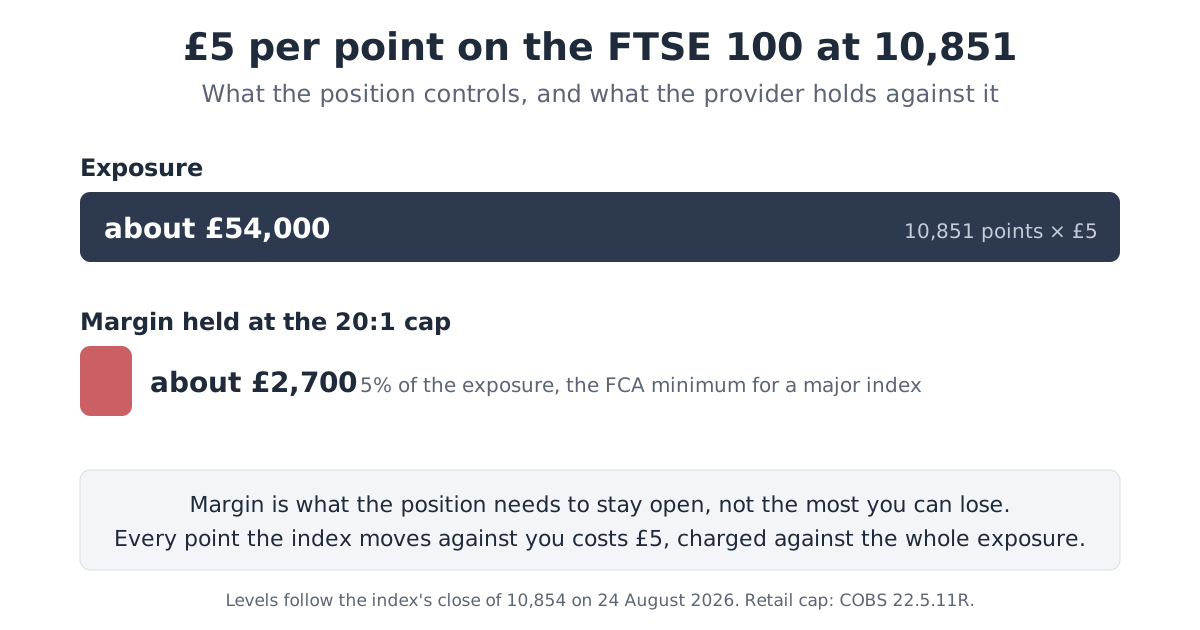
Margin is the deposit your provider holds against the position while it is open, and leverage is the multiple that deposit controls. A £5 per point bet on the FTSE 100 at 10,851 carries a notional value of roughly £54,000. At the 20:1 cap that applies to major indices for retail clients, the provider asks for about £2,700 of that. Margin is not the most you can lose: it is the amount the position needs to stay open. Move far enough against the position and the provider asks for more margin, or closes it.
The same £5 per point bet as two bars. The long bar is the exposure, about £54,000; the short bar is the margin the provider holds at the 20:1 cap, about £2,700. A move against you is charged against the whole exposure, not the margin.
{/*
S5 item 13 (C03, C04, C05): spread betting beside its co-hyponyms. Every cell is GLM 5.3's; the
margin figures, the ICE units and expiries and the restricted-option test are market-facts reads
rendered inside one data-fact wrapper with their links and dates (Gate 33 check 7); tax binds
tax.json only (SDRT from permitted_percentages; HMRC CG56105 and CG56100 linked in the sources line).
*/}
How Does Spread Betting Compare With CFDs, Shares, Futures And Options?
Spread betting is closest to a CFD, and it differs from share dealing, futures and options in ownership, tax and expiry.
Product
Own The Asset?
UK Tax For Most Retail Traders
Position Unit
Leverage Or Margin
Expiry
Where We Cover It
Spread betting
No
No Capital Gains Tax or Stamp Duty for most UK retail traders
£ per point
Retail margin from 3.33% on a major currency pair to 20% on a share, under the FCA rules
Daily funded bets have none fixed, quarterly bets expire on a set date
This page’s section on daily funded and quarterly bets
CFDs
No
Gains under Capital Gains Tax, losses can be allowable, no Stamp Duty Reserve Tax
Units or contracts of the asset
The same FCA retail margin rules as spread bets
Rolling cash contracts have none, futures-based contracts expire
Both examples below use the same quote on the FTSE 100: a sell price of 10,849 and a buy price of 10,851, a spread of 2 points. Levels follow the index’s close of 10,854 on 24 August 2026. Nothing here is a prediction of what the FTSE will do, only of what the arithmetic does when it moves.
Example 1: A Long Bet That Wins
You expect the index to rise during the session, so you buy at 10,851 with a stake of £5 per point. The market rallies and you close the bet at the sell price of 10,899.
Opening level (you buy at the offer)
10,851
Closing level (you sell at the bid)
10,899
Points gained
10,899 − 10,851 = 48 points
Stake
£5 per point
Profit
48 × £5 = £240
The 2-point spread is already inside that £240, because you bought at the higher price and sold at the lower one. Overnight funding would be charged on top if you held the bet past the daily close.
Example 2: A Short Bet That Loses
Take the same quote and the opposite view. You expect the index to fall, so you sell at 10,849 with a stake of £5 per point. Instead it rallies to 10,899 / 10,901, and you close the bet by buying at 10,901.
Opening level (you sell at the bid)
10,849
Closing level (you buy at the offer)
10,901
Points lost
10,901 − 10,849 = 52 points
Stake
£5 per point
Loss
52 × £5 = £260
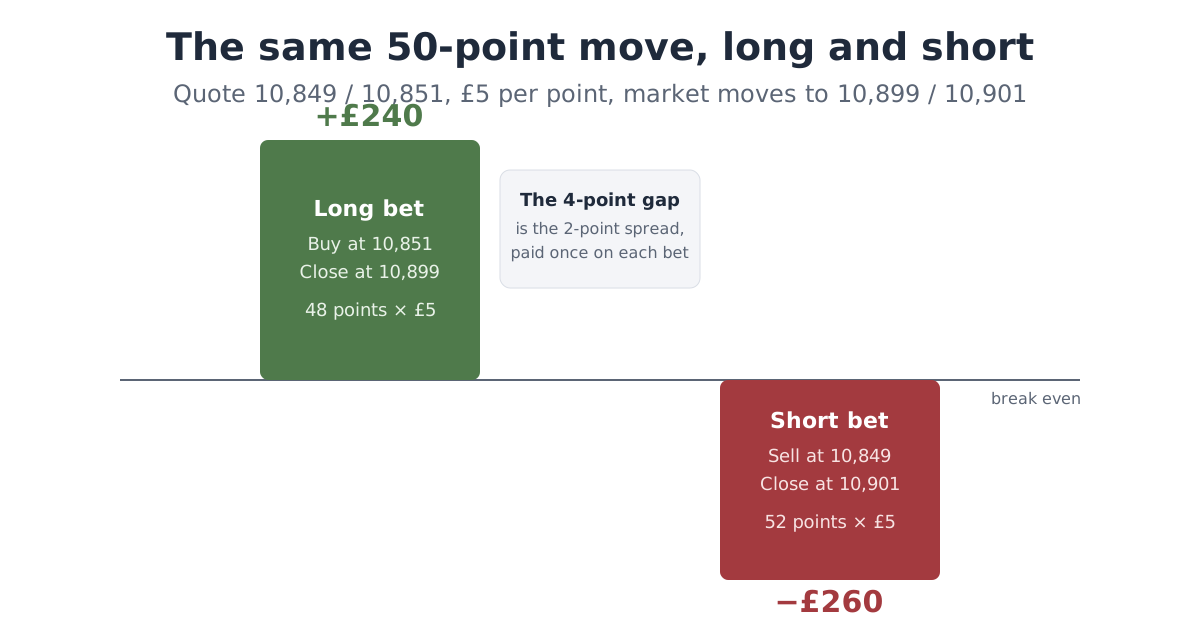
The market made the same 50-point move in both examples, from a 10,849 / 10,851 quote to 10,899 / 10,901. The long made £240 and the short lost £260, and the 4-point gap between those results is the 2-point spread, charged once on each bet. A stop-loss set to close the short at 10,899 would have capped the loss at 50 points, £250, provided the market did not gap straight through the level. In our timed FTSE 100 orders between 18 and 27 August 2026, 23 of the 28 triggered stops filled away from their stop level. The median gap was 1.0 points and the largest was 2.5 points. A stop tends to close near its level rather than exactly at it, as the order-by-order slippage data shows.
The two worked examples side by side. The long makes 48 points and the short loses 52 on the same 50-point move, because each bet pays the 2-point spread once.
The calculator below runs the same arithmetic on your own stake and levels, including the margin the position would need. The full version, with more markets, lives on our spread betting calculator page.
Spread betting calculator
Cost, profit or loss, and margin on one bet
Direction
On GBP/USD one point is a 0.0001 move, so £5 per point is £5 per pip.
1.3393 is 13,393 points.
is quoted in index points: one point is a 1.0 move of the level, and the bet is priced per index point.
Opening level from the Mon 21 Sep 2026 5pm New York closeOpening level: your own figure, from your platform's deal ticketSpread: Pepperstone published, 18 Sep 2026Spread: your own figure
A buy at £5 per point that closes 80 points highermakes£400.00 before the spread. Pepperstone's published0.9-point spread costs £4.50 on this bet, leaving £395.50. The margin held to open it is £2,232.17.
Enter the level from your platform's deal ticket and your provider's spread in points; the ledger then prices the bet.
Profit or loss on the move80 points × £5.00 per point£400.00
Cost of the spread0.9 point × £5.00 per point, paid on entry− £4.50
Net result£395.50
Margin to open13,393 points × £5.00 = £66,965 notional, at the FCA 30:1major-pair cap£2,232.17
HMRC's Capital Gains Manual (CG56105) states that no chargeable gains or allowable losses arise from spread betting. For most UK retail traders, profits are therefore free of Capital Gains Tax. Tax treatment depends on individual circumstances and can change. See how spread bets are taxed. Overnight funding is not included; see overnight funding in spread betting. Spreads are the brokers' own published figures, read on 18 Sep 2026, or your own figure where you type one; neither is a quote at the moment you deal. Margin uses the FCA COBS 22.5 retail leverage cap for the market class.
{/*
S5 item 8 (M09, M10, C04): daily funded against quarterly bets, the id another page links
(/betting/vs-cfd-trading/ -> #daily-funded-bets). It absorbs the FAQ "How Long Can A Spread Bet Stay
Open?", which left the FAQ array. No broker published a daily and a quarterly FTSE 100 spread in a clean
first-party read on 21 Sep 2026 (seo/s5/guide/raw/dfb-quarterly-attempts-2026-09-21.md), so the table
states the difference qualitatively from IG's UK guide, read that day (data-fact "often wider").
S5 (21 Sep 2026): the calculator link above is unlinked, text unchanged, to hold ten in-content links.
*/}
Daily Funded Bets And Quarterly Bets
A daily funded spread bet stays open until you close it, with a nominal expiry usually many years away and overnight funding charged nightly. A quarterly bet expires on a set date, with funding costs in its price.
Daily funded bets are usually used for short-term positions and quarterly bets for longer-term ones. The choice between them is a cost decision over your holding period.
Attribute
Daily Funded Bet
Quarterly Bet
Expiry
None fixed, nominal expiry usually many years away
Expires on a set date
Spread
Often narrower than quarterly bet spreads
Often wider than daily funded bet spreads
Financing
Overnight funding for each night held
Cost to expiry built into the quoted price
The table follows how IG describes the two bet types in its UK guide. Source: IG, Bet types and costs, read .
{/*
§2.4. The six steps live on the beginners guide; answer exclusivity (06 §4)
forbids a second procedure here. The sentence is the one the old step 1
ended with, re-anchored on the beginners page's H1, with "shortlist" read as
"guide" because the page is now the procedure and not only the shortlist
(one word; flagged in the review map). S4 (21 Sep 2026) cut the strategies
bridge: the rail's "More guides" list links /betting/strategies/, and the
page's in-content links were held to about ten.
*/}
How Do You Start Spread Betting?
{/* S5 (21 Sep 2026): unlinked, text unchanged, to hold ten in-content links (D-S4-13 precedent); the rail and nav still reach the beginners guide. */}
Newer traders can start from our Spread Betting For Beginners In The UK guide.
What Are The Advantages And Disadvantages?
Advantages
Disadvantages
Profits free of Capital Gains Tax for most UK retail traders
Losses can exceed the money you staked on the position
No Stamp Duty, which saves 0.5% against buying UK shares
Leverage magnifies a loss as fast as it magnifies a profit
Going short is as simple as going long
Overnight funding charged on every night you hold a daily funded bet
Stakes and profits stay in pounds on overseas markets
The spread is a cost on every bet, paid at the open
Usually no separate commission, with the cost in the spread
Losses cannot be offset against tax for most retail traders
{/*
§2.2: the risk section as a definitional block linking the two pages that
own the mechanics. S4 (21 Sep 2026): the leverage paragraph went (its link
sat on a paragraph's first word; the link now sits on "leverage" under
Margin And Leverage), the loss band paragraph went (it repeated the FAQ this
page owns, "How risky is spread betting?"), and GSLO_COUNT was added.
*/}
How Do You Manage Spread Betting Risk?
Risk management on a spread bet comes down to two decisions, both taken before the position opens. How much is a point worth to you, and where does the bet close if you are wrong.
A stop-loss closes the position for you. It sits at the level you set and closes the bet at the best available price once the market reaches it, which caps the loss without you watching the screen. A guaranteed stop-loss order goes further and closes at exactly your level even when the market gaps past it, for a premium the provider charges on top. Our stop-loss order guide covers both order types and what each one costs.
Of the 14 brokers we compare, eight offer a guaranteed stop-loss order on their own UK sites, while Pepperstone, FXCM, FxPro and Vantage do not.
Bear in mind that there is always a risk involved with spread betting, and only capital you can afford to lose belongs in the account.
What Can You Spread Bet On?
UK providers price spread bets on a range of markets spanning six main groups, and the same stake-per-point mechanics apply to all.
Forex
Indices
Shares
Commodities
Bonds
Options
Crypto is the notable exclusion: the FCA banned the sale of crypto derivatives, including spread bets, to retail clients from 6 January 2021. Our spread betting markets page lists what each group covers in detail.
Financial Spread Betting, Sports Spread Betting And The American “Point Spread”
{/*
BLOCK G1 (Batch 6 §13); its third sentence re-cut on 5 Sep 2026 (Session W2 Part 3) to carry the cluster trigram, the first two sentences unchanged. The American point-spread sentence is
kept, relocated rather than rewritten. The hand-up to the money page (Wave 1,
30 Aug 2026) closes the section. Batch 8 §0: the anchor is the audit's
plan string for this page, "best spread betting platform UK", with the
annotation 05 §4 assigns before it (the monthly ranking of all 14
FCA-regulated providers), the count rendered. S4 (21 Sep 2026): the two
wrong regulator sentences (G70, G72) are replaced by SPORTS_REG, and the
hand-up by PLATFORMS_BRIDGE, without "best" (ruling S4-5) or "tightest" (G74).
*/}
Sports spread betting is regulated by the FCA, the same regulator as financial spread betting, and the Gambling Commission says so in its guidance. They share a name and the per-point pricing idea and differ in the markets involved, and only Spreadex among the 14 brokers we compare also takes sports spread bets. Spread Bet UK covers financial spread betting only and does not review sports spread betting firms.
The American “point spread” is different again: a handicap applied to a team at fixed odds, where the stake and the return are both known before the event, which is not spread betting in the British sense at all.
Risky enough that most people lose. Every firm that sells CFDs or spread bets to retail clients has to publish the share of its own retail clients who lose money, and across the brokers we rank that figure runs from 61% to 76.6% of retail investor accounts. That number counts accounts that ended in loss. It says nothing about how much was lost or how long anyone traded, so read it as a floor on the risk rather than a description of it. Leverage is what makes a loss arrive faster than the market does, because your balance moves by the full size of the market move and not by the size of your stake. The page’s worked short bet lost £260 when 52 points moved against a £5 per point stake. Negative balance protection caps the loss at the money in your account; it does not prevent one (see how spread betting is regulated).
Is Spread Betting A Good Idea?
Whether spread betting is a good idea depends on your circumstances. It can suit someone who understands leverage, sizes stakes they can afford to lose and accepts that most retail accounts lose money. Whether it is worth it is your call, given that loss disclosures run from 61% to 76.6% of retail investor accounts. The spread is a cost on every bet, averaging 1.79 points across nine currency pairs at five brokers, read 18 Sep 2026.
Is spread betting gambling?
Spread betting is treated like betting for tax and is regulated by the FCA as a financial product. For most retail traders, HMRC’s BIM22015 says profits are not taxable and losses get no relief, because they are not carrying on a trade. The comparison is set out in spread betting and gambling compared. Tax treatment depends on your individual circumstances and can change, so you should seek professional tax advice if you’re unsure.
Can You Lose More Than Your Deposit?
A retail spread betting account cannot lose more than the money in it under the FCA’s rule. A single bet can still cost more than the margin you put up for it. In the page’s worked example, a £5 per point FTSE 100 bet carries about £2,700 of margin. A move of about 540 points against it uses that margin up, and each further point costs £5 from the rest of the account. Professional clients do not have this protection, and the detail is in what negative balance protection covers. Source: FCA Handbook COBS 22.5.17R, read .
Justin Grossbard co-founded Spread-Bet.co.uk with Noam Korbl in 2024, and co-founded the broker comparison network CompareForexBrokers with him in 2014. He has been investing since 1998 and actively trading since 2014, and has written on forex and CFD trading for Kiplinger, Entrepreneur, Finance Magnates and MoneyShow since 2019.